English

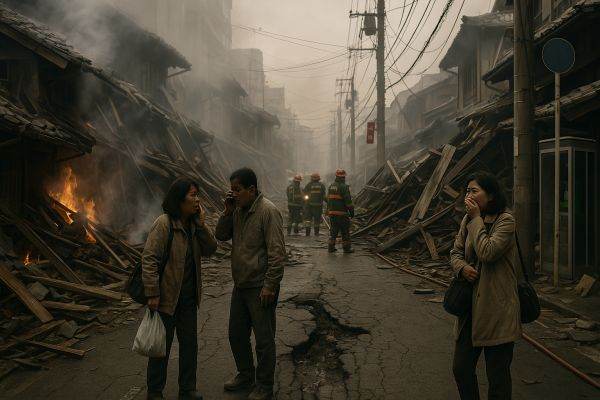
A major earthquake, with a magnitude of 7.3, that would hit the Tokyo metropolitan area, could cause 18,000 deaths, the destruction of hundreds of thousands of buildings and huge economic losses, estimated at 535 billion dollars, according to an assessment published by the Japanese authorities and cited by the WAM agency. The estimate is to be discussed within a group of experts and could form the basis of a new national disaster preparedness plan. The new projection is slightly more optimistic than the one made in 2015, when the authorities anticipated 23,000 victims and economic losses of 95 trillion yen (approx. 700 billion dollars). However, the difference is not enough to meet the then-announced goal of halving mortality in a similar scenario.
Japan is one of the world's most seismically active regions, and Tokyo (a metropolis with over 37 million inhabitants in the wider area) lies at the intersection of major tectonic plates. The government estimates that the chance of an earthquake measuring 7 or greater hitting the region in the next three decades is around 70%, a prospect that has fuelled ongoing debates about infrastructure, population preparedness and emergency management. Current estimates also include the potential impact on mobility: up to 8.4 million people could be stranded in the metropolitan centre, unable to return home due to collapsed transport infrastructure, fires or massive power outages. The hypothetical 7.3-magnitude quake would be far smaller than the 2011 disaster, when a 9.0-magnitude quake off the coast of Tohoku triggered a tsunami that crippled the Fukushima Daiichi nuclear power plant. However, Tokyo's extreme density means that the human and economic risks are incomparably greater.
• Government updates its action plan
Japanese authorities estimate that such a quake could destroy around 400,000 buildings, mainly old wooden structures, located in the capital's dense neighborhoods. At the same time, secondary fires remain a major hazard, having been responsible for considerable damage in the past after major earthquakes in the archipelago. In light of these figures, the Japanese government plans to update its basic disaster plan, with the new estimate to be made public at the end of the month. "The figures could change further," a government source quoted by Kyodo News said, a sign that authorities are considering new assessment models adapted to current standards of infrastructure and urban mobility. The updated plan includes reviewing warning systems, upgrading vulnerable buildings and expanding evacuation and intervention capacities in the capital's main districts.




















 Euro
Euro Dolar SUA
 Franc elveţian
 Liră sterlină
 Gram de aur