English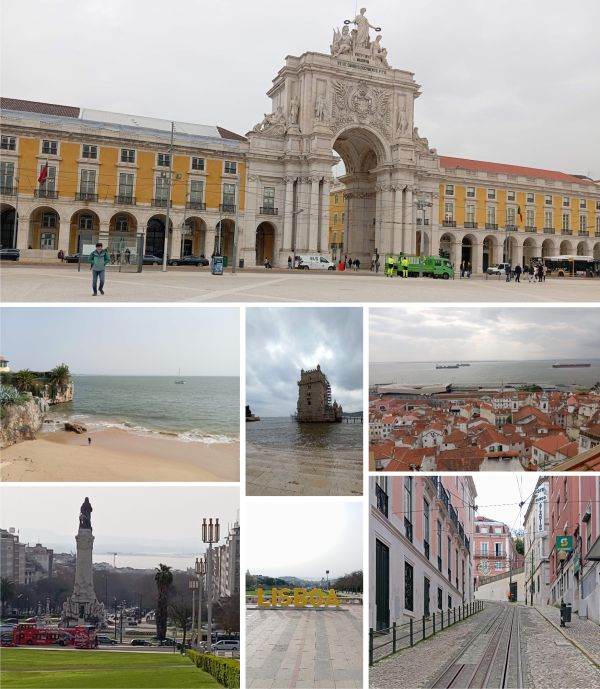

I set off for Portugal less than 24 hours after the Persian Gulf once again turned into a battlefield of global pride, fear and economic interests. I couldn't have chosen a worse moment for cultural-historical tourism. The world seemed to be shrugging its shoulders, dressed in a coat a few sizes too small. But I consoled myself with the thought that I had chosen Lisbon and not Dubai. Although, if you listen to the apartment salesmen, the latter would also moan about history, culture, science and a kind of cheerful security.
After landing, my first gesture was almost instinctive: I went straight to the Atlantic Ocean. I needed to cool my mind and feet after the hours of flying and the avalanche of news that had transformed the world map into a front-line bulletin. The cold ocean water had the effect of a reset. To maintain the internal engine, we continued with a simple lunch: Bacalhau à Bras, one of the classic Portuguese dishes, in which salted cod is mixed with fries and eggs. A kind of gastronomic gasoline, because the real one is becoming, in the meantime, more expensive than we expected.
After the meal, we set off at a walk on Rua Augusta, one of the main arteries of the old center, a line that provides you with access to some famous areas for Lusitanians and not only, Alfama, Rossio, Baixa and Chiado. Under the elegant arcades and between the pastel buildings, tourists move in a continuous flow, as in an open-air museum. Among them, young people from Africa try to sell sunglasses and "original-fake” handbags. Their method of approach is ingenious: they hook you with questions about the capitals of the world, as in an improvised geography contest, in which any correct answer sinks you to the loss of a few euros. To shorten the conversation and solve the competition, I adopted a simple strategy. Every time I am asked where I come from, I answer dryly: Faroe Islands. Usually, the dialogue ends there. Torshavn is not on the list of capitals they have memorized.
However, the historic area of Lisbon also has a small problem: if you want to buy something banal, a water, a loaf of bread, maybe a bag of potatoes, you quickly discover that the usual shops are almost completely absent. Instead, tourist boutiques abound. I entered such a shop that sold, in addition to fridge magnets, colorful scarves and key chains with yellow trams, and a few bottles of still water. Since no price was displayed, I ironically commented that the products seemed priceless. The reply came unexpectedly, in surprisingly good Romanian.
The seller was a man from Bangladesh, Fahim. The dialogue quickly developed. He told me that he had worked in construction in Romania for nine months before arriving in Portugal, where he has been living for four years. He left Bucharest because of problems with his documents: he only had a one-year visa, and in Portugal the procedures are simpler. If there are, if not, it's not a problem. To my surprise, his memories of Romania were warm and precise. He began to list neighborhoods in Bucharest as if they were intimate landmarks: Militari, Drumul Taberei, Rahova, Berceni. Then cities: Braşov, Constanţa - "the most beautiful sea in the world,” he said with a broad smile. Then he uttered a sentence that, in the tourist noise of the street, rang unexpectedly clear: "Romania... there I live without fear.”
He asked me for information about the price of plane tickets. He said that he would like to return one day, when he had the opportunity and the necessary documents. Romania, in his memory, had remained "the quiet country.” Sometimes, to understand what a country really looks like, you don't need to see it from the inside. It's enough to hear it told in a souvenir shop in Lisbon by a man from Bangladesh.
Then you realize that, in the middle of a hectic and restless world, Romania can mean a very simple thing to someone: a place where life is lived without fear.
Otherwise, to further reduce the concentration of idealization and optimism, on my way home I found myself in the proximity of three compatriots, who would have made me blush with shame wherever I was in the world, regardless of the means of locomotion, plane, truck or cart. However, since statistics are very important, around them there were at least 100 other Romanians, decent people who were going about their business.








 Euro
Euro Dolar SUA
 Franc elveţian
 Liră sterlină
 Gram de aur