English


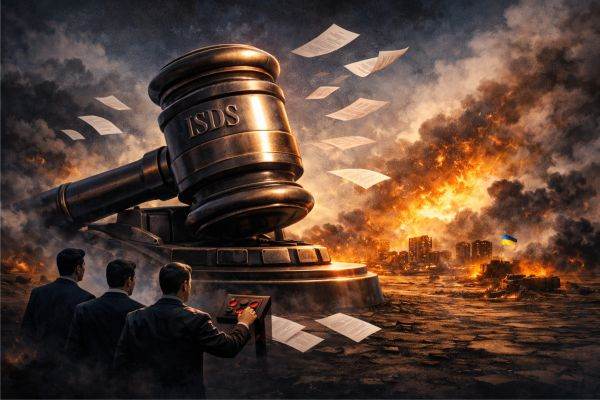
Russian oligarchs close to the Kremlin have found a simple way to circumvent the sanctions imposed by Ukraine on their businesses: resorting, through affiliated companies they control in European Union states, to the international arbitration system ISDS (investor-state dispute settlement system) to demand compensation from the authorities in Kiev, according to an investigation carried out by journalists from the website Follow the Money. What at first glance seems like a legal quirk turns out to be, in reality, a major vulnerability of the global economic architecture, exploited at a time when Ukraine is fighting not only on the military front, but also on the financial and legal front.
The investigation carried out by journalists from Follow the Money brings to light a sophisticated mechanism by which sanctions intended to economically isolate Russia are circumvented through international investment agreements. In practice, although direct economic relations between Ukraine and Russia were suspended after the 2022 invasion, Russian investors do not disappear from the equation, but only change their "legal nationality”. Using entities registered in Luxembourg, the Netherlands, the UK or other European jurisdictions with favorable treaties, they return through the back door and sue Ukraine for lost profits. According to the cited source, the most emblematic case is that of ABH Holdings, a company registered in Luxembourg, but controlled by the core of Alfa Group, one of the most influential Russian financial conglomerates. The shareholder base is dominated by Andrei Kosogov, with approximately 41%, along with billionaires Mikhail Fridman and Petr Aven, all three of whom were sanctioned by Ukraine and Western states after Russia's invasion of the neighboring country. After Ukraine nationalized Sense Bank (formerly Alfa Bank) in 2023, considering it a national security risk, ABH Holdings launched an international arbitration at ICSID, demanding over a billion dollars in damages, invoking the bilateral treaty between Ukraine and Belgium-Luxembourg. This is not a simple commercial dispute, but a direct test of Ukraine's ability to defend its security decisions in the face of a global legal system originally designed to protect investors. Also surrounding the same bank is E.M.I.S. Finance, a Dutch-registered entity that financed the acquisition of Sense Bank and claims that the nationalization blocked its recovery of a loan worth hundreds of millions of dollars. It is demanding about 400 million dollars in damages, bringing Ukraine's total exposure in this banking case to about 1.4 billion dollars. Basically, the same financial operation generates two distinct lawsuits, through two different European jurisdictions, both used as legal platforms against Kiev.
Another relevant example comes from Germany, where, according to the cited source, the company AEROC Investment Deutschland GmbH opened an arbitration against Ukraine after the seizure of its BCA factories. Although formally a German company, AEROC is controlled by the Russian group LSR and by the oligarch Andrey Molchanov, a close Kremlin confidant sanctioned by Ukraine for indirect contributions to the war effort, including by paying taxes to the Russian state and involvement in projects for the Russian army. The dispute concerns exactly the effects of the sanctions: the Ukrainian state confiscated the assets, and the investor is now demanding compensation based on the bilateral Germany-Ukraine treaty.
Austria also appears in this legal map, designed by the people at Follow the Money. An Austrian company, whose name was not disclosed by the arbitration court, has filed a lawsuit after being placed on Ukraine's sanctions list, with authorities alleging that its Ukrainian founder continued to pay taxes to Russia after the invasion. While the case is less transparent, it confirms the same pattern: sanctions become the starting point for ISDS disputes, and companies use Western jurisdictions to challenge Kiev's decisions. The list doesn't end there. Recent analysis shows that several companies with direct or indirect ties to Russia have launched or are preparing similar lawsuits. CTF Holdings, a Luxembourg-registered beverage company associated with Mikhail Fridman's network, sued Ukraine after being sanctioned. Smart Energy and Enwell Energy, gas companies, are challenging the suspension of their licenses on the grounds that they have ties to businessman Vadym Novynskyi, who is considered close to Russia. Even Russian oil giant Tatneft has initiated legal action, seeking to freeze its assets and transfer them to the Ukrainian state, with claims estimated at hundreds of millions of dollars.
All of these cases have one thing in common: they are not brought directly by Russian companies, under the Russia-Ukraine treaties, but through legal vehicles in the European Union or other jurisdictions protected by favorable treaties. This legal engineering allows sanctioned investors to avoid political blockages and use ISDS mechanisms against a state at war.
In practice, Ukraine faces a double pressure. On the one hand, it is forced to apply sanctions and take control of assets considered risky for national security. On the other hand, these actions trigger international disputes in which the same decisions are reinterpreted as illegal expropriations or discriminatory treatment. The ISDS system thus becomes a tool through which the economic interests of actors connected to Russia continue to exert financial pressure on Kiev.
The potential impact is huge. The cases already quantified alone exceed 1.4 billion dollars, and other disputes could raise the bill to much higher levels. At the same time, the precedent set by these lawsuits could encourage other Russian investors to follow suit, making Ukraine one of the most exposed countries in the world to international arbitration. At a time when every resource counts for survival, the legal battle risks becoming as important as the one on the front line.









 Euro
Euro Dolar SUA
 Franc elveţian
 Liră sterlină
 Gram de aur