English


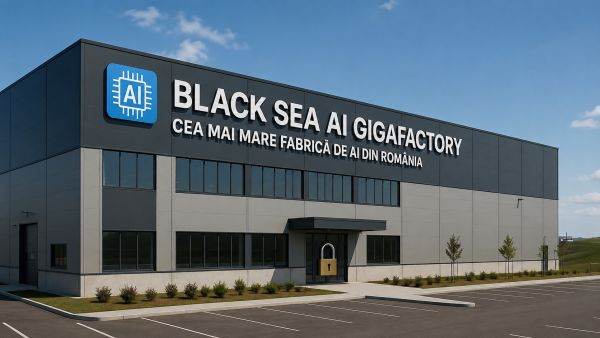
The Black Sea AI Gigafactory project, presented by the authorities in Bucharest as the investment that was to transform our country into a regional hub of artificial intelligence, does not appear in the official list of states participating in the European program for the construction of the seven AI gigafactories. The document published by the European Commission on July 30, 2026 shows that Romania has not assumed the mandatory financial contribution for participation in the program.
While Germany, France, Italy, Spain, Poland, Greece, Portugal and other countries have put hundreds of millions of euros on the table, the government in Bucharest, due to ongoing political disputes, has remained outside the most important European infrastructure project for artificial intelligence.
On July 30, 2026, the European Commission and the EuroHPC Joint Undertaking launched the official procedure for the construction of up to seven European artificial intelligence gigafactories. It is one of the largest industrial policy and technological sovereignty operations ever initiated by the European Union: up to 10 billion euros of European and national funds, aimed at mobilizing private investments of at least 20 billion euros. The gigafactories will bring together advanced processors for artificial intelligence, energy-efficient data centers, cloud infrastructure, high-speed connections and systems capable of training models with trillions of parameters. The Commission explicitly states that these centers must allow Europe to develop advanced artificial intelligence on its own infrastructure, in accordance with European rules on security, data protection and technological independence. The European procedure was officially launched on 30 July 2026, and offers can be submitted until 12 November 2026.
However, Romania does not appear in Annex 2 of the documentation, unequivocally titled "List of participating states investing in AI gigafactories”. It does not appear as a host state, it does not appear as a financing state, it does not appear as a partner in a multinational project and it does not even appear as a possible secondary site connected to a gigafactory in another country. The Ministry of Finance, the Ministry of Energy, the Authority for the Digitalization of Romania or any other institution in Bucharest are also missing from the list of national contracting authorities.
• State contributions for the first and second stages of the AI gigafactories program
This is not a simple editorial omission, nor is it a matter of the possibility that our country may be mentioned in another annex. Annex 1 is the application form, and Annex 3 contains the model framework contract. Annex 2 is the special document dedicated to the states that participate financially in the program. It lists by name the countries that have assumed contributions, the amounts offered by each and the locations for which they can be used. If a state does not appear in this annex, it does not benefit, in the published form of the procedure, from the national and European mechanism for guaranteed acquisition of computing power.
This is the financial essence of the program: the European Union does not build gigafactories alone and does not simply offer billions to governments that have sent letters of intent. Each project must be supported by the host state or by a group of states that at least match the European contribution. For the medium-sized gigafactories in Lot 1, the Union provides in the first phase 100 million euros for each project, and the participating states must jointly provide an equivalent amount. For the large gigafactories in Lot 2, the initial European contribution is 200 million euros, which must be matched by national budgets. In the second phase, subject to the EU's future multiannual financial framework, the European contribution can reach a further 400 million euros for a medium-sized project and a further 800 million euros for a large one. In each phase, the Union contribution is limited to a maximum of 17% of the capital expenditure for the IT infrastructure.
Given its initially announced size - over 100,000 AI accelerators, two locations and a potential energy consumption of up to 1,500 MW - the Black Sea AI Gigafactory would have naturally fallen into the category of large projects in Lot 2. To participate in the first stage, Romania would have had to offer a national commitment of up to 200 million euros or create a multinational formula in which its contributions and those of partner states would equal the European amount. The government in Bucharest does not appear with such a commitment.
• Many promises in Bucharest, missing financial commitment in reality
We recall that in June 2025, the authorities in Bucharest announced that they had sent the European Commission a letter of intent to host the Black Sea AI Gigafactory. The project was to install over 100,000 artificial intelligence accelerators in two stages: the first in Cernavodă, near the nuclear power plant, and the second in Doiceşti, where the small modular reactors project is planned. The infrastructure was to benefit from nuclear energy, renewable sources, fiber optic connections and submarine cables and serve not only Romania, but also the Republic of Moldova, Ukraine, Serbia, Turkey and the entire Black Sea region. The total investment was estimated at 4-5 billion euros, and the Government had collaborated with World Bank experts to prepare the technical elements of the proposal. The Ministry of Economy then presented the project as a unique infrastructure in Europe.
In April 2026, the Ministry of Energy and the Ministry of Finance launched a note of interest to identify the leader of the consortium that would develop the project. The authorities were looking for an entity with experience, financial solidity and the ability to form and coordinate a credible consortium. In June, the Ministry of Finance announced that companies from eight countries in Europe, North America, the Middle East and Asia had expressed interest in the project. The Black Sea AI Gigafactory thus seemed to move from rhetoric to organization. However, while Bucharest was looking for a private leader and counting expressions of interest, other governments were preparing their budgetary commitments required by Brussels.
• Our country is not even among the states that financially support other AI gigafactory projects
The result is dryly recorded in the Commission document of July 30. Eighteen of the 27 governments in the European Union have pledged money in one form or another for AI gigafactories, with commitments for the first phase approaching euro3 billion, according to information published by Politico. Our country is among the nine states that have not put money on the table.
Germany has built the strongest financial position. Berlin has committed euro200 million for the first phase of a large gigafactory and indicated another euro800 million for the second phase, bringing the total national contribution to euro1 billion. Spain, Italy, Portugal and Greece have each committed euro200 million in the first phase. Greece has indicated at least another euro150 million for the second phase, Italy at least another euro200 million, and Spain at least euro50 million, to which can be added funds unused in the first phase.
France has made available 100 million euros for a medium-sized gigafactory, and Ireland has added 10 million to participate in the project hosted by the French. The Czech Republic and Poland have each committed 100 million euros, Denmark - 100 million euros for its own medium-sized project or 20 million for a smaller site connected to the Finnish project. Sweden is ready to offer 50 million euros for a secondary site linked to Finland, Latvia 15 million, Estonia 20 million, and Poland has attracted Croatia, Hungary and Lithuania to its candidacy, with declared contributions of 10 million, 25 million and one million euros respectively. Slovakia has announced its financial participation in the second phase.
• We will still have an AI factory
The mechanism chosen by the European Union is trying to solve precisely the problem of private capital reluctance. AI data centers require huge investments, consume huge amounts of electricity and water, require access to advanced chips, and face more expensive energy and slower permitting procedures in Europe than in the United States. That's why governments are not simply financing buildings, but are promising to become "guaranteed customers” of the gigafactories and buy computing power once they are operational. The public demand guarantee reduces the risk for investors and allows consortia to mobilize the necessary private capital.
Payments would not start immediately. After the winning projects are selected, expected in early 2027, the consortia would have up to 18 months to configure, install and prepare the infrastructure. In many cases, governments would only start paying in 2028, with payments spread over the next five years. In other words, Romania was not asked to immediately pour 200 million euros into a non-existent data center, but to provide a multi-year budgetary guarantee, conditional on the project's completion and operationalization.
Public support is also limited. European officials have stated that public funding will not exceed 35% of the total investment, with the rest to be provided by industry. The model is designed to leverage European and national resources for private investment. In Spain, Telefonica and Banco Santander have already joined forces for a bid. Global chipmakers such as AMD, Nvidia and Qualcomm have sent letters of intent to supply equipment to the participating consortia. Europe is thus trying to catch up with the United States, where projects such as Stargate and Colossus benefit from massive private capital and the technological capacity of companies such as OpenAI, Anthropic and xAI.
Finally, there remains an important difference between the Black Sea AI Gigafactory and the RO AI Factory, the Romanian project already selected in the EuroHPC network. Romania is home to one of the 19 European "AI factories”, but an AI factory and an AI gigafactory are not equivalent. The existing factories provide startups, researchers and enterprises with supercomputing resources and support services. Gigafactories are infrastructures of a scale several times larger, with at least 75,000-100,000 advanced processors, designed to train frontier models. The European Commission lists RO AI among the existing factories, but Romania is missing from the list of countries financing the new generation of gigafactories.
There is, in theory, still a way back. The tender remains open until November 12, 2026, and the documentation can be amended through an official rectification. To do this, the future government with full powers would have to assume its financial contribution, designate the contracting authority, consolidate the consortium and obtain Romania's inclusion in Annex 2. Submitting a private offer would not be enough, as the architecture of the program requires the financial participation of the host state or some partner states. Contributions marked as provisional can be confirmed at least six weeks before the submission deadline, but this possibility is provided for countries already nominated in the annex, not for Romania.
The Black Sea AI Gigafactory could be the project that would link Romanian nuclear energy, digital infrastructure, regional security and the European artificial intelligence market. Instead, it risks becoming yet another case study about the gap between the announced ambition and the administrative capacity to finance it.




















 Euro
Euro Dolar SUA
 Franc elveţian
 Liră sterlină
 Gram de aur