English

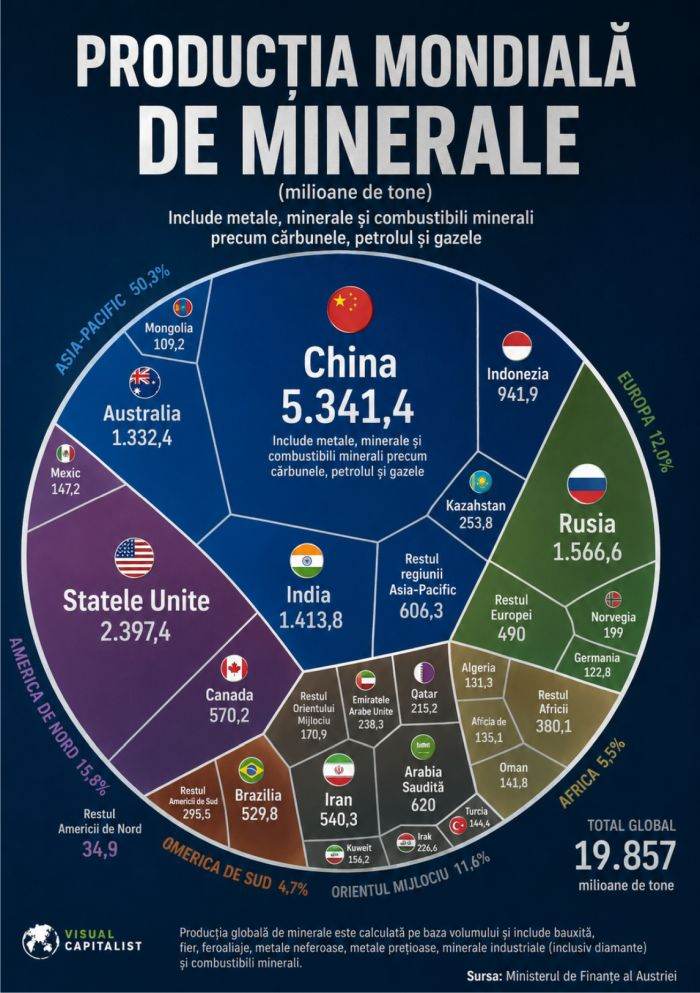
Minerals are essential for energy systems, construction, manufacturing and advanced technologies. However, their extraction is highly concentrated in resource-rich countries and major fossil fuel industries, according to visualcapitalist.com.
The cited source ranks the world's major mineral producers (countries) by the amount extracted in 2024, based on data from the Austrian Ministry of Finance, which includes all metals, industrial minerals (such as bauxite and diamonds) and mineral fuels such as coal, crude oil and natural gas.
The analysis is based on production volume, showing the total tonnage extracted, not the value of mineral production. This means that bulk commodities like coal weigh much more than precious metals like gold, the source said.
• China leads global mineral production thanks to coal
China led global mineral production in 2024 by a wide margin, putting 5.3 billion tonnes on the market, or 26.9% of the global total. The bulk of this volume came from coal production, which reached almost 4.8 billion tonnes.
The United States came in second place, with 2.4 billion tonnes, or 12.1% of the global total, less than half of China's output. The US's top position reflects its substantial production of fossil fuels, particularly oil and natural gas, where the US is the world leader.
Russia (1.56 billion tonnes; 7.9% of the total), India (1.41 billion tonnes; 7.1% of the total) and Australia (1.33 billion tonnes; 6.7% of the total) complete the remaining places in the Top 5. Russia is a major producer of fossil fuels, gold and base metals, while India is the world's second largest coal producer. Australia is the world's leading producer of bauxite, iron ore and lithium. Other major energy producers also appear in the Top 10. Saudi Arabia (seventh place) produced 620 million tonnes (3.1% of the total), while Iran (ninth place) put 540.3 million tonnes (2.7% of the total), reflecting the inclusion of fossil fuels in the data set. Indonesia ranked sixth with 941.9 million tonnes (4.7% of the total), and is both a major fossil fuel producer and the world's largest nickel producer.
• Asia-Pacific produces half of the world's minerals
The Asia-Pacific region generated 50.3% of global mineral production in 2024, equivalent to almost 10 billion tonnes. The region's total was driven by China, India, Australia and Indonesia.
Even excluding China, Asia-Pacific produced 4.7 billion tonnes of minerals, or 23.4% of the global total, highlighting that the region's advantage extends beyond a single country.
North America ranked second, with 15.9% of global production (about 3.15 billion tonnes), followed by Europe with 12% (2.37 billion tonnes) and the Middle East with 11.6% (2.31 billion tonnes).
Africa accounted for 5.5% of total production (1.08 billion tonnes), despite being a major producer of lower-volume commodities such as cobalt and platinum group metals. South America, a leading region for copper and lithium, accounted for 4.7% (934 million tonnes).
• Global mineral production is highly concentrated
The top 25 countries in the ranking accounted for almost 90% of global mineral production in 2024. In terms of volume, the majority of global production therefore comes from a relatively small group of countries.
This concentration reflects differences in geology, energy reserves, industrial capacity and the size of domestic demand. It also shows that large producers remain the backbone of global energy supply chains, infrastructure and manufacturing.























 Euro
Euro Dolar SUA
 Franc elveţian
 Liră sterlină
 Gram de aur