English


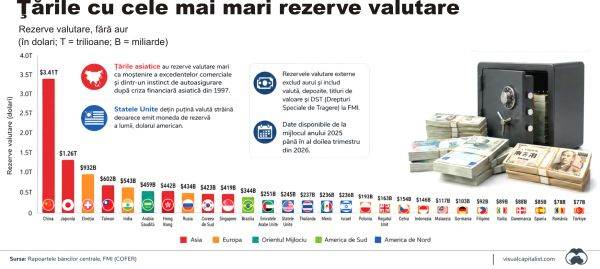
The largest foreign exchange reserve holders today were shaped by a crisis that occurred almost three decades ago. After the 1997 Asian financial crisis exposed the risks of relying on foreign capital during market turmoil, many governments began to build up massive foreign exchange reserves as a form of economic self-insurance, reports visualcapitalist.com.
The cited source ranked countries based on their foreign exchange reserves, excluding gold, based on IMF data. Data presented is from mid-2025 to the second quarter of 2026.
• Asia dominates the rankings
A clear pattern emerges in the global rankings: Asia dominates, with seven of the world's top ten foreign exchange reserve holders located in the region. Together, these countries control about two-thirds of global foreign exchange reserves. Such concentration reflects decades of export-led growth, persistent trade surpluses, and policies aimed at maintaining strong financial reserves.
The top ten in the ranking are as follows: China ($3.41 trillion), Japan ($1.26 trillion), Switzerland ($932.3 billion), Taiwan ($602.5 billion), India ($543 billion), Saudi Arabia ($458.6 billion), Hong Kong ($442.1 billion), Russia ($434.5 billion), South Korea ($423.1 billion), Singapore ($419.3 billion).
• Why the US only ranks 13th
One of the most surprising aspects of the ranking is the position of the United States. While it remains the world's largest economy, the US holds far fewer foreign exchange reserves than many Asian economies, ranking only 13th globally, with $244.6 billion, behind Brazil (11th; $344.2 billion) and the United Arab Emirates (12th; $251.4 billion).
The explanation lies in the unique role of the US dollar, according to the cited source. Because the dollar serves as the world's primary reserve currency and dominates global trade, the United States generally does not need to accumulate large amounts of foreign currency.
Countries around the world demand dollars for trade, investment, and central bank reserves, allowing the US to pay its obligations in its own currency.
As a result, US policymakers allow the dollar to float freely, rather than actively managing the exchange rate through large-scale reserve interventions. This contrasts with many export-oriented economies, which maintain substantial reserve stocks to support financial stability and manage currency fluctuations.
• Why governments build up massive foreign exchange reserves
Foreign exchange reserves act as a country's emergency fund. Central banks can use them to stabilize currencies during market turmoil, pay for essential imports, cover external debt, or calm investors during periods of capital flight.
The larger the reserve, the stronger a country's ability to respond to external economic shocks without relying on foreign assistance.
The importance of accumulating reserves became particularly clear after the 1997 Asian financial crisis. Many Asian economies were hit by massive currency collapses and were forced to seek external assistance. In the years since, governments across the region have adopted a strategy of building up substantial reserves as a form of economic self-insurance.
• What large reserves mean for the global economy
Large reserve holdings can offer important benefits. Countries with substantial reserves are often better positioned to withstand external shocks and maintain investor confidence during periods of market stress.
However, reserves also come with costs. Funds invested in reserve assets are typically held in low-yielding government securities, rather than being used elsewhere in the economy. Policymakers must therefore balance the security offered by reserves with the opportunity cost of holding them.
The rankings illustrate how global financial influence extends beyond the size of an economy. . While the US remains the central pillar of the international monetary system due to the dollar's dominant role, Asia's massive reserve holdings underscore the region's importance in global trade, manufacturing and cross-border capital flows.
• Dollar continues to dominate central bank foreign exchange reserves
Central banks held total foreign exchange reserves equivalent to $13.1 trillion at the end of 2025, according to visualcapitalist.com, citing IMF data. Despite efforts to dedollarize, the US dollar remains by far the world's most important reserve currency. Central banks collectively held $7.46 trillion in dollar-denominated reserves at the end of 2025, accounting for 56.8% of the global total.
The dollar's dominance stems from the size of the US economy, the depth of US Treasury markets and its central role in global trade and finance.
Many commodities, including oil, continue to be priced and settled in dollars, bolstering demand for the currency worldwide. The dollar's share has gradually declined from around 65% a decade ago, but no single currency has emerged as a clear replacement.
The euro is the world's second-largest reserve currency, with $2.66 trillion in holdings and 20.2% of total reserves. Although it lags far behind the dollar, it remains the main alternative for central banks seeking diversification. The currency benefits from the economic size of the eurozone and the liquidity of European government bond markets. Together, the dollar and the euro account for more than three-quarters of all global foreign exchange reserves.
Beyond these two leaders, the Japanese yen and the pound sterling hold shares of 5.8% and 4.4%, respectively. The Canadian dollar (2.5%) and the Australian dollar (2%) follow in the rankings.






















 Euro
Euro Dolar SUA
 Franc elveţian
 Liră sterlină
 Gram de aur