English
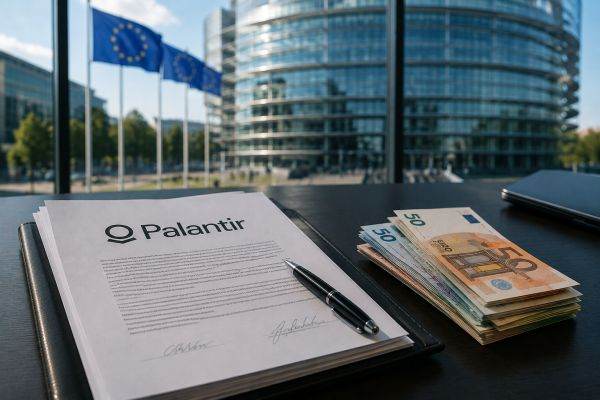
The American technology giant Palantir, one of the most influential software providers for defense, intelligence, police and health, is at the center of a controversy that risks fueling one of the most sensitive debates in Europe: how sustainable it is for European governments to spend billions of taxpayers' money on contracts with a company that, according to a recent analysis, contributes extremely little to the public budgets of the states it serves. The research conducted by the Centre for International Corporate Tax Accountability and Research (CICTAR), at the request of the European Federation of Public Service Unions (EPSU), and published yesterday by the investigative journalistic website Follow the Money claims that Palantir had a global effective tax rate of only 1.4% in 2025, paying only $22.7 million in corporate tax, despite reporting a pre-tax profit of $1.66 billion. In other words, for every dollar earned before taxes, the company paid less than two cents to the tax authorities, a spectacularly low level even in the context of tax optimizations practiced by large multinational corporations. The finding is all the more sensitive as over 145 states have agreed, within the framework of the agreement coordinated by the Organization for Economic Cooperation and Development (OECD), on a global minimum tax rate of 15% for large corporations. The study recalls, however, that the United States negotiated an exception to this mechanism, which allows some American companies to continue to benefit from tax facilities that are impossible to replicate in Europe. In this context, the CICTAR researchers argue that Palantir benefits from a tax architecture that moves most of the profits generated in Europe to the United States, where they benefit from preferential tax treatments and a series of deductions and tax credits introduced for American multinationals.
The investigation describes a mechanism that is not presented as illegal, but which the authors consider emblematic of what they call a model of aggressive tax avoidance. In many European countries, Palantir customers do not contract services through local subsidiaries, but pay directly to the headquarters in the United States. As a result, the profits resulting from European contracts do not remain in the jurisdictions where they were generated, but are registered in the US. The European subsidiaries subsequently receive only limited remuneration for the services provided, which artificially reduces taxable profits in those countries. In Germany and the UK, according to CICTAR, the company's own financial documents show that the activity of local offices is carried out for the benefit of the US headquarters, and the contracts are accounted for across the Atlantic. In Spain, the mechanism is different, but the effect is similar: the local subsidiary pays the US parent company substantial royalties for software licenses, expenses that exceed 70% of the revenues generated and significantly reduce the taxable base.
• Taxes paid by Palantir in Europe: 641,000 euros in Germany and 147,000 euros in Spain
Added to this strategy is the widespread use of remuneration through shares and stock options, a common practice in the technology industry, but which further reduces taxable profits. According to EPSU and CICTAR, Palantir uses this instrument both in the United States and in several European countries, including Spain, Norway and the UK. Matt Gardner, a senior fellow at the Institute of Taxation and Economic Policy, told Follow the Money that Palantir has accumulated billions of dollars in tax breaks related to R&D and stock-based compensation over time, which will allow it to significantly reduce its tax liability in the years to come. He also points out that Palantir believes that about $45 million of the tax breaks it claimed last year could be canceled in a tax audit, concluding that Palantir appears to be "very experienced at operating in the gray areas of tax law.” The data presented for 2024 shows that this is no exception. That year, Palantir paid just over $21 million in corporate income tax worldwide, despite reporting pretax profit of $489 million, which corresponds to a global effective tax rate of just 4%. In the UK, the company paid £2.1m, which represents an effective rate of 8.2%, still significantly below the 15% threshold set by the OECD agreement. In Germany and Spain, the effective rates were apparently higher, at 31% and 26.2% respectively, but the absolute tax payments remained low, at only euro641,000 in Germany and euro147,000 in Spain, as a significant portion of the revenue was transferred to the US headquarters. France is the exception highlighted by the report. French tax authorities intervened to ensure that revenue generated on the local market was recorded in the French subsidiary and not in the US, meaning Palantir paid around euro1.6 million in corporate tax there, at an effective rate of 33%. In the case of the Netherlands, the analysis could not determine the level of taxation because the Amsterdam office operates as a branch of the European headquarters in London and does not publish separate financial statements.
The reaction from European unions has been extremely critical. Marieke Manschot, a representative of the Dutch FNV union and a member of the board of Public Services International, told Follow the Money that the company's tax model raises serious equity issues. "It is unacceptable that Palantir is avoiding its social responsibility through opaque arrangements,” said Marieke Manschot. In her opinion, the company pays very little tax, despite using the infrastructure, education system, healthcare and all other public goods financed by citizens' taxes. "The bill thus ends up being borne by the ordinary taxpayer," warns the union representative.
However, the company rejects the criticism and claims that it complies with its tax obligations in all jurisdictions in which it operates. In a point of view sent to the authors of the investigation, Palantir states that its partnerships with European public and private institutions reflect a shared commitment to the values that strengthen European society. Company representatives emphasize that their software allows institutions to carry out their work more efficiently, while maintaining full control over their own data and sovereign decisions. At the same time, the company argues that the overwhelming majority of its revenues and profitability come from the United States, and the level of taxes paid in each jurisdiction reflects the real degree of economic activity carried out there.
• European experts: dependence on Palantir, harmful for the EU
The report does not stop at the fiscal dimension, however, and extends the discussion to the geopolitical and democratic implications of Palantir's rise in Europe. Founded in 2003, immediately after the September 11 attacks, by investor Peter Thiel and Alex Karp, the company has become one of the most important providers of data analysis and artificial intelligence technologies used by armies, intelligence services and public institutions. At the same time, Palantir is criticized for its collaboration with the Israeli army and for its involvement in the systems used by the US authorities to combat illegal immigration. CICTAR states that governments and companies that buy Palantir software "are not just buying technology, but also a certain ideology and worldview." The report notes that Peter Thiel wrote in 2009 that he no longer believes that "freedom and democracy are compatible,” while Alex Karp has publicly argued that some cultures are superior to others and admitted that the company's technology is used in military operations that have resulted in casualties. The corporate governance structure also raises questions. According to the research, Palantir uses a system of shares and voting rights that allows founders Peter Thiel and Alex Karp to control the company despite its listing on the stock exchange in 2020. Jill Fisch, a professor of corporate law at the University of Pennsylvania, and Dorothy Lund, a professor at Columbia Law School, told Follow the Money that they have never encountered a similar governance structure, based on a trust mechanism with variable voting rights. Dorothy Lund warns that in such an architecture, shareholders cannot expect independent and critical oversight of management, since the board of directors is inevitably aligned with the interests of controlling shareholders and executive management. Palantir responds that this very structure represents the foundation of the organizational culture that allows it to take risks, innovate and avoid the constraints specific to traditional companies.
Beyond the tax figures, the cited investigation highlights an increasingly pressing strategic problem for the European Union: technological dependence on large American companies. Jesse Six Dijkstra, consultant to the organization Digitale Doetank and former Dutch parliamentarian, warns, according to the cited source, that reducing this dependence is already difficult, but becomes almost impossible if American companies simultaneously benefit from significant tax advantages. Under these conditions, European competitors embark on an unbalanced competition from the very first moment. According to this, Brussels is preparing new directives that could allow public authorities to take into account criteria such as digital sovereignty and social responsibility when awarding public contracts, which could reduce the chances of companies that do not contribute sufficiently to European economic prosperity. Even in this scenario, says Dijkstra, the final decision will depend on the existence of credible technological alternatives, but governments have, at the very least, "a moral obligation to take into account the extent to which companies contribute to overall prosperity”.
The CICTAR investigation does not accuse Palantir of breaking the law, but it raises uncomfortable questions about the relationship between legality and tax fairness, about the relationship between large technology corporations and the states that finance them through public contracts, and about the real costs of Europe's dependence on American digital infrastructure.





















 Euro
Euro Dolar SUA
 Franc elveţian
 Liră sterlină
 Gram de aur