English


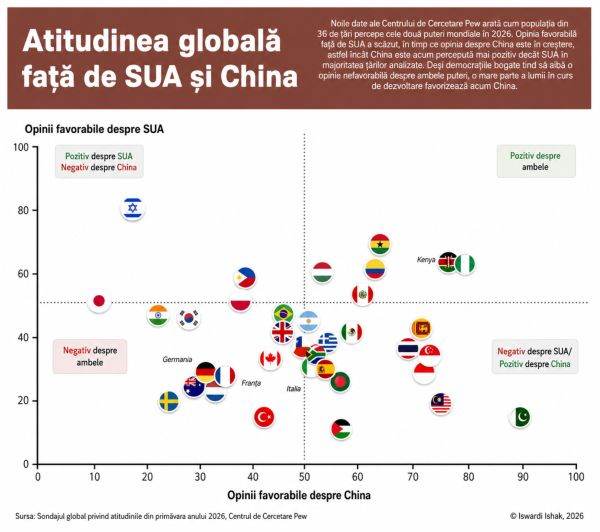
Public perception of the world's two largest economic powers - the US and China - has undergone a notable shift. The Global Attitudes Survey, conducted by the Pew Research Center this spring, reveals significant differences in how countries perceive China and the United States.
Visualcapitalist.com compares, using Pew data, favorable attitudes toward both countries in 36 countries, showing where public support has been strongest and where opinions remain sharply divided.
• Pronounced regional differences
The global survey conducted by Pew shows pronounced regional differences. Many countries in Africa, Southeast Asia, and parts of Latin America express more favorable views of China. The United States (perceived favorably) leads in nine countries: Brazil, Ghana, Hungary, India, Israel, Japan, the Philippines, Poland, and South Korea.
• Pronounced divide
The poll reveals several broad groups. Wealthier Western democracies remain broadly skeptical of both countries, with Germany, France, Sweden, Australia, and the Netherlands recording relatively low favorability scores for each.
Much of the developing world falls into the opposite pattern, where China receives overwhelming support while positive views of the United States are less so. Pakistan stands out with a 90% favorable view of China, compared with just 15% for the United States.
Wider gaps also emerge in Malaysia (75% vs. 19%) and Indonesia (72% vs. 29%).
Several African countries, including Ghana, Kenya and Nigeria, express positive views of both powers. This suggests that many of those surveyed see value in maintaining relationships with each country, rather than seeing them as mutually exclusive.
• Why China's Image Has Improved
The improvement in perceptions of China reflects both a rise in favorability toward Beijing and a decline in favorable views toward the United States, according to the source cited. Recent data suggests that this reversal has been particularly pronounced among several long-standing U.S. trading partners, including Canada and countries in Europe.
Public opinion is rarely based on a single factor. Analysts point to expanding Chinese trade and diplomatic engagement, along with changing perceptions of foreign policy and trust in the United States. As countries deepen their economic ties with Beijing, trade has become an increasingly important factor in international relations. Some news reports published by the BBC and analyses by the Council on Foreign Relations also suggest that many countries are pursuing pragmatic relations with both powers, balancing security partnerships with ever-expanding economic ties with China.
• Global competition
While China receives higher favorability scores in most countries surveyed, the results do not necessarily translate directly into geopolitical alignment.
Instead, the survey points to an increasingly multipolar world in which economic influence, trade, diplomacy and public perception contribute to global power. As China expands its international presence and the US strives to maintain long-term alliances, the competition between the two superpowers is increasingly measured not just in economic and military terms but also in global public opinion.
• China's economy - in the weakest advance in the last three years
China's economic growth slowed in the second quarter of 2026, despite strong exports (supported by the global boom in artificial intelligence), the acceleration of industrial production and the return of retail sales above expectations in June, informs AFP, according to Agerpres.
In the period April-June 2026, the Gross Domestic Product (GDP) of the world's second largest economy grew by 4.3% at an annual rate, the National Bureau of Statistics (NBS) reported this month, a figure below the estimates of analysts, who were counting on an advance of 4.5%. This is a significant slowdown in the Chinese economy after growth of 5% in the first quarter. Beijing has set a growth target for this year between 4.5% and 5%.
China, which has made exports a pillar of its economic model, still relies heavily on foreign trade to fuel its growth, at a time when a prolonged housing slump and weak consumption continue to weigh on it.
However, tensions over the conflict between the United States and Iran have threatened this dynamic by disrupting shipping traffic in the Strait of Hormuz, causing oil prices to rise, risking disrupting global supply chains and negatively impacting demand for Chinese goods.
"There are many unstable and uncertain external factors, and the domestic imbalance between abundant supply and weak demand persists,” the National Bureau of Statistics commented, concluding: "The foundation for an economic recovery still needs to be consolidated.”
On the other hand, other recently published economic indicators show a better outlook. Thus, China's industrial production grew by 5.3% in June 2026 compared to June of last year, accelerating much more sharply than analysts surveyed by Bloomberg had anticipated (+4.6%), after an advance of 4.5% in May.
Also, retail sales, a barometer of consumption, recovered in June (+1% compared to the previous year), while experts expected a new decline after a decline of 0.6% in May. These data suggest that household demand, which had been extremely weak, is starting to recover.

























 Euro
Euro Dolar SUA
 Franc elveţian
 Liră sterlină
 Gram de aur