English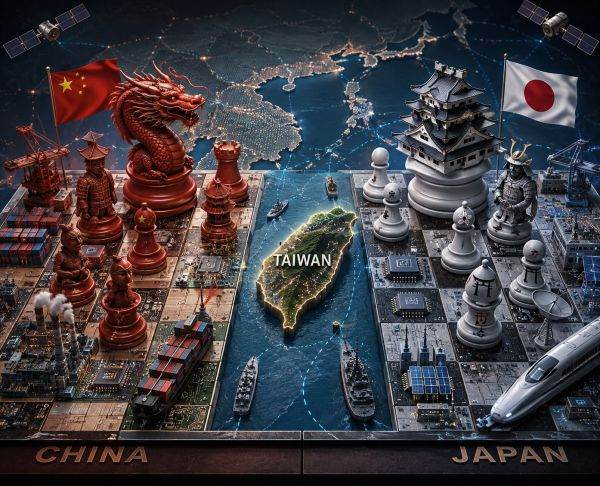
The Tokyo government designates China as the biggest strategic challenge to Japan's security, according to the new Defense White Paper, cited by The Japan Times and Reuters. Japanese authorities believe it is necessary to mobilize "national strength as a whole."
The new wording shows that Tokyo no longer views competition with Beijing as a problem reserved for the military. Japan's security begins to encompass the economy, industry, research, infrastructure, energy, dual-use technologies, access to raw materials and the resilience of supply chains. In this vision, the factory becomes an extension of military strategy, the university laboratory enters the national security architecture, and public investment in defense is presented as a tool for stimulating the entire economy.
The White Paper states that China's military activities and other actions by Beijing constitute a serious concern for Japan and the international community and represent the most important strategic challenge for Tokyo. The assessment is not essentially new, but the tone, the scope of the response and the explicit link to economic policy mark an acceleration. Japan is no longer limited to noting the growth of Chinese military power, but is trying to transform this pressure into a justification for rebuilding its own industrial and technological capacity.
At the heart of Japanese anxiety is Taiwan. A conflict triggered by China around the island could directly affect Japan, both through the geographical proximity of the southwestern archipelago and through its military alliance with the United States. American bases on Japanese territory would inevitably acquire a role in a regional confrontation, and Japanese islands near Taiwan could become logistical points, military objectives or areas exposed to blockades and attacks. Prime Minister Sanae Takaichi has already provoked Beijing's anger by stating that Japan could mobilize its Self-Defense Forces if a Chinese attack on Taiwan threatened the survival of the Japanese state.
The pressure does not come only from China. Russia is stepping up its military activities in the region and cooperating more closely with Beijing, while North Korea is developing its nuclear arsenal and ballistic missile capabilities. For the government in Tokyo, this strategic rapprochement between China, Russia and North Korea is transforming the region into a space where crises can no longer be dealt with separately. A Sino-Russian naval exercise, a North Korean launch or an escalation in the Taiwan Strait are all part of the same picture: the emergence of a regional environment in which military power and economic coercion can change the balance before diplomacy has time to react.
Japan's response goes far beyond conventional military modernization. The Tokyo government is investing in missiles with ranges of more than 1,000 kilometers, capable of hitting targets on an adversary's territory, as well as in drones, autonomous systems, artificial intelligence, cyber defense and space technologies.
The war in Ukraine and the conflicts in the Middle East have shown that cheap ammunition, unmanned systems and the speed of industrial production can matter almost as much as sophisticated military platforms. A country that cannot quickly manufacture, repair, replace and adapt equipment risks losing a war of attrition no matter how advanced the weapons it enters the fight with. For this reason, the government is calling for the wider use of commercial components in military production, financing of start-ups and the transfer of civilian technologies to defense. Japan has exceptional skills in electronics, robotics, sensors, advanced materials, optics, shipbuilding and precision manufacturing, but much of this technological strength has remained outside the military industry for decades. Now Tokyo is trying to dismantle the wall between the civilian economy and the defense sector. According to The Japan Times, the Japanese Ministry of Defense explicitly argues that military investment can benefit the economy and the lives of citizens. The message is part of Prime Minister Takaichi's policy of using strategic state spending to stimulate economic growth. The 2026 Defense White Paper thus becomes more than an inventory of threats: it is a manifesto for rebuilding Japan's industrial power under the umbrella of national security.
The stakes are high. After decades of restrictions on arms exports that have reduced the available market and discouraged private investment, Japan is beginning to view military production as an export industry. Relaxing the rules could allow Japanese companies to sell complete systems, components and technologies to partners in Asia, Europe and the Pacific. The interest is already there , fueled by wars that have strained U.S. industry and allies' doubts about Washington's predictability.
Companies such as Toshiba and Mitsubishi Electric are expanding their capabilities, hiring staff and creating structures dedicated to military exports. Toshiba plans to recruit about 500 people over the next three years and is building production and testing facilities, while Mitsubishi Electric estimates its defense sales could reach 600 billion yen by 2031. Demand for complete systems is strong in Asia, and Europe, Australia and the United States offer opportunities for components and joint development, according to a Reuters analysis of the opening of Japan's arms market.
Tokyo is also seeking to reduce its dependence on the United States. About 95 percent of Japan's arms imports came from the United States between 2021 and 2025, according to SIPRI data cited by Reuters. This dependence offers interoperability with Japan's main ally, but it brings delays, high costs, and obvious vulnerability when American industry must supply multiple theaters of conflict simultaneously. Building Asian production chains, developed around Japanese industry and connected to Australia, the Philippines, European states, and other partners, could transform Tokyo from a strategic customer to a security provider.
The model being pursued is, to some extent, that of South Korea, which has converted military investments into an industrial and commercial success, becoming a major supplier to Poland and the Philippines. But Japan is starting with a much larger technological and economic base. Even burdened by historical restrictions, its defense industry is comparable in size to those of South Korea, Germany, Italy, and Israel. Lifting export barriers, larger domestic orders, and joint international programs could unleash long-hidden industrial potential.
But this strategy comes at a price that the Defense White Paper cannot hide. Defense spending has reached about 2 percent of gross domestic product, and the government is financing Japan's largest military buildup since World War II through a mix of tax increases, spending cuts and temporary revenues. The Takaichi administration has not convincingly explained how it will finance further growth without deepening the strain on public finances. The budget for the fiscal year ending in March 2027 reached a record 122.3 trillion yen, to which was added an additional 3.1 trillion yen package to protect people and businesses from higher energy costs. Reuters shows that the promise of prosperity through rearmament thus runs up against a basic question: who pays the bill?
There is also the risk that military industrial policy will divert resources from civilian sectors, create companies dependent on state orders, and turn the external threat into a permanent argument for ever-increasing spending. Defense investment can generate jobs, research, and reusable technologies in the civilian economy, but not every missile automatically produces prosperity, and exported weapons are not ordinary commercial goods. They bring political responsibilities, reputational risks, and the possibility of Japan being drawn deeper into confrontations that it has tried to avoid for eight decades.
The shift is, however, difficult to reverse. China provides the strategic argument, the war in Ukraine provides the industrial lesson, uncertainty about American support imposes autonomy, and Japan's economic stagnation creates the temptation to use the military budget as a technological accelerator. Beijing is defined as the main challenge, but Tokyo's response is not just more ships, missiles, and drones. Japan is trying to transform security into a national project of economic modernization.
























 Euro
Euro Dolar SUA
 Franc elveţian
 Liră sterlină
 Gram de aur