English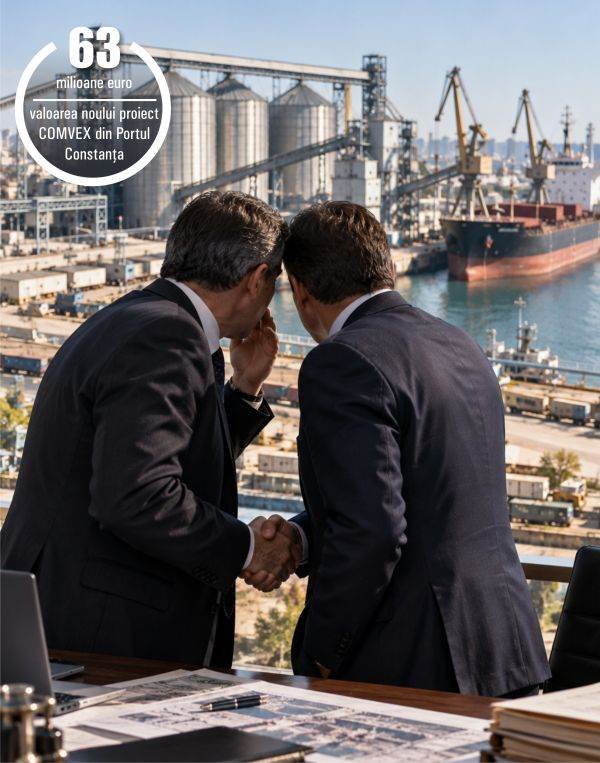
COMVEX SA is preparing for a new major investment in the Port of Constanta: 63 million euros, excluding VAT, for the development of a terminal for solid bulk fertilizers and liquid products at Dana 84 and Halda 5. Shareholders were convened for September 21, 2026 to approve in principle the opportunity and value of the project, presented as one of the most important private investments made in recent years in the port infrastructure of Constanta. The new terminal would allow the docking of large-tonnage ships, the construction of cellular silos and tanks, as well as the installation of automated loading and unloading systems, designed to reduce the time spent by ships and trains. The information was published on September 6 by Replica de Constanta, and the convocation of the EGMS and the project were also presented by our newspaper.
At first glance, the news seems to belong exclusively to the economic success column: a Romanian port operator invests, diversifies its activity, enters the fertilizer logistics market and consolidates the role of the Port of Constanta in the Black Sea region. But COMVEX is not a company about which an investment of tens of millions of euros can be reported only by reproducing the figures in a convenor. In the recent history of the company, investments have not only represented industrial projects. There were also arguments for changing the capital structure, redistributing power between shareholders and triggering one of the most complicated corporate conflicts that reached the courts in Constanta.
We return, therefore, to the COMVEX case not to dispute the need for the new terminal nor to insinuate that the 63 million euro investment necessarily hides a new controversial operation. We return because the great COMVEX scandal also started from an investment: the construction of the 200,000-ton grain terminal in Dana 80, which in 2026 was upgraded to 240,000 tons. And then, the industrial project was presented as a strategic investment, necessary for the development of the company and the consolidation of the Port of Constanta, and the company's management invoked the need for financing. However, before requesting an increase in the share capital, the people who controlled the majority shareholder had requested approval to contract a bank loan of up to 52 million euros for the construction of the same terminal.
Documents from file no. 27863/3/2019 from the Constanta Court of Appeal and the Constanta Court of Appeal show that, for the investment in the grain terminal, discussions had been held with Raiffeisen Bank and EximBank with a view to syndicated financing. The banks were to provide up to 80% of the project value, and COMVEX was to contribute the remaining approximately 20%. Subsequently, the increase in share capital was justified precisely by the need to ensure this own contribution and the conditions required by the financiers. This was the official economic argument. However, the way in which the increase was prepared and carried out radically changed the COMVEX shareholder structure.
• How the COMVEX shareholder structure changed
In September 2016, COMVEX approved the issuance of six million new shares, at a price close to the nominal value, much lower than the price at which the existing shares were traded on the market. The operation was organized in two stages. In the first, shareholders could subscribe proportionally to preserve their holdings. In the second, the remaining shares were allocated according to the "first come, first served” rule. Solidmet, the shareholder who held approximately 63.24% of COMVEX and on whose behalf the need for the increase had been supported, did not exercise its preemptive right. As a result, its stake would collapse to approximately 30.68%.
Just a few days before the registration date for the increase, two people who were not previously among the significant shareholders of COMVEX each bought 40 shares: Anca Drăgoi, wife of Dan Drăgoi, and Ruxandra Nicola, wife of COMVEX's general manager, Viorel Panait. The 40 shares did not have an impressive economic value: approximately 820 lei for each package. However, their importance was not given by their immediate value, but by the right they opened. The 40 shares conferred on each of them the status of shareholder and, with it, the possibility of participating in the capital increase.
In the second stage, Anca Drăgoi and Ruxandra Nicola each subscribed 2,050,000 COMVEX shares. The mechanism can be summarized brutally simply: 40 shares, purchased for approximately 820 lei, opened access to 2.05 million new shares, and the two beneficiaries each reached approximately 17.6% of the company. Together, they acquired approximately 35% of COMVEX, while Solidmet, the former majority shareholder, was diluted to approximately 30.68%.
Here begins the the dilemma that has haunted the company for years: was the capital increase really just a financial solution for building the grain terminal or did the investment become the vehicle through which economic control over COMVEX was reconfigured? The fact that bank financing and the capital increase could be part of the same financial arrangement is not, in itself, suspicious. Banks can ask a beneficiary to provide their own contribution, and a company can combine credit with shareholder contributions. But the suspicion did not arise from the simple existence of the two sources of financing. It arose from the sequence of operations: the majority shareholder requests and votes for the increase, does not subscribe to it, agrees to be diluted, and the remaining shares are massively taken over by the wives of two people at the center of the company's management and control.
Raimondo De Rubeis, former administrator and direct and indirect shareholder of COMVEX, claimed that this succession was not accidental, but the result of an operation prepared to transfer a significant part of the company to the Dragoi and Panait families. His accusations were rejected by those concerned, and De Rubeis definitively lost the central trial in which he requested the nullity of the initial acquisitions and subsequent subscriptions. But what the justice system actually established is much more complicated than the convenient formula according to which the plaintiff lost numerous trials and, therefore, all his accusations were proven false.
• The appeal and restitution courts refuse to rule on one of the pieces of evidence
The Constanţa Court entered into the merits and, by Civil Sentence no. 592 of May 23, 2024, dismissed De Rubeis' action as unfounded. The court considered that he had not proven fraud under the law, illicit cause, violation of a mandatory rule or the illegal nature of the takeover of control. The court held that the increase had been approved by the company's bodies and the ASF, that De Rubeis had had the opportunity to subscribe, but had not used it, and that he had subsequently approved, as administrator, the decision by which the completion of the operation had been validated. The court also showed that acquiring control over a company is not, in itself, prohibited and that the dilution of the shareholder who refuses to subscribe is a natural consequence of the capital increase.
One of the essential arguments of the court was that the trading of shares was done in an algorithmic stock exchange system, in which the orders were anonymous and the investor could not control or know the person in the counterparty. The Constanţa Court of Appeal took over and developed this thesis. By Civil Decision no. 90/LP of 28 May 2025, the Court, however, substantially changed the basis of the sentence. It did not content itself with confirming that De Rubeis's accusations were unfounded. It decided that Viorel Panait and Dan Drăgoi did not have passive procedural capacity for the counts relating to the acquisition of the 40 shares, that De Rubeis did not justify a personal, determined and current interest and that the subscriptions of the 2.05 million shares could not be attacked separately through an action for nullity, because they did not represent autonomous legal acts, but facts integrated into the complex operation of increasing the capital.
De Rubeis therefore lost definitively. The High Court of Cassation and Justice rejected his appeal by Decision no. 1923 of December 11, 2025. However, the ÎCCJ did not replay the film of the operations and did not re-evaluate the evidence to establish who knew what, who controlled the orders and whether they were coordinated. The supreme court verified the legality of the Court of Appeal's decision within the strict limits of the appeal. For several criticisms, the ÎCCJ explicitly showed that a new analysis would have implied a re-evaluation of the facts and evidence, something that cannot be done in an appeal.
It is here that the piece that prevents the journalistic closure of the case by counting the lost sentences appears: the recording of a conversation with the Raiffeisen broker. We are not talking about a recording whose origin is unilaterally claimed by De Rubeis. According to the documents in the file, the recording was sent to a DIICOT file by Raiffeisen itself. In the conversation, Viorel Panait simultaneously discusses his own order to sell 40 COMVEX shares and Ruxandra Nicola's order to buy 40 shares, which he transmitted as her proxy, as we also showed in the BURSA newspaper.
The broker tells him that he cannot perform the operation in the form of a "cross", but proposes the introduction of two distinct orders, in opposite directions, at the same price. Furthermore, he explains to Panait that the two orders would partially meet. Panait accepts. In that meeting, Ruxandra Nicola bought 40 shares, and Viorel Panait sold 33 shares, at the same price and through the same intermediary.
The recording does not prove there is no evidence that there was fraud, market manipulation, or illegal trading. Nor does it prove that Panait could guarantee that his shares would reach Nicola, because the algorithmic system, other orders, and priority rules could influence the outcome. But it does prove something that the courts' reasoning does not explicitly confront: Panait was not a seller who knew nothing about an anonymous buyer. He knew his own order, he knew the buyer's order because he was administering it under a power of attorney, and the broker knew both instructions and anticipated their partial meeting. Anonymity in the Bucharest Stock Exchange system means that the identity of the clients is not displayed to the other participants. It does not automatically mean that a person transmitting instructions for both directions of the operation does not know who is behind them. It is one thing to say that the algorithm did not guarantee the outcome, it is another to argue that the orders met without the people involved knowing the intentions of buying and selling. The Raiffeisen recording makes this second description incomplete at best.
Neither the Tribunal nor the Court of Appeal explain in their reasoning how this conversation is reconciled with the premise that the investor could not have known the counterparty. The High Court was also challenged on the failure to analyze the telephone transcripts, but it replied that a court is not obliged to discuss each piece of evidence separately if its reasoning is based on the totality of the evidence. This is a response about the legal standard of reasoning, not about the content of the recording. The ÎCCJ did not determine that the recording was irrelevant, that Panait was unaware of the two orders, or that the broker had not anticipated their meeting. It only determined that the lack of an individual examination of this evidence was not a sufficient reason for quashing the decision.
• Cross transaction legal or illegal?
There remains the issue of the "cross”. The BVB Code applicable in 2016 used a broader notion than that of "cross order”, which could include, under certain conditions, the automatic execution of two distinct orders, of opposite direction, administered by the same Participant. The Panait-Nicola situation factually resembles this definition: two opposite orders, same instrument, same price, same intermediary, knowledge of both instructions and an anticipated partial execution. However, the similarity does not allow the verdict that the operation legally constituted a cross transaction. For this, it is necessary for the BVB to specify the exact mechanism applicable to the CMVX shares in the respective session, the priority rules and the obligations that accrued to the Participant. This is the reason why the 63 million euro investment brings the COMVEX case back into focus. Not because any investment by the company would be suspect, nor because the new fertilizer terminal project should be blocked. On the contrary, such infrastructure can be important for the Port of Constanta and for the Romanian economy. But the history of COMVEX shows that, in a society with a conflicting shareholder structure, the question "what do we build?” cannot be separated from the questions "who pays?”, "who decides?”, "who gets diluted?” and "who gains power after the investment?”.
In the case of the grain terminal, the company eventually obtained bank financing and completed the project. The investment exists, operates and contributed to the development of COMVEX. This industrial success does not, however, erase the way in which its financing was used as justification for a capital increase that brutally redistributed power between shareholders. The fact that a hall, a silo or a terminal were built does not automatically answer the question of whether all corporate operations carried out in their name were transparent and fair.

























 Euro
Euro Dolar SUA
 Franc elveţian
 Liră sterlină
 Gram de aur