 English

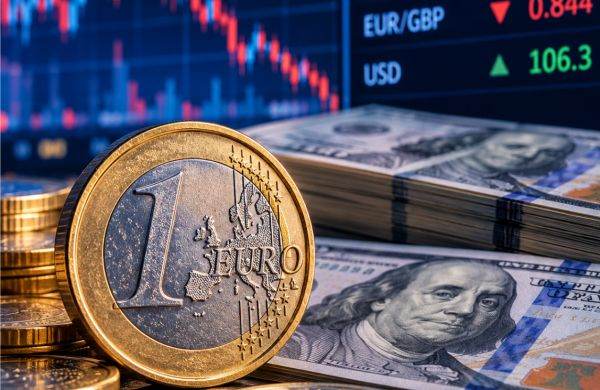
Last week, the single European currency (the euro) fell to its lowest level against the US dollar since mid-May 2025, and reached its lowest point against the British pound since early June 2025. This decline was driven by the explosive rise in energy costs, tensions in the bond market-linked to France's public finances-and the strengthening of the US dollar, according to euronews.com.
This drop occurred despite the fact that the European Central Bank (ECB) has raised interest rates twice this year-a move that would typically bolster a currency.
On Wednesday, the European currency traded at approximately 1.111 dollars, hitting its lowest level since mid-May 2025 and falling below the previous low recorded earlier that month. By Thursday, the euro recovered slightly to reach about 1.121 dollars, and on Friday, during the first part of the day, it stood at 1.1248 dollars, according to Bloomberg data. Since the end of August, the single European currency has lost nearly 5% of its value, completely erasing the gains made over the summer. Against the British currency, the euro reached a level of approximately 0.842 pounds on Wednesday-its lowest point since the beginning of June 2025-before recovering slightly to around 0.846 pounds on Thursday. By Friday morning, the exchange rate stood at 0.8438 pounds. Consequently, the euro has fallen by about 2% against the pound since the end of September, erasing the gains accumulated since mid-July.
Since an exchange rate involves two sides, the depreciation of the euro also reflects a strengthening of the US dollar.
The US Dollar Index-which measures the currency's performance against major global currencies-hit an 18-month high on Wednesday, following the announcement that the US inflation rate had climbed to 3.7% in September, exceeding forecasts.
• Interest rate hikes offer no protection
The US inflation data led to a near-doubling of the probability-as estimated by traders-that the Federal Reserve (Fed) will raise interest rates at its October 28 monetary policy meeting. The Fed's benchmark interest rate is already in the 3.75%-4% range, a level significantly higher than the European Central Bank's 2.5%.
On September 10, the ECB raised its deposit interest rate by a quarter of a percentage point to 2.5%-the second such increase this year. The measure was intended to counter the shock to the energy market caused by the war in Iran; since Europe imports the bulk of its energy, the continent is far more exposed to a sharp rise in oil prices than the United States.
Since then, inflation in the eurozone has climbed to 3.8%, reaching its highest level in three years.
Currently, traders anticipate that the ECB will keep interest rates unchanged at its October 29 meeting, with further hikes expected in December.
"We will likely need to implement further increases," Pierre Wunsch, Governor of the National Bank of Belgium, told Bloomberg on Wednesday.
Bundesbank President Joachim Nagel took a more cautious stance, stating earlier this month: "So far, there are no clear signs that inflation has spread to the price- and wage-setting process."
In the United Kingdom, robust economic data have fueled speculation that the Bank of England will also raise interest rates in November-a prospect that has provided support for the pound sterling.
• France's Debt Crisis
The yield spread that investors demand for holding 10-year French government bonds compared to German ones-an indicator of market jitters-surpassed the 150-basis-point threshold earlier this month, reaching its highest level since the Eurozone debt crisis around 2011.
The French government's draft budget for 2027, which targets savings of approximately euro54 billion and a reduction of the deficit to 5% of GDP (down from an estimated 5.4% for the current year), faces a difficult path through a divided parliament; debates began on Tuesday, amid student protests calling for additional public funding for the education system, the source notes.
France's public debt reached a record high of 119% of GDP at the end of June 2026, according to data from INSEE. This figure-approximately euro3.59 trillion-is double the official EU threshold for the public debt-to-GDP ratio, which is set at 60%.
ECB President Christine Lagarde has tempered expectations regarding any potential support intervention from the central bank. "The primary solution-the very first one-must be found within France itself (...) and it concerns fiscal policies," Lagarde stated last week, on the sidelines of the annual meetings of the IMF and the World Bank Group, held in Bangkok. Meanwhile, Spain is heading toward snap elections on November 29, a development that intensifies the political turbulence affecting European markets.

























 Euro
Euro Dolar SUA
 Franc elveţian
 Liră sterlină
 Gram de aur































Reader's Opinion