 English

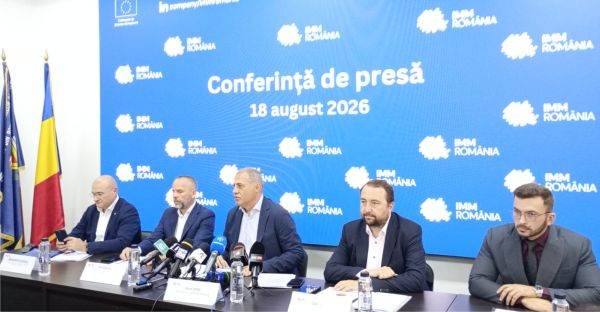
Florin Jianu, President of IMM Romania, declared, during a press conference held yesterday at the headquarters of the employers' confederation, that at the end of the implementation period, Romania will not exceed an absorption rate of 50% of the initial allocation of the National Recovery and Resilience Plan (PNRR). Mr. Jianu warned that the reductions in transport projects, the elimination of industrial investments in energy and the poor execution of digitalization leave behind structural vulnerabilities, while small and medium-sized enterprises remained insufficiently represented in the program.
We recall that the PNRR started in 2021 with a value of 29.2 billion euros, but, after successive renegotiations with the European Commission, it reached approximately 21 billion euros. As the deadline for implementation is 31 August 2026, IMM Romania has analysed four key components - motorways, rail infrastructure, energy and digitalisation - to assess what will actually remain after the closure of the programme.
In road infrastructure, the initial plan envisaged approximately 429 kilometres of motorway. IMM Romania's analysis indicates a reduction of over 40%, to around 251-257 kilometres, after the complete removal of sections of the A8 and A3 from the PNRR. The A7 remains the main financed project, and the Margina-Holdea tunnel segment of the A1 continues to be at risk of not being completed on time. At the same time, the value of the motorway component has increased from 3.1 billion to over 3.3 billion euros.
"For motorways, although the amount increased to 3.3 billion euros, the number of kilometers decreased from 429 km to 254 km, a 40% elimination. Two strategic projects, the A8, which connected Moldova to Transylvania, and a piece of the A3 have completely disappeared from the PNRR. For railways, the reduction is 33%, from 328 km to 220 km,” said the president of IMM Romania.
On the railway, the Cluj-Napoca-Oradea-Episcopia Bihor corridor was kept in its entirety in length, but the completion targets for the last lots were renegotiated downwards, according to the analysis carried out by IMM Romania. Of the Caransebeş-Timişoara-Arad corridor, only Lot 2 is still active in the PNRR. Overall, the mileage of the major railway corridors decreased from approximately 328.5 to 220.2 kilometers.
• Energy: industrial capacities removed or suspended from PNRR
The document presented yesterday by the president of IMM Romania also shows that energy projects that were to be financed from PNRR have seen a decrease in budgets and even the disappearance of some industrial capacities. The 150 million euro investment for the production, assembly and recycling of batteries has been eliminated in full. Contracts for green hydrogen and for the photovoltaic value chain have been suspended, and the targets of other investments - including hydrogen and cogeneration - have been reduced or reformulated.
"In energy, battery storage has been completely removed from PNRR, although Romania needed to replace fossil fuel production. The production of photovoltaic panels has also been removed, with 373 million lei being unilaterally suspended by the state, the consequence being that we continue to import panels from China," Florin Jianu said.
For SMEs in Romania, the stakes go beyond absorbing a sum: abandoning investments in batteries and photovoltaics means losing an opportunity to form national value chains in a strategic sector and reduce dependence on imports.
• Digitalization, the component with low execution and delayed strategic projects
The digital transformation brings together 20 measures coordinated by different institutions. The data analyzed by SMEs in Romania indicate an execution of approximately 21.5% at the level of the C7 component. The weakest results are found precisely in some of the strategic investments: migration of applications to the government cloud, eHealth, electronic identity, cybersecurity and administration automation.
"In digitalization, the execution is only 21.5%; we risk losing almost 80% of the money, given that we see databases in public institutions that are under cyberattack and non-functional platforms, such as the public procurement one", warned Florin Jianu.
In these circumstances, IMM Romania claims that the limits of the PNRR were visible from the drafting stage, when the consultation of social partners would not have been truly reflected in the final form of the plan. IMM Romania proposed 5.1 billion euros to support small and medium-sized enterprises, but the business environment received approximately 1.3 billion euros. Neither the proposal for vouchers of 5,000 euros each for the digitalization of 100,000 SMEs nor the "Romania Tech Nation” and EQUITY programs were taken up in the proposed form. The SME digitalization scheme, with grants between 20,000 and 100,000 euros, was also difficult to implement.
In the opinion of IMM Romania, the PNRR's effectiveness shows that the design of future European programs must start from the real needs of the economy and effectively include the social partners. Otherwise, accounting absorption risks hiding the failure of some competitiveness and private sector consolidation objectives.
• Warning regarding the decision-making deadlock and the deterioration of the economic environment
The President of IMM Romania also referred to the current decision-making deadlock, given that we have had an interim government for over 100 days.
"Unfortunately, at this moment our feeling is that we have a paralyzed state, which in no way makes a decision. It seems that it is not going in any direction. It seems that everything is starting to collapse around us and I mean critical infrastructure. Look at energy, digitalization, the way we protect our economy and society - and I also mean agriculture or HoReCa - and decisions are slow to appear", said Florin Jianu.
The entrepreneurs' representative linked the PNRR situation to the lack of quick decisions to maintain purchasing power and support small and medium-sized enterprises. He also cited the deterioration of entrepreneurial dynamics and the labor market.
"During the period January 1-June 30, 2026, we have a number of 75,000 new companies registered and a number of 85,000 companies that have closed. So a negative growth of 10,000 companies which, if maintained, means that we will have less than 20,000 new companies this year as well. Our prediction was for over 60,000 lost jobs. I believe that by the end of the year we risk reaching up to 100,000 lost jobs. We are already at 60,000 lost employment contracts this year," said Florin Jianu.
Therefore, the president of IMM Romania appealed to President Nicuşor Dan for the rapid appointment of a prime minister tasked with forming the new government with full powers, capable of adopting the necessary measures to recover the economy.



















 Euro
Euro Dolar SUA
 Franc elveţian
 Liră sterlină
 Gram de aur





























