 English

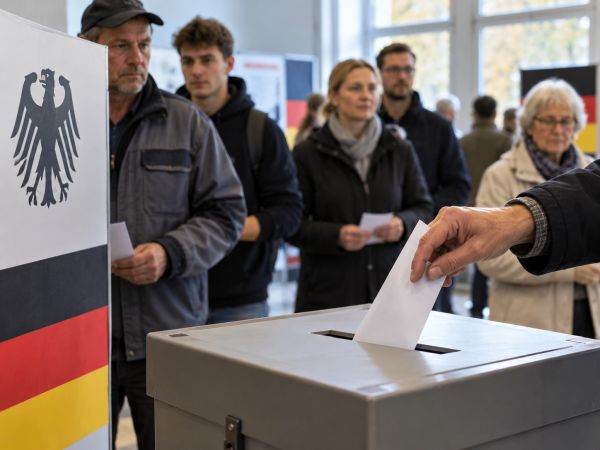
The victory of 43.8% obtained on Sunday by the Alternative for Germany (AfD) in the state of Saxony-Anhalt, which represents less than 3% of the German electorate, cannot be transformed into a verdict for the entire country, but neither can it be treated as an East German accident. The AfD doubled its score, won the elections in all 218 localities of the state and became the dominant party among workers and many categories of young and middle-aged voters. In practice, Germany woke up after the elections in Saxony-Anhalt to a reality that its political class had long tried to keep behind a "protective wall": the AfD categorically won the regional elections, with double the votes obtained in 2021 and came within three mandates of an absolute majority.
The CDU, the party of Chancellor Friedrich Merz, which had led the state since 2002, collapsed from 37.1% to 17.2%. The AfD won 39 of the 83 seats, the CDU only 15, and the SPD, the Greens and Die Linke eight each. The Sahra Wagenknecht - BSW - alliance entered the regional parliament with five seats, while the FDP was eliminated after falling to 2.6%.
This was after an election in which voter turnout reached around 77.8%, compared to 60.3% in 2021. So the victory cannot be explained by absenteeism, the mobilization of a radical minority or the resignation of opponents. On the contrary, society mobilized massively, and this mobilization primarily benefited the AfD.
Saxony-Anhalt has 2,120,252 inhabitants and around 1.7 million voters. Its electorate represents around 2.9% of the approximately 59.2 million Germans eligible to vote. Around 1.32 million people took part in the regional elections, and the AfD received around 580,000 votes. This represents around 1% of the entire German electorate. Therefore, 43.8% in Saxony-Anhalt does not mean that 43.8% of Germany has switched to the AfD, but the fact that the state only represents 2.9% of the electorate does not make the result irrelevant. Infratest dimap data shows that 55% of AfD voters in last Sunday's election say they voted for the party out of conviction and only 35% say they voted out of disappointment. This means that the AfD's electoral core is no longer temporary and that the protest vote is starting to turn into a political identity.
• AfD, with support across all social strata
The AfD won 51% of the votes of men present at the polls and around 40% of the votes of women; it reached 58% among men aged 35 to 44 and 57% among those aged 45 to 59. It received the votes of 61% of workers, 52% of the self-employed and 46% of employees. Even among young voters, the AfD won around 42% of the votes.
These figures contradict the reassuring image of a party supported only by nostalgic pensioners, isolated extremists or residents left behind after German reunification. The AfD is penetrating precisely the categories that work, pay taxes, use social media intensively and will determine the election results for the next 20 years.
Ulrich Siegmund, the regional leader of the AfD, immediately understood the significance of the moment. "We have made history,” he said, claiming that voters had sent a signal that "could hardly be clearer.” In front of his supporters, the message became even stronger: "We are taking our country back. It starts in Saxony-Anhalt.” Siegmund called Friedrich Merz "a very good election agent” for the AfD, after the German chancellor had promised to reduce the AfD by moving the CDU to the right, through a tougher speech on immigration and by distancing himself from the Angela Merkel era. The strategy not only did not work, but it seems to have validated his opponent's agenda.
• Sunday's result, the effect of bad policies in Berlin
According to data cited by the German press, 88% of respondents in Saxony-Anhalt believe that the AfD would not have become so strong if the federal government had made better policies. Even 86% of CDU voters share this opinion. In another poll, 86 percent of those who left the CDU said the Berlin government had promised too much and delivered too little. In essence, in last Sunday's election, voters voted against Berlin, against the chancellor, and against a system perceived as incapable of controlling immigration, reviving the economy, protecting industry, and providing a future for declining regions. German media reports that Saxony-Anhalt is one of Germany's poorest and oldest states. At the end of 2025, it had more than 15,000 fewer inhabitants than a year earlier. Demographic decline, the exodus of young people, low wages, and the feeling that decisions are made by distant elites have created fertile ground for AfD propaganda. The paradox is that some of the party's policies - limiting immigration, straining relations with the European Union and discouraging foreign investors - could hit regions that rely on foreign capital and additional labor.
But economic warnings are no longer enough. Chancellor Merz told voters that investors could withdraw if the AfD comes to power. The message did not prevent the party from winning. For many voters, such warnings no longer sound like an explanation, but like a threat from a system that demands they keep the current order for fear that the alternative will be worse.
• European trend favoring populists
What is happening in Germany is part of a European trend fueled by economic stagnation, immigration, distrust and the feeling that the old parties no longer represent society. The trend may continue, but it is not irreversible. Bans, health cordons and moral warnings are not enough to stop it: traditional parties must once again become capable of governing and producing visible results.
According to PopuList research, over 23% of European voters supported far-right parties in the most recent national elections, compared to around 10% a decade ago and around 5% in the mid-1990s. Almost 30% vote for parties defined as anti-establishment.
In France, Marine Le Pen's Rassemblement Nationale - the political party of Marine Le Pen - has become the main electoral force of the right. In Austria, the FPO won the 2024 parliamentary elections. In Portugal, Chega has passed the 20% threshold and entered the center of political life. Giorgia Meloni leads Italy, and nationalist, sovereignist or radical parties influence the government in Slovakia, Finland, the Czech Republic, Belgium and other states. In Romania, AUR and the other sovereignist parties have shown that they can seriously challenge the old parties.
Moreover, in the 2024 European elections, groups to the right of the European People's Party came to control together about a quarter of the seats in the European Parliament. They did not conquer the institutions of the Union, but they shifted the agenda of the European Commission to the right, especially on immigration, border security, climate policies and national sovereignty.
Therefore, we are dealing with a trend. But not with a uniform and inevitable march towards populist dominance, because the parties united under this label are very different. Some are Atlanticist, others favorable to Russia, others defend budgetary discipline, and some political parties promise protectionism, subsidies and a welfare state reserved for their own citizens. Some of the populist parties want to reform the European Union, others are thinking about dismantling it. The differences between AfD, Brothers of Italy, RN, Fidesz, FPO, Chega or AUR may become important once these parties have to govern, not just protest.
• How the current trend can be changed
The lesson from last Sunday's elections is that isolation can prevent a party from holding office, but it cannot eliminate the reasons why people vote for it. If the traditional parties build ever wider and more incoherent coalitions just to block the radical right, it remains the only visible opposition. All the grievances accumulate in its account, while all the compromises, failures and crises are settled by the parties in power. The populist trend can be stopped or reversed, but not by simply repeating the accusation of extremism. Germany has solid institutions, a strong civil society and constitutional instruments capable of limiting abuses. These are necessary for the defense of democracy, but they cannot replace politics.
The first condition for changing or reversing the current trend is economic recovery. People who fear losing their jobs, that industry is moving to another country and that their standard of living will fall are becoming receptive to radical solutions. Germany must respond to the crisis in industry, energy prices, bureaucracy and the gap between East and West with investments and measurable results, not just promises.
The second condition is to regain control over immigration. Democratic parties must not adopt xenophobic discourse, but also not deny the problems of integration, crime, schools, housing and the pressure on public services. Denying a reality that voters perceive every day leaves the subject in the hands of the AfD.
The third condition is to restore public services. For the citizen, the state is not a constitutional theory, but the train that is late, the doctor that cannot be found, the school without teachers, the administration that does not respond and the housing that cannot be afforded. When the state no longer functions, the promise of a radical break becomes attractive.
The next condition is the return of traditional parties to social representation. AfD dominates among the labours, because the left and center have lost touch with part of the working world. Voters who feel culturally, economically, and territorially ignored cannot be brought back by contempt, labels, or moral lessons.
Then there is the need for credible leaders. Friedrich Merz tried to combat the AfD by taking over some of its vocabulary, but without demonstrating that he can produce the change he promised. The result in Saxony-Anhalt shows that radicalizing discourse without administrative efficiency can strengthen the very extreme it is trying to weaken.
Finally, access to government may represent both the peak and the beginning of the populists' decline. It is easier to promise mass deportations, cheap energy, social protection, lower taxes, a break with Brussels, and a repair of relations with Russia than to achieve all of these goals simultaneously. Governing exposes contradictions, lack of personnel, internal conflicts, and the gap between slogan and administration.
But this erosion does not happen automatically. Giorgia Meloni has shown that a party from the radical right can adapt institutionally, occupy the center of the system and maintain its support. Relying solely on the idea that populists will compromise themselves is a dangerous strategy. Populism advances not only because it manipulates, but also because it exploits real problems that its opponents have mismanaged, minimized or refused to name. Therefore, the decisive barrier will not be raised by intelligence services, bans or coalitions of all against one, but will be removed by functional governments, real control at the borders of the European Union and, not only that, by rebuilding citizens' trust in state institutions. Otherwise, what happened on Sunday in Saxony-Anhalt will become a preview of a Germany and a Europe in which the revolt no longer knocks on the door of power, but begins to enter.

























 Euro
Euro Dolar SUA
 Franc elveţian
 Liră sterlină
 Gram de aur





























