English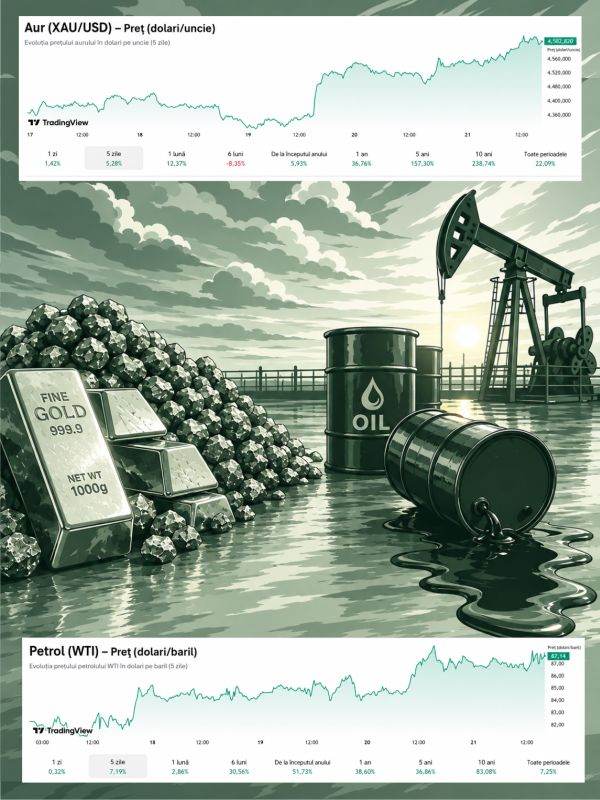
The price of gold ended a week on Friday with a significant upward course, this being the third consecutive week of growth for the yellow metal. On August 20, the gold futures quote closed the US trading session (Comex) at over 4,500 dollars/ounce, and on Friday morning it had exceeded 4,650 dollars per ounce, which means an increase of over 5% in the last week. The main factors that generated this dynamic are the weaker dollar, which favored investments in gold (safe-haven asset); the decrease in US bond yields at certain times of the week; geopolitical uncertainty; concerns about the US government's debt and finances, and expectations regarding the Fed's monetary policy.
According to Barron's, one thing to note was that gold continued to rise between August 17 and 21, even with higher nominal yields, suggesting that the market is starting to value fiscal and geopolitical risk more than the traditional "higher yields = weaker gold” relationship.
According to tradingview.com, gold has gained about 12% in the past month, and almost 7% since the beginning of the year. The advance in the last 12 months is more than 36% (data from Friday, 3:45 p.m. local time).
In turn, oil ended the week on the rise, but the reason is different. The price of West Texas Intermediate (WTI) crude oil for delivery in October exceeded $87 per barrel on Friday morning on the Nymex New York, and that of Brent crude oil for delivery in October exceeded $94/barrel in the afternoon. Brent crude oil prices approached $95/barrel last week, the highest level in the past month, before a slight correction and then the price rose again. Last week, oil prices rose by more than 6%, according to tradingview.com (Friday, 3:45 p.m. local time), in the past month - by more than 2%, and since the beginning of the year - by 51%. In the past 12 months, the advance was about 38%.
The dominant factor in this increase is supply risk: tensions in the Middle East, generated by the US-Iran conflict, continue to pose a major risk to shipping through the Strait of Hormuz, so oil supplies are uncertain.
"With little sign of diplomatic progress in the conflict, the oil market is once again taking the brunt of the diplomatic failure,” Janiv Shah, vice president of oil markets research at Rystad Energy, told CNBC on Friday.
• Fiscal anxiety fuels gold market
An unusual market dynamic is unfolding as gold prices rise in line with the advance of long-term US interest rates. Usually, higher interest rates reduce the attractiveness of gold, but this time markets interpret their rise as a signal of fiscal difficulties rather than economic strength, positioning gold as an alternative to the dollar, according to finance.biggo.com. Although the yield on 30-year US Treasury bonds exceeded 5.3%, reaching its highest level since 2007, gold maintained its rise.
In a recent report, Yuanta Securities noted that "what determines the direction of gold is not the level of interest rates, but the reason for them to rise.”
Of particular note is that long-term yields are rising simultaneously in major economies, including Japan, Germany and France, not just the United States. Markets are interpreting this as concerns about global fiscal burdens rather than an economic recovery. The fact that the dollar is weakening even as U.S. interest rates are rising also marks a departure from previous cycles of rate hikes, according to Yuanta Securities.
• Morgan Stanley: $5,000 an ounce of gold by 2027
Investment bank Morgan Stanley has estimated that after the price of gold breaks through $4,450 an ounce, it could surpass $5,000 by 2027 or sooner. The bank said demand for gold ETFs is growing amid lower expectations of interest rate hikes by the Federal Reserve and a weaker dollar, while central bank purchases and physical demand continue to support prices. Morgan Stanley interpreted gold's rise, despite high long-term interest rates, as a signal that investors are increasingly focused on expanding government debt and currency devaluation risks. Given the rapid rise in gold prices, some voices are signaling the potential for a short-term correction. Ilya Spivak, head of the Global Macro division at Tastylive, said that after such a significant increase, some decline could occur if market volatility intensifies. However, he added that once the $4,400-$4,500 per ounce range is exceeded, if gold prices stabilize above this level, the upward momentum could continue.
• OPEC+ continues to increase oil production
Seven OPEC+ (Organization of the Petroleum Exporting Countries and allies) members decided this month to increase production quotas by 188,000 barrels per day (bpd) in September compared to August levels, Bloomberg reports. The decision was announced after an online OPEC+ meeting attended by Saudi Arabia, Russia, Iraq, Kuwait, Kazakhstan, Algeria and Oman, in which global market conditions and prospects were analyzed.
In OPEC+'s collective commitment to support the oil market, the seven assure that they will flexibly adjust their oil production taking into account market developments. The next meeting is scheduled for September 6, Agerpres notes.
OPEC+ agreed to resume the production increase from April, but the closure of the Strait of Hormuz made it impossible to increase production to the established quotas. In June, OPEC+ averaged 36.28 million bpd of crude oil production, up 3 million bpd from May. The May figures include the United Arab Emirates (UAE), which left OPEC and OPEC+ on May 1.
• IEA member states hold large oil stocks
Member states of the International Energy Agency (IEA) still hold substantial oil reserves despite the largest coordinated release of crude from strategic reserves, the IEA said in July, according to Reuters.
The agency said member states have released about 290 million barrels of oil since the operation announced on March 11, and together they hold more than 1 million barrels of oil in reserve stocks.
In mid-March, the IEA decided to release about 400 million barrels of oil from its reserves to cushion the price rise triggered by the Middle East war. This was the sixth release of oil from strategic reserves and, at the same time, the largest in the institution's history.
"We estimate that Gulf exports are below the high level of the middle of last month, but significantly higher than in March,” said Fatih Birol, the director of the International Energy Agency, at the time.
On the demand side, top consumer China recorded a 43.1% decline in crude imports in June, to the lowest level in almost a decade.
Fatih Birol warned that the global economy would face a new challenge if the conflict that has blocked the Strait of Hormuz is not resolved within a few weeks. In July, he said: "Markets are nervous and facing great uncertainty due to the escalation of attacks from both sides, which threaten to disrupt the transport of oil, fertilizer, natural gas and other goods through this key waterway. If the Strait of Hormuz remains closed, we may once again face some difficulties for economies around the world, including those in the region, developing nations and Asia. We are not talking about months, but weeks, after which the strait must be fully open, unconditionally open.”
























 Euro
Euro Dolar SUA
 Franc elveţian
 Liră sterlină
 Gram de aur