English

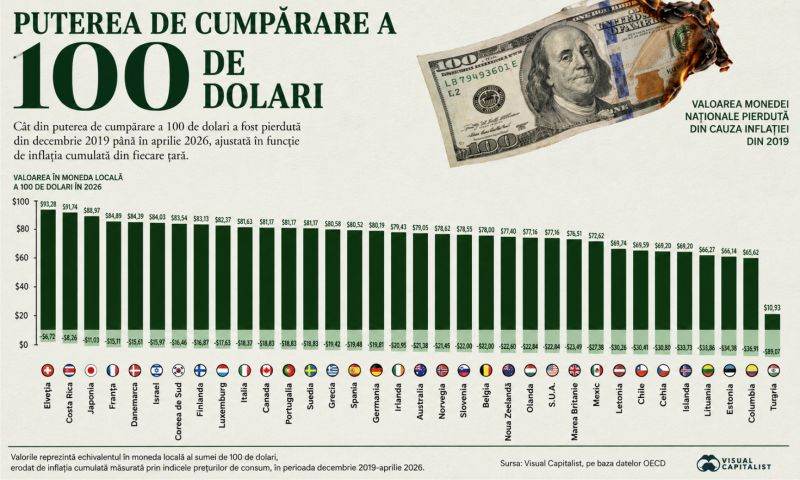
A $100 budget doesn't cover nearly as much as it did before the pandemic.
Visualcapitalist.com compares the impact of inflation in 35 countries, based on OECD data, with figures showing how much value $100 has lost from 2019 to 2026.
• Countries where $100 has held its value best
Eight countries in the ranking lost less than 17% of their purchasing power from the end of 2019 to this year. These include Switzerland (losing just $6.72 per $100), Costa Rica (-$8.26), Japan (-$11.03), France (-$15.11), Denmark (-$15.61), Israel (-$15.97), South Korea (-$16.46), and Finland (-$16.87).
Purchasing power fell by 23% in the United States and by more than 30% in nine countries, including Latvia, Chile, Lithuania, Estonia, Colombia and Hungary.
Consumer prices in Turkey rose by more than 814% from December 2019 to April 2026, making $100 in 2019 worth less than $11 today in purchasing power.
• What a 23% drop in purchasing power means for Americans
For Americans, this decline explains why the cost of living remains high even as inflation has moderated. Wage increases have offset some of the impact, but slower inflation is not reversing past price increases, according to the cited source.
Energy and housing costs highlight how inflation has been fueled. Since December 2019, electricity prices in the US have risen by about 45%, while rents have increased by 32%. According to national indices, a $100 electricity bill in 2019 now costs about $145, while a monthly rent of $1,500 is currently about $1,980.
• US dollar under pressure
The US dollar is facing increasing risks of depreciation, as the deterioration of the US budget situation, weaker economic data and uncertainties about Federal Reserve (Fed) policy are starting to reduce the currency's attractiveness, strategists warned quoted by CNBC, according to news.ro.
Even rising US bond yields, which traditionally support the dollar, may no longer have the same effect if investors interpret it as a sign of fiscal risk and persistent inflation.
High U.S. Treasury yields have helped support the dollar in 2026 as they have drawn capital into U.S.-denominated assets. The dollar index, which tracks the greenback against a basket of six major currencies, has risen 1.15 percent this year to hit a 52-week high of 101.80 on June 24. On Wednesday, however, the index was hovering around 99.4.
Charu Chanana, chief investment strategist at Saxo, cautions that investors need to look at why U.S. bond yields are rising. If they are rising because of a strong economy or in anticipation of tighter monetary policy, the dollar could benefit. But if yields are rising because of a budget deficit, a growing government borrowing requirement or a higher risk premium, the effect on the dollar may be much weaker. This difference could explain why the recent rise in U.S. Treasury yields has not been accompanied by an equally strong dollar appreciation. The yield on the U.S. 30-year bond hit its highest level since 2007 this week. Another pressure factor is a slowdown in some U.S. economic indicators. Weaker data on consumption, inflation and the labor market have prompted investors to revise their estimates of interest rates and reduce bets on the appreciation of the dollar, according to Societe Generale.
Kit Juckes, chief currency strategist at Societe Generale, believes that the fundamental arguments for maintaining favorable positions in the dollar have diminished.
Under these conditions, the dollar index could continue to decline or could evolve in a range of about 95-100 points until the end of the year.
At the same time, Deutsche Bank identifies as a negative factor the lack of clarity on how the Federal Reserve will react to the evolution of inflation. George Saravelos, global head of currency research at Deutsche Bank, believes that the mixed signals sent by Fed Chairman Kevin Warsh regarding the inflation target and monetary policy instruments are ultimately unfavorable for the dollar.
In addition, interventions to support the yen and a possible wider use of the Fed's FIMA facility could put additional pressure on the US currency. Through this facility, certain foreign central banks can temporarily obtain dollars in exchange for US government securities deposited as collateral. Saravelos believes that a sharp expansion of this facility would have an economic effect similar to an indirect form of monetary easing and would be another negative factor for the dollar.
• Falling stock markets do not necessarily mean a weaker dollar
A possible sharp correction in US stock markets would not automatically lead to a depreciation of the dollar.
Data analyzed by BBH show that foreign investors bought US stocks worth about $920 billion in the 12 months ended in June, more than three times more than the purchases of US government securities, $294 billion.
Elias Haddad, a strategist at BBH, believes that in the event of a sharp decline in the stock market, foreign investors may not simply withdraw capital from the US, but move it to US bonds, which are considered safe-haven assets.
Therefore, the dollar retains some of its defensive appeal, but the combination of high fiscal deficits, slowing economic indicators and uncertainty about Fed policy creates increasing risks to its evolution.























 Euro
Euro Dolar SUA
 Franc elveţian
 Liră sterlină
 Gram de aur