English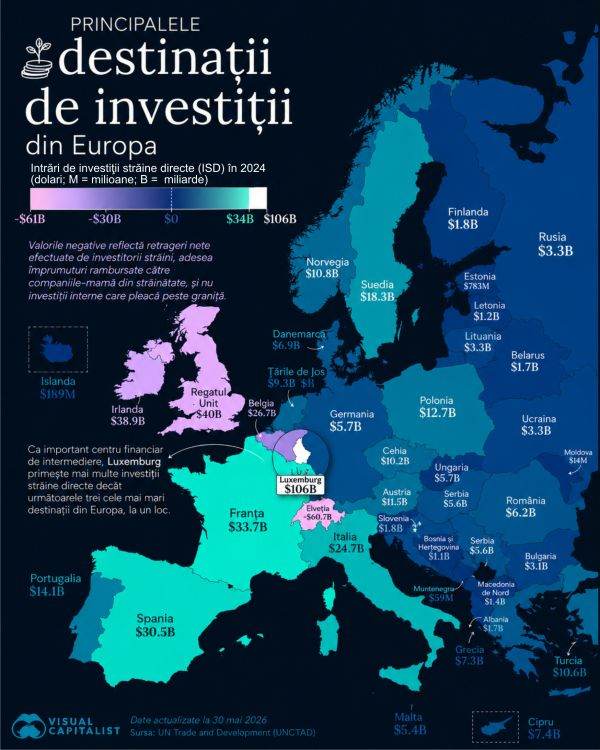
A country with just 700,000 inhabitants attracted more foreign direct investment (FDI) than any other nation in Europe in 2024, reports visualcapitalist.com, which presents FDI inflows on the continent, using data from the World Investment Report, 2025 edition, published by the UN Department for Trade and Development.
These FDI inflows measure the direct investment positions of foreign companies in local enterprises and subsidiaries, including equity investments, reinvested earnings and intra-company loans.
• Luxembourg - a favorite for tax relief
Luxembourg attracted nearly $106 billion in foreign direct investment in 2024, more than France ($33.74 billion), Spain ($30.54 billion) and Italy ($24.73 billion) combined, according to the cited source. Despite its small population, the country ranked by a wide margin as Europe's largest destination for FDI.
Luxembourg serves as one of the world's largest financial conduits. Companies often direct capital through the country to reduce tax burdens in larger markets, which can significantly inflate FDI flows relative to the size of the domestic economy.
Luxembourg is not the only European country associated with international tax planning. However, many other financial centers recorded negative FDI inflows in 2024.
Switzerland recorded FDI inflows of -$60.7 billion, while Ireland recorded -$38.9 billion. Both countries are also commonly used by multinational companies for tax and corporate structuring purposes.
On the positive side, however, the 5th-10th places in the ranking of countries that attracted significant FDI in 2024 are as follows: Sweden ($18.29 billion), Portugal ($14.06 billion), Poland ($12.74 billion), Austria ($11.53 billion), Norway ($10.76 billion), Turkey ($10.59 billion).
• London and negative inflows
Ireland and Switzerland account for half of the European countries with negative FDI inflows. The other two are Belgium ($-26.7 billion) and the United Kingdom ($-40 billion), the latter being particularly important due to the presence of London, a global financial center.
Negative FDI inflows can occur when foreign-owned firms reduce their investment positions in a country. This can happen through capital withdrawals, divestments, or repayments of intra-company loans.
For example, Ireland hosts local subsidiaries of many US multinationals in the technology and finance sectors. If one of the subsidiaries were to repay a loan to its US parent company, this would contribute to a decrease in FDI flows to Ireland.
• FDI in major European economies
In addition to the United Kingdom, most major European economies also serve as significant host countries for international investment. France, Spain, and Italy have attracted significant amounts, as mentioned above. In contrast, in a surprising situation in the data presented is Germany. Despite being Europe's largest economy, it attracted just $5.7 billion in FDI in 2024, ranking 18th, behind much smaller countries including Poland, Portugal and Sweden.
Part of the explanation for this dynamic is that multinational firms often structure investments through intermediary jurisdictions such as Luxembourg. As a result, some investments linked to larger economies may appear for the first time in the FDI statistics of smaller financial centres.
Germany's relatively high corporate regulations and taxation may also affect official foreign direct investment flows, explaining why Europe's largest economy ranks so far below other smaller markets.
• European Commission: FDI screening continues to protect EU security and public order
The European Commission published its fifth annual report on the screening of foreign direct investment (FDI) in the EU last autumn. The report shows that the number of notifications to the EU cooperation mechanism has increased by 15% since 2021, a year after the entry into force of the corresponding regulation. In 2024, EU member states notified 477 investments, triggering questions from other member states in about 10% of cases, notes Agerpres. Of the 477 notified cases, the majority (92%) were closed within two weeks.
The remaining 8% were subject to an in-depth security risk assessment.
Around half of these in-depth assessments were related to production, often triggered by concerns about potential technology or knowledge leakage, as well as security of supply issues. As in the previous year, the Commission issued opinions in less than 2% of cases. The report shows that by the end of 2024, 24 EU Member States had national legislation on FDI screening in place.
In January 2024, the Commission presented a legislative proposal to further strengthen the current EU framework for FDI screening. If agreed by the co-legislators, the revised regulation will require all EU Member States to establish and maintain a national FDI screening mechanism and introduce a minimum level of harmonisation across the EU.


























 Euro
Euro Dolar SUA
 Franc elveţian
 Liră sterlină
 Gram de aur