English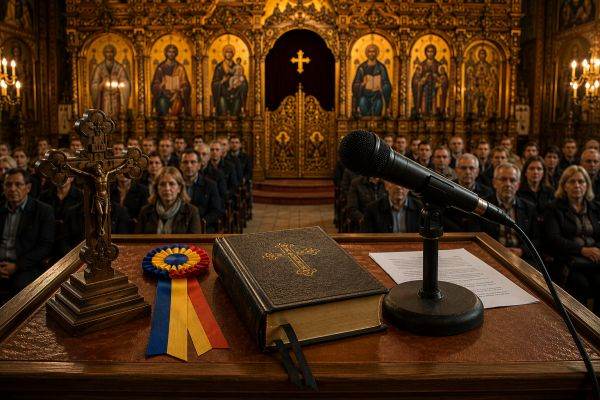
Silence prolonged enough becomes a form of complicity. The silence of the leadership of the Romanian Orthodox Church after the recent conference held by Dan Puric at the Romanian Orthodox Church Center in Munich belongs to the second category. Not because every uninspired phrase uttered in a place of worship should be followed by a patriarchal communique, but because, in this case, we are not talking about a simple eccentric opinion or a metaphor accidentally getting out of hand. We are talking about the transformation of a church space into a tribune of political, anti-Western and ultra-nationalist propaganda, about the use of faith to legitimize an ideology and about the proclamation of an alleged ethnic superiority under the benevolent gaze of a vicar bishop.
Dan Puric was invited by the Romanian Orthodox Church Center in Munich, a structure under the authority of the Romanian Orthodox Metropolis of Germany, Central and Northern Europe, to support the conference "Where to, Romanian People?”. It was not his first appearance in this framework. Vicar Bishop Sofian Braşoveanul introduced him with praise, stating that he is "a lover of the Romanian people, a connoisseur of the depths of the Romanian soul”, who "loves the Romanian people, the spirituality of the Romanian people” and is "a very, very suitable man to speak to us”.
What followed, however, was less a conference about faith and more a political spectacle built of national victimization, historical forgeries, dubiously attributed quotes, hostility towards the West, attacks against the authorities and ethnic exaltation. Everything wrapped in references to Christ, saints, the Cross, soul and salvation, as if the simple utterance of religious words could transform propaganda into sermon and resentment into Christian virtue.
Puric began his intervention in a register that says almost everything about the public character he plays: "It's fantastic! Romania is following me”. Not the humility of the Christian before the community, but the triumphant entry of the prophet who considers himself followed by the destiny of the nation. Romania does not just concern him, it does not disturb him and does not demand responsibility from him; Romania "follows him”. He is the chosen one, the interpreter, the man through whom the people would hear their own voice.
In this self-assumed role of national guru, Dan Puric spoke about the existence of a "soul substance of this people” and about a "holy Romanian freedom”. Freedom is no longer a universal right, guaranteed to every person, but receives a certificate of Romanian origin and a religious halo. The people are elevated above their own history, exempt from self-criticism and presented as permanent victims of foreign powers that attack their identity. It is the favorite mechanism of nationalist propaganda: you tell the public that they are exceptional, you explain to them that the world is conspiring against them and then you present yourself as the only man capable of restoring their lost dignity.
• Germany, ridiculed in an Orthodox church in Munich
"If you want to destroy a people, cut off their roots, destroy their self-confidence and cut off their connection with heaven”, proclaimed Dan Puric, attributing the phrase to Sun Tzu. However, the quote cannot be identified in "The Art of War” and circulates in the public space mainly as an apocryphal formula. For Puric, verification of the source is secondary. What is important is the sonority. The quote must confirm the existence of a conspiracy against Romanians, and Sun Tzu's name lends it an authority that the demonstration does not have.
The same technique appears when Dan Puric talks about cultural memory: "There is a holy compass that you must have. They are removing Eminescu, Goga, and Brâncoveni from textbooks, so that the Romanian people will no longer have any landmarks.” Who are "them”? From which school curriculum were Eminescu or the Brâncoveni removed? What is the institutional decision and who adopted it? We do not find out. "Them” represents the faceless opponent of propaganda, the enemy vague enough to encompass the Government, the European Union, intellectuals, teachers, the press, or anyone who rejects the speaker's mythology.
The Munich conference took place in Germany itself, in a country where many Romanians found the living conditions, freedoms, and opportunities that communist Romania could not offer its own citizens. Nevertheless, Dan Puric used the space of a Romanian church to ridicule German authority and Western society. Through an anecdote about prisons, he suggested that the Romanian prison would resemble "Iocan's Glade” compared to prisons in Germany or France, where authority would no longer have a "soul.”
In the world Puric constructs, the Western institution is efficient but soulless, while Romanian disorder becomes authentic humanity. The law applied is cold; native improvisation is warm. The rule is suspect; arbitrariness becomes humanity. It is one of the most convenient forms of national self-deception: transforming one's own weaknesses into virtues and the successes of others into symptoms of decadence.
"The Romanian language has untranslatable words. You cannot translate pity, longing, grief. I heard a prayer in German, it was beautiful. When I heard it in Romanian, I took wings," said Dan Puric. Any person can have a deep connection with their native language, and the emotion produced by a prayer heard in their own language is natural. But from here to the insinuation of a spiritual superiority of the Romanian language is a step that Puric takes deliberately. "Pity" can be translated, "jale" can be translated, and the experience expressed by "longing" has approximate equivalents in other languages, just as German has "Sehnsucht", Portuguese "saudade", and other cultures have their own words that are difficult to perfectly equate. The difficult nature of a term to translate is not proof that the people who use it possess a superior soul.
• "The superior race of the Romanian” - an expression reminiscent of Adolf Hitler
From this factory of linguistic and spiritual exceptionalism, one inevitably arrives at the most serious statement: "The superior race of the Romanian. The superior gene of the Romanian”. Regardless of the rhetorical context invoked, such expressions are not innocent and cannot be subsequently washed away by explanations about metaphor, poetry or love of country. Europe knows all too well the path of theories about superior races, genes and peoples, especially in the wake of the Second World War triggered by Adolf Hitler. They do not become acceptable if they are uttered theatrically, if they are wrapped in the tricolor or if they echo within the walls of a church. On the contrary, the place amplifies their gravity.
Christianity does not proclaim the existence of a superior gene and does not distribute certificates of sainthood based on ethnic criteria. The Romanian is no more valuable in the eyes of God than the German, the Ukrainian, the Jew, the Hungarian or the Russian. If the pulpit ends up legitimizing the superiority of a nation, the Gospel is pushed into the background, and faith is replaced by ethnic idolatry. The nation ceases to be a historical community and becomes an object of worship.
Dan Puric went so far as to proclaim that "the Romanian is an uncompromising saint”. It is a formula that dissolves individual responsibility and falsifies the very meaning of holiness. No one is holy by birth, by passport or by ethnic affiliation. Holiness is not written in the genome and is not administratively transmitted with the citizenship certificate. It cannot be confiscated by a nation and transformed into an electoral argument.
At another point in the conference, Dan Puric asked: "What is the right of the Romanian people now, today?”, after a confused foray into the history of Dacia and Roman law: "When the Roman Empire came, it conquered a quarter of Dacia. The rest retreated to enclaves. Now inhabited by free Dacians. They talk about Roman law. The great scholar Nicolae Paulescu talks about how terrible the Roman law that these people inherit can be.”
Beyond the historical inconsistencies, the evocation of Nicolae Paulescu as a moral authority cannot ignore his virulent anti-Semitism. Paulescu's scientific contributions can be discussed and evaluated separately, but his transformation into a landmark of national rebirth without mentioning the ideology he propagated is a convenient mutilation of history. Especially in a speech that reaches, a few dozen minutes later, to the "superior race” and the "superior Romanian gene.”
One of Dan Puric's statements at that conference encapsulates the hostility towards critical thinking: "Philosophers and intellectuals produce indigenous viruses.” It is a formula that should send shivers down a spine in a society that has known violent slogans against intellectuals and the purge of elites. The intellectual is transformed into a pathogen, and the idea that Dan Puric disagrees with becomes a "virus.” From that moment on, debate is no longer necessary. The virus is not fought through argument, but isolated and eliminated. In another sequence, Puric compared the European Union to a "bra” hanging from a fence post and waving in the wind. We do not have here an articulated critique of European institutions, bureaucracy, the democratic deficit, or economic policies. We have mockery. The European Union, the organization of which Romania is a member and which has contributed decisively to the modernization of infrastructure, economic development and the guarantee of freedom of movement, is reduced to a vulgar image intended to arouse laughter in the hall. Also in the church in Munich, Dan Puric attacked Ilie Bolojan and insulted those who do not share his opinions, calling them, according to the excerpts reproduced from the conference, "goats", "scumbags", "suffocated" and "worms". This is how the Christian love preached by the one who speaks of "forgiveness, mercy and love" looks: the opponent becomes an animal, a parasite or a being lower class. The dehumanization is then covered with a new reference to Christ, the cross or the Romanian soul.
• "Christian”, recruited by the Securitate
Behind this spectacle of national purity lies the biographical episode that Dan Puric and his admirers cannot erase with rhetoric about dignity and resistance. CNSAS documents show that, in March 1976, when he was 17 years old and a student at the "Nicolae Tonitza” High School of Fine Arts, Dan Puric was recruited by the Securitate for the informative surveillance of his colleagues. He signed a commitment and received the secret name "Christian”.
The legal truth must be presented in full: CNSAS established that Dan Puric cannot be attributed the quality of a collaborator of the Securitate within the meaning of the law, because no informative notes written by him were identified, nor any information transmitted that would meet all the legal criteria. There was recruitment, there was commitment and there was the conspiratorial name "Cristian”, but there is no CNSAS verdict declaring him a collaborator in the legal sense.
However, the legal distinction does not cancel the moral contradiction. The man who today speaks with prophetic gravity about betrayal, the Romanian soul and resistance to the system accepted, as a teenager, recruitment by the communist repressive apparatus. The fact that the file does not contain the notes necessary for legal classification as a collaborator must be respected, but it must be remembered just as rigorously that recruitment and commitment are documented. "Cristian” is not an invention of Dan Puric's opponents, but the conspiratorial name inscribed in the archives of the institution that he evokes when he speaks about the suffering of Romanians under communism.
• Who are the nationalists in BOR?
Dan Puric has the right to speak, to publish his theories and to support any political option permitted by law. The problem is not his freedom of expression. The problem is who gives him the space, who gives him legitimacy and who presents him to the faithful as an interpreter of the Romanian soul. A conference organized in a church center, hosted by a bishop and promoted through the channels of a BOR structure no longer represents exclusively the ideological adventure of an actor. It becomes a problem of institutional responsibility.
Bishop Sofian of Braşov was not a spectator who accidentally entered the hall. He invited him, introduced him laudatoryly and stayed with him during the conference. Metropolitan Serafim Joantă heads the church structure in which the Munich Center operates. The Romanian Patriarchate represents the central authority of the Romanian Orthodox Church. Each level of this hierarchy has the possibility and moral obligation to explain whether the expressions "superior race of the Romanian” and "superior Romanian gene”, political attacks, insults and anti-Western propaganda are compatible with the pastoral mission of the BOR.
Until the writing of this article, no clear demarcation of the leadership of the Metropolia or the Patriarchate from the controversial messages delivered in Munich was identified on the official public channels consulted. The silence is all the more difficult to justify since the Holy Synod established its own rules. The BOR officially states that it does not recommend supporting any party or political ideology and prohibits clergy from partisan politics and participating in electoral campaigns as supporters.
Dan Puric is not a clergyman, but the organizers and church sponsors of the conference are. The rules cannot be circumvented by inviting a layman to say from the microphone what a priest is forbidden to say directly. Political neutrality does not exist if the pulpit is outsourced to a lecturer. The Church cannot declare itself non-partisan in press releases, only to then provide space, prestige and an audience for speeches that attack political leaders, ridicule the European Union, minimize NATO and recycle the themes of radical sovereignist currents.
The BOR leadership does not have to answer for every word spoken by Dan Puric throughout his career. However, it must answer for what is legitimized in the institutions under its authority. Who approved the conference? Does the Metropolitanate consider that the discourse about a "superior gene” is compatible with Christian teaching? Is it acceptable for a guest to attack the Romanian Government, the European Union and NATO in a church center? Is it permissible for people who do not share his views to be called "goats” and "worms” in a place of worship? Where does the cultural conference end and where does political propaganda begin?
These questions are not an attack on faith or an offensive against the Church. On the contrary, they defend the right of believers not to have their church turned into a propaganda headquarters. Romanians in the diaspora come to church for prayer, communion and spiritual support, not to be taught to despise the societies that welcomed them, to be constantly suspicious the West and confuse patriotism with ethnic superiority.
Dan Puric had the microphone. Bishop Sofian Braşoveanul offered him the stage and the endorsement. The Metropolis and the Patriarchate now have the obligation to provide explanations. In their absence, silence can no longer be presented as pastoral balance. It becomes a message. And the message is that, in certain churches of the BOR, political propaganda, anti-Western hostility, insults and discourse about ethnic superiority can pass as a defense of faith, as long as they are delivered theatrically, amidst crosses, icons and applause.





















 Euro
Euro Dolar SUA
 Franc elveţian
 Liră sterlină
 Gram de aur