English

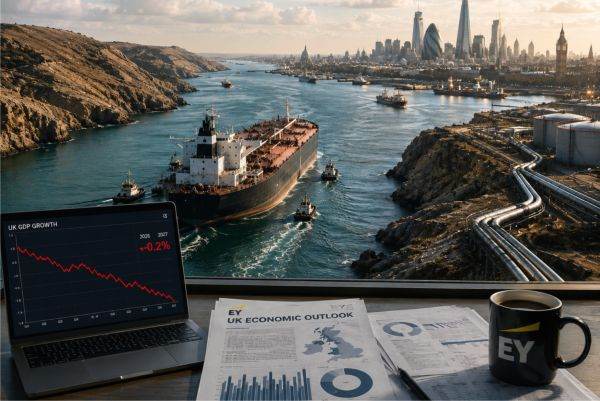
The UK economy could contract in 2027 if the Strait of Hormuz is not reopened to shipping by the middle of next year, warn EY economists, according to a recent report published yesterday by The Independent, The Guardian and the BBC.
In the worst-case scenario, in which the conflict in the Middle East continues and the sea route remains blocked until early or mid-2027, the UK's gross domestic product would grow by just 0.5% in 2026 and fall by 0.2% next year. Inflation could rise to 6.4% by the end of this year, amid rising oil, gas and electricity prices.
"If the Strait of Hormuz reopens in the coming months, we expect the UK to avoid a more pronounced slowdown, but a prolonged closure until 2027 would fuel inflation and could push the economy into contraction next year,” Peter Arnold, EY's chief economist for the UK, told the sources cited.
The Strait of Hormuz is one of the strategic arteries of global energy trade, with around a fifth of global oil and gas being transported through this area under normal conditions. Blocking it for a long period would keep energy prices at high levels, with direct effects on business costs, household bills, consumption and investment.
EY's base case scenario, however, assumes the Strait will reopen by the end of the third quarter of 2026. Under these conditions, the firm estimates that the British economy will grow by 0.9% this year, compared with a previous forecast of 0.8%, and by 1.2% in 2027. Inflation is expected to peak at around 3.5% this year, well below the projected level if the lockdown is extended.
The outlook for business investment has already deteriorated. EY expects a 0.7% decline in 2026, after a previous forecast indicated stagnation. Household consumption is expected to grow by just 0.3% this year and 0.9% in 2027, constrained by high prices and the postponement of interest rate cuts.
EY economists expect the Bank of England to keep its benchmark interest rate at 3.75% until the end of 2026 and to make two cuts, in April and July 2027, to 3.25%. However, the intensification of inflationary pressures caused by expensive energy could considerably narrow the space for monetary policy easing.
The Bank of England estimates, in an adverse scenario in which oil and natural gas remain 30%-60% more expensive than markets anticipate, that quarterly inflation could reach 4.5%. Even under these conditions, the institution still forecasts economic growth close to 1% in 2027, which makes EY's assessment significantly more pessimistic.

























 Euro
Euro Dolar SUA
 Franc elveţian
 Liră sterlină
 Gram de aur