English

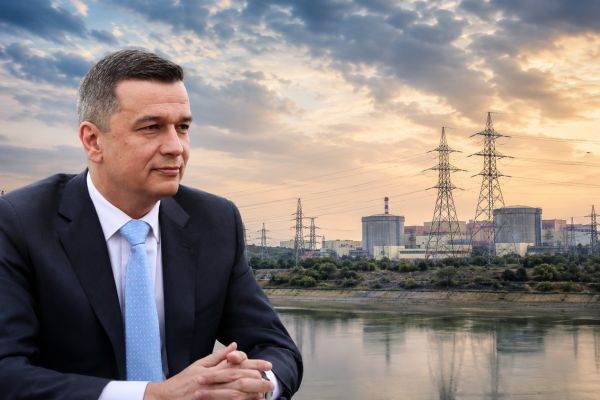
We have come to watch helplessly as one of the two reactors at Cernavodă, which together provide approximately one fifth of the national electricity production, is taken out of service due to the extremely low level of the Danube. Unit 1 was shut down in a controlled manner on July 28, 2026, and Unit 2 should have had the same fate, after the river flow dropped to the limits that no longer allowed the safe operation of the capture and cooling systems. Fortunately, the experts at Cernavodă and those of the Government have found a solution for Unit 2 to continue operating within normal parameters.
We are not talking about a nuclear accident, there was no damage and nothing can be blamed on the plant's specialists, who applied the mandatory preventive procedures. However, it was a slow-moving administrative accident, produced under the eyes of ministers who knew that Romania had a strategic vulnerability at Cernavoda, had a project on the table intended to reduce this vulnerability and let time flow along with the water of the Danube.
The severe drought explains the timing of the shutdown of Unit 1, but it does not explain the state's passivity. At the end of July, the flow of the Danube at the entrance to the country had dropped to around 1,600 cubic meters per second, almost three times below the multi-annual average for the month. Under these conditions, Nuclearelectrica shut down Unit 1 before the parameters associated with the water supply reached the operating limits. The decision was correct, prudent and necessary. The problem is not why one of the two reactors was shut down, but why our country came to depend almost exclusively on the hydrological goodwill of the Danube in 2026, although the state had known about the risk for years and was officially preparing the Bala II project.
Now, after approximately 700 Megawatts (MW) of nuclear production have temporarily disappeared from the system, the Government has urgently found seven million lei for works in the area of the Cernavodă adduction. The Lower Danube River Administration is being mobilized, the Naval Forces have been called in, barges are being prepared for water diversion and temporary hydrotechnical interventions, and the population and industry are being asked to voluntarily reduce consumption during peak hours. When prevention has failed, the state miraculously discovers mobilization. When strategic projects lie in institutions, there is no hurry; when reactors stop, government decisions, money, commands and emergency operations appear. The Bolojan Government is today trying to solve with crisis improvisations what the administration should have treated methodically, financed and responsibly in previous years.
The Bala II project is not a political invention that emerged after the shutdown of Unit 1 at Cernavodă. It is an official state objective, with the Ministry of Transport and Infrastructure as the holder and the Lower Danube River Administration Galaţi as the beneficiary. The project aims to redistribute the flow between the Bala branch and the Old Danube, including by raising the existing bottom threshold, so that the water level in the targeted sector can increase by up to 1.20 meters. Officially, the investment was presented primarily through the benefits for navigation and the environment, but its implications for the Cernavoda area are obvious: more water on the Old Danube, greater resilience to very low flows and more predictable conditions near the power plant's supply system.
The water management permit was issued on June 20, 2022. The environmental agreement followed on September 6, 2023. On September 4, 2024, the Government approved by Decision no. 1,079 technical and economic indicators of the investment, declared an objective of public utility and national interest. Financing was provided from European funds, through the Transport Program 2021-2027, and from the state budget. Therefore, the project was not left without identity, without owner, without beneficiary, without approvals and without a declared source of financing. It was left without the administrative speed that its importance required.
We note that the June 2022 approval did not mean that Sorin Grindeanu, as Minister of Transport and Infrastructure, could send excavators to the construction site the next morning. Environmental procedures, approval of indicators, design, effective financing and procurement of works were still necessary. But this is where political responsibility begins, it does not end. A minister is not paid just to note the existence of procedures, but to lead them, coordinate them and prevent them from turning into a labyrinth with no way out. The official documentation estimates a 60-month implementation period for Bala II, of which 12 months for design and 48 for execution. Every year lost before the actual start pushes the real protection of the energy system further and further.
Sorin Grindeanu led the Ministry of Transport from November 2021 to June 2025, that is, exactly during the period in which the Bala II project received the water management approval, the environmental agreement, the approval of the technical-economic indicators and the inclusion in the financing mechanism. His ministry was the project owner, and AFDJ, the beneficiary institution, was in the Transport sector. Therefore, the political and administrative responsibility of Minister Sorin Grindeanu is direct and cannot be dissolved in the convenient formula "state institutions". He must explain what happened after each approval, when the documentation was finalized, when the effective financing was secured, when the procurements were initiated, what deadlines were set, who did not respect them and why an objective declared of national interest does not produce the effects for which it was conceived even today.
It cannot be stated, without an official technical expertise, that the completion of the Bala II project would have definitely prevented the shutdown of Unit 1 and the limited operation of Unit 2 under the current exceptional hydrological conditions. It would be incorrect to turn a probability into a certainty. The project has several objectives, including navigation and environmental protection, and its exact effect on the water supply to the plant must be quantified by specialists. However, it can be stated that the investment is intended precisely to improve the distribution of flows and increase the resilience of the sector to very low waters. It can be stated that the risk was known, that the permanent works were not completed when the crisis hit. And it can be noted that the Government is now trying to obtain, through provisional measures and emergency costs, exactly the type of hydraulic correction that the state should have prepared in advance.
Legal liability is a separate issue. In order to speak of criminal negligence, abuse or the production of imputable damage, the concrete obligations of each person, the decisions taken, the available resources, the exact causes of the delays and the connection between them and the shutdown of the plant must be established. Such conclusions cannot be made editorially in place of the control bodies or the courts. But political responsibility does not need a criminal sentence. It begins when a strategic project, under the authority of the same decision-makers for years, is not completed, and the foreseeable consequences of the delay are borne by the entire country.
Sorin Grindeanu cannot be declared, based on existing public data, the sole culprit for the shutdown of Unit 1, nor that he is the author of the drought. But he has a clear and differentiated share of political responsibility for the way the state managed its vulnerability. Sorin Grindeanu is responsible for the pace of the project whose title was his own ministry. Along with him, the management of AFDJ, Nuclearelectrica, Apele Române and all the government structures that knew the route of the project must be checked.
Cernavodă is not just a power plant and Bala II is not just another hydrotechnical work hidden in a European program. Romania is preparing the re-engineering of Unit 1 and promises to build Units 3 and 4, but it cannot credibly talk about two more reactors if it is not able to provide the water needed for the existing ones under predictable conditions. You cannot proclaim energy independence at conferences and then import electricity because the investment that was supposed to reduce a known vulnerability is moving at the pace of files being passed between institutions.















 Euro
Euro Dolar SUA
 Franc elveţian
 Liră sterlină
 Gram de aur