 English

The decision of the Bolojan government to continue the Naval Procurement Program by contracting two patrol ships under the European SAFE mechanism, in parallel with the direct acquisition of the Turkish corvette "Rear Admiral August Roman”, has reignited the dispute regarding Romania's strategy in the field of military procurement and the efficiency of the use of defense funds. The controversy has been fueled in recent days by the exchange of remarks between former Prime Minister Victor Ponta and the interim Minister of National Defense, Radu Miruţă, each supporting a different vision on the costs, capabilities and economic impact of the two naval programs. However, the discussion goes beyond the simple comparison between two ships and brings back to attention the questions regarding the role of the German group Rheinmetall in the programs financed through SAFE, the future of the Mangalia Shipyard and the direction in which Romania is developing its national defense industry.
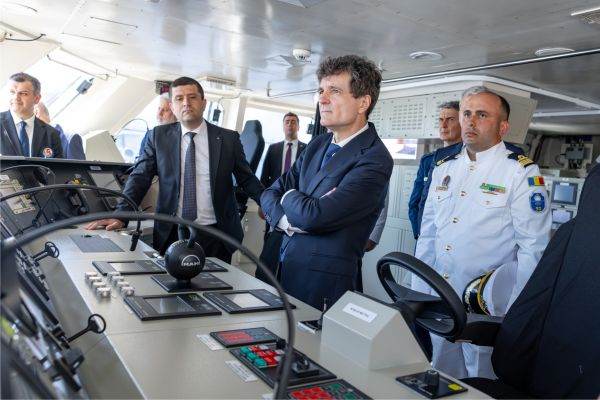
The subject has become even more sensitive as President Nicuşor Dan recently attended the ceremony in Istanbul for the entry into service of the Romanian Naval Forces of the ship "Contraamiral August Roman", the first military ship built in Turkey and delivered to a member state of the European Union and NATO. The event was interpreted by the international press as a symbolic moment for the expansion of the Turkish defense industry on the European market and for the consolidation of the strategic relationship between Ankara and Bucharest in a region marked by the war in Ukraine and the competition for the security of the Black Sea. In this context, Victor Ponta publicly criticized the difference in cost between the corvette built in Turkey and the ships to be built in Romania through the SAFE program, stating that the Romanian state risks paying almost double for platforms that it considers comparable. In the podcast "Marius Tucă Show", the former prime minister declared: "They say they will do them, Miruţă signed them. The problem is this: the one from the Turks, which is identical to the NATO one, everything, equipment. It is made by a company that deals with that, makes corvettes. They have made a lot of them, it cost 220 million euros, those two that Rheinmetall and Miruţă are said to be making cost 850 million. Wow, do you have to be an Olympian in mathematics to understand that you take two for 850 after you were present at one for 220? You realize that anyone who was a minister who said: «Wow, I took one for 220, then I take two for 425..." I wrote that I know exactly how much they cost. They don't care".
Victor Ponta continued his argument, claiming that the price difference cannot be justified exclusively by the way the ships are built and directly compared the experience of the builders involved.
"The main reason is that Rheinmetall has no experience in the naval field. It has never built military ships before. It never has. And then the Germans, being more serious than Miruţă, said that they could not deliver the corvettes in three years", Ponta specified.
Victor Ponta's statements came at a time when the debate on Rheinmetall contracts is already fueled by the scale of the projects that the German group could implement in Romania through the SAFE mechanism. In recent months, discussions on these programs have targeted not only the land component, but also the expansion of Rheinmetall's presence in the naval sector. The contracts for OPV maritime patrol vessels and for intervention stars intended for divers are awarded to Rheinmetall Naval Systems in association with NVL, which would strengthen the German group's position including in the field of military shipbuilding. From the authorities' perspective, these projects are part of the strategy to develop a national industrial capacity, but their critics argue that they raise questions about the costs and how the orders financed by the European program are distributed.
At the same time, the acquisition of the Hisar OPV corvette from Turkey is seen by several analysts as more than a simple military acquisition. It marks the entry of the Turkish naval industry into the European defense market and opens a new stage in the strategic cooperation between Romania and Turkey. The decision on the rapid purchase of the ship was approved at the meeting of the Supreme Council of National Defense of March 28, 2025, in the context of the need to accelerate the Romanian Navy's acquisition programs, after the failure of the contract for the Gowind corvettes and the modernization of the frigates.
The response of the acting Minister of National Defense, Radu Miruţă, came yesterday, just one day after the former prime minister's statements and aimed to dismantle the comparison between the Hisar corvette and the ships contracted through the SAFE mechanism, claiming that the two projects have completely different technical configurations and objectives. In a post published on his official page, the minister stated that Victor Ponta is "lying again" and comparing "apples with pears" in a field that "you can see from the plane that he does not master".
"The Hisar corvette delivered very quickly from Turkish partners cost 223 million euros and had a certain level of equipment. What the Romanian state contracted through SAFE, saving the shipyard in Mangalia-2 Mai, is something else entirely, the only similarity between the two ships, for someone like you, being that both are probably floating", wrote Radu Miruţă, claiming that the value of the contract negotiated through SAFE includes combat systems that do not equip the ship purchased from Turkey.
The minister also presented a breakdown of the main equipment that, according to him, justifies the difference in cost. Thus, the SAFE program includes the CIWS Oerlikon Millennium close-in defense system, valued at approximately 15.5 million euros, a passive infrared surveillance and early warning system of approximately 2.5 million euros, systems for force protection and combating modern threats estimated at 15 million euros, electronic warfare systems of approximately 3 million euros, torpedo launchers valued at 9.5 million euros, the RAM missile system worth almost 60 million euros, the related ammunition, the launch system for NSM missiles and the costs of integrating all these capabilities into a single platform, estimated at approximately 50 million euros.
"When you add these capabilities, their integration and the obligation to invest in the shipyard so that they can be produced in Romania, as for the first time, through SAFE we introduced as an obligation, the reality is different from the simple story that you are trying to sell, manipulating lies, and the price of the new ships becomes even more advantageous", argued Radu Miruţă. He added that the program does not only aim to purchase naval platforms, but also to relaunch military shipbuilding in Romania, through investments in the Mangalia shipyard and maintaining jobs. "After years in which the Army only paid by buying from others, and shipyards in the country closed due to lack of orders and corruption, these new ships will be written for the first time in 35 years, MADE IN ROMANIA again”, stated Radu Miruţă.
In the Greek press, this development is interpreted as a signal of the consolidation of an Ankara-Bucharest axis in the field of security in the Black Sea, amid the intensification of military cooperation between the two states and the development of the Turkish defense industry, which aims to expand its presence on the European market. According to the Greek publication Business Daily, the delivery of the Hisar corvette to Romania represents more than the first export of such a ship to a member state of the European Union and NATO. The publication believes that Ankara is thus consolidating its position in the European security architecture and expanding its influence in the Black Sea region through its defense industry. At the same time, Romania appears as one of the main buyers of military equipment produced in Turkey, after the contracts for Bayraktar TB2 drones, Cobra II armored vehicles and cooperation agreements between Turkish companies and the national defense industry.



















 Euro
Euro Dolar SUA
 Franc elveţian
 Liră sterlină
 Gram de aur





























