 English


An analysis by the Federal Reserve (Fed) of New York indicates that prices for many everyday products would have fallen last year and early this year had it not been for the tariffs imposed by President Donald Trump.
According to a study by a research team at the US central bank's New York branch, the cost of 67 categories of goods was 2.9 percentage points higher in February due to these tariffs, CNBC reports. The researchers did not specify which of the 67 product categories were evaluated.
The authors of the analysis found that, without these levies, the prices of the products studied would have dropped by nearly 1%.
The cited report offers the clearest evidence to date regarding the impact of Trump's tariffs-a central measure of his second term in the White House-on consumer budgets. Economists had largely anticipated that these tariffs would drive up prices, although the exact effects were difficult to estimate due to the policy's variable nature and the lack of transparency regarding how companies set their prices.
"The Trump administration has consistently maintained that the burden of tariff costs would ultimately be borne by foreign exporters who depend on access to the U.S. economy," White House spokesperson Taylor Rogers said in a statement to CNBC.
However, the Fed team found that for every percentage-point increase in the average tariff rate, consumer goods prices were approximately a quarter of a percent higher a year later.
According to the report, the annual rate of price increases for the many products monitored peaked in early 2026. Estimates suggest that, due to this policy, consumers will continue to pay high prices throughout 2027.
Approximately two-thirds of the tariffs' impact on prices stemmed directly from the customs duties themselves, according to the New York Fed report. The remainder of the increase was driven by indirect effects-such as those experienced by U.S. companies using imported components and materials in their products-the source noted.
"Tariffs have a larger and more persistent impact on consumer prices than the simple direct effect would suggest," emphasized the study's three authors: Mary Amiti, Sebastian Heise, and David Weinstein. Trump argued that companies could absorb the additional costs generated by tariffs rather than passing them on to consumers in the form of price hikes. The New York Fed team noted that approximately 26% of last year's tariff increases were reflected in higher prices.
In February, the U.S. Supreme Court struck down many of the tariffs imposed by Trump, resulting in billions of dollars being refunded to merchants. The White House pledged to continue enforcing the levies through alternative measures, and products imported from numerous countries are now often subject to tariffs of around 10%. In many cases, this level is significantly lower than that of the previous round of tariffs.
• Economies most dependent on trade with the US
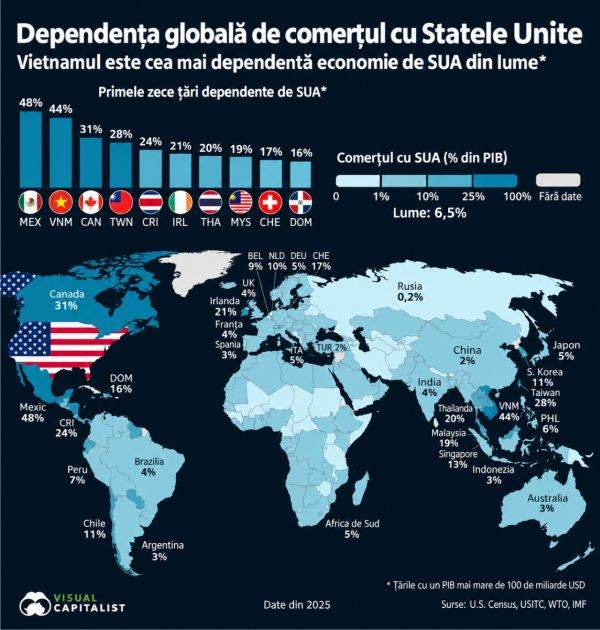
When US trade policy shifts, some economies barely feel the impact. For others, however, trade with the US is significant enough to visibly influence economic growth.
According to visualcapitalist.com, the disparities are striking: some major economies maintain close trade ties with the US, while others have far less exposure relative to the size of their economies.
The cited source presents each country's trade in goods with the United States (exports plus imports) as a share of GDP in 2025, drawing on data from US federal statistical agencies, the US International Trade Commission, the World Trade Organization, and the IMF.
The figures reveal that Vietnam's economy relies heavily on trade: the combined value of its exports and imports amounted to 190% of its GDP in 2025. The US is Vietnam's largest export market, and bilateral trade accounts for 44% of the country's GDP-a share surpassed, among major economies, only by Mexico. Vietnam's exports to the US rose by 28.1%, exceeding $153 billion in 2025; these exports were dominated by computers and electronic products, driven by US efforts to reduce supply chain reliance on China. Taiwan-where trade in goods with the US accounts for 28% of GDP-saw a 78% increase in exports to the US, reaching $198.3 billion in 2025. Alongside Vietnam, Thailand (20%), and Malaysia (19%), four of the eight major economies with the highest exposure to US trade serve as key hubs in the supply chains powering the global electronics industry.
• America's key partners often have lower exposure levels
Mexico and Canada are the only trillion-dollar economies in the top 10, with trade with the US representing 48% and 31% of their respective GDPs. In Canada's case, energy plays a pivotal role in this relationship: 90.1% of its crude oil exports were destined for the US in 2025.
When looking at economies of all sizes, some smaller nations rank even higher. Nicaragua (34%), Cambodia (34%), and Honduras (32%) all rank ahead of Canada, as their garment and assembly industries forge strong ties to US demand.
China sits at just 2%, or roughly one-third of the global average. Despite the immense value of trade between the US and China, this figure is relatively low when compared to China's economy-valued at $19.6 trillion-and the volume of its trade with the rest of the world. Germany and Japan, two other major economies, both account for a 5% share.
Switzerland (17%) is the most exposed European economy, after Ireland (21%). This exposure resulted in significant costs in 2025, when the US imposed a 39% tariff on many Swiss exports between August and November, before a framework agreement reduced the rate to 15%.

























 Euro
Euro Dolar SUA
 Franc elveţian
 Liră sterlină
 Gram de aur






























Reader's Opinion