 English

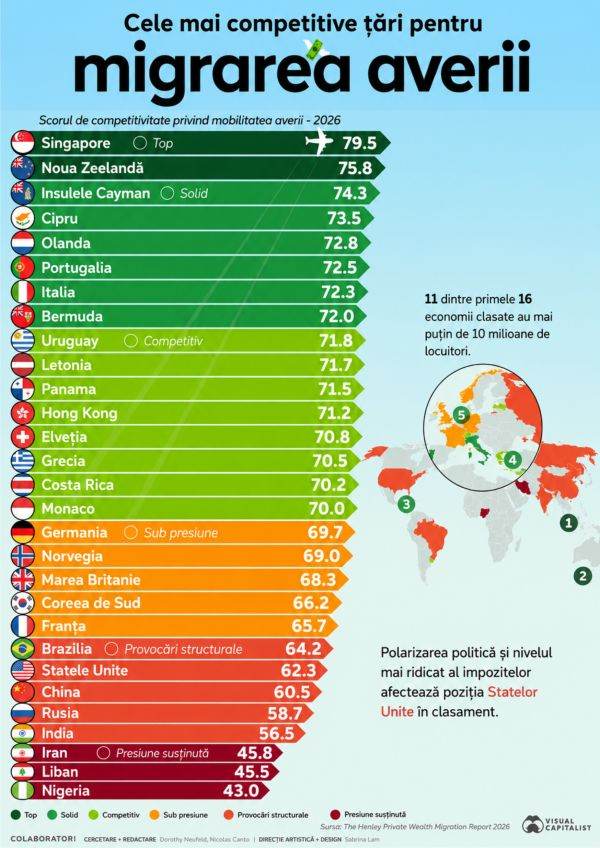
Countries are increasingly competing to attract wealthy individuals, along with companies and skilled workers. For many governments, international mobile wealth is a source of investment, entrepreneurship and long-term economic growth, according to visualcapitalist.com, which ranks the world's most competitive destinations for private wealth migration, using data from the Henley Report for 2026. The report evaluates countries based on 12 factors, including tax policy, investor residency, regulatory quality and the overall business environment.
• Most Competitive Countries
The ranking ranks countries based on their competitiveness in attracting international mobile wealth. Singapore leads the world with a score of 79.5, ahead of New Zealand (75.8) and the Cayman Islands (74.3). Europe also performs well, with Cyprus (73.5), the Netherlands (72.8), Portugal (72.5), Italy (72.3), Switzerland (70.8) and Greece (70.5) all in the top 15.
Singapore's ranking reflects a combination of low taxes, political stability and business-friendly regulations. Together, these strengths have made it one of the safest countries for investors and a magnet for wealth in Asia.
• Small countries stand out
One of the clearest patterns in the ranking is the strength of smaller economies. Overall, 11 of the 16 most competitive countries have populations under 10 million. Many of these countries have spent decades building investor-friendly ecosystems. Singapore offers a globally connected financial center, Cyprus has attractive residency pathways, and Switzerland combines political stability with an established private banking industry.
So, rather than relying on the size of their domestic market, many of these countries offer predictable regulations, efficient tax systems, strong legal institutions, and easy ways for investors to establish residency or relocate their wealth.
• The U.S. lags behind
Despite having the world's largest economy, the United States faces several structural challenges in attracting wealth. Citizenship-based taxation, tax complexity, longer processing times for investor applications, and political polarization are among the factors that influence its score. In contrast, many higher-ranking countries offer simpler tax regimes, making them more attractive to internationally mobile wealth.
Unlike most countries, the US taxes its citizens on global income, regardless of where they live, a feature that can increase the tax burden for internationally mobile individuals.
• Why countries compete for mobile wealth
Countries are increasingly competing for more than just businesses and skilled workers. They are also competing for private capital, according to the cited source.
In 2025 alone, nearly one million people globally became millionaires, highlighting the growing pool of internationally mobile wealth. High-net-worth individuals often move along with their businesses, investment capital and philanthropic spending. As global wealth continues to grow, attracting even a relatively small number of wealthy residents can have a disproportionate economic impact, especially for smaller countries.
• Ultra-rich population is expanding rapidly
The world's ultra-rich population is expanding rapidly, but the growth is occurring in very different ways from country to country. While the US is expected to produce far more ultra-high net worth individuals (UHNWIs) than any other nation, estimates show that many smaller economies will see a faster percentage increase in their population with wealth of at least $30 million, according to Knight Frank's World Wealth Data.
The US is expected to add nearly 67,000 people with wealth of at least $30 million between 2021 and 2026, almost three times the growth seen in China over the same period. No other country comes close in absolute terms. America's expansive capital markets, technology sector, and concentration of fast-growing private companies continue to generate wealth on a scale unmatched by other economies.
China is in second place, with over 22,000 new ultra-high net worth individuals, cementing its position as one of the largest wealth creation markets globally. The following countries rank 3-10 on the list: Germany (+9,273 ultra-high net worth individuals), India (+7,716), Switzerland (+4,968), Australia (+4,036), France (+3,781), the UK (+3,005), Italy (+2,886), Spain (+2,708).
While the US dominates in terms of the total number of new ultra-high net worth individuals, the fastest growth is taking place elsewhere. Poland is the world leader, with a projected 109% increase in its ultra-high net worth population, followed by Qatar - with 107% and Turkey - with 94%. These gains suggest that wealth creation is accelerating beyond traditional financial centers and spreading to a broader group of emerging and rapidly developing economies. Many of these countries are benefiting from industrial expansion, energy exports, infrastructure investment and growing financial sectors. Gulf states such as Qatar and Saudi Arabia are also seeing wealth growth, linked to increased energy revenues and economic diversification initiatives.
India is one of the few countries to appear near the top of both rankings. The country is expected to add more than 7,700 ultra-high-net-worth individuals, as its ultra-high-net-worth population grows by 63%.
Established wealth centers such as Switzerland, Singapore and the United Arab Emirates remain important magnets for the wealthy, but the geography of wealth creation is becoming increasingly diverse.
























 Euro
Euro Dolar SUA
 Franc elveţian
 Liră sterlină
 Gram de aur





























