 English

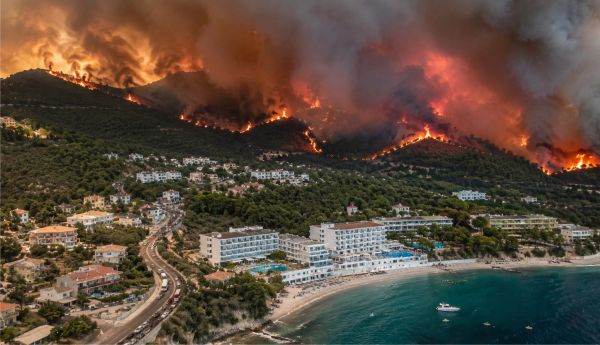
The wave of wildfires that has been sweeping across Europe this summer can no longer be seen as just a succession of local disasters. Greece, Spain, France, Croatia, Germany and Belgium have been affected by fires, some of them in tourist areas or near localities, and the scale of the phenomenon is starting to be reflected in the costs for agriculture, infrastructure, energy, tourism and insurance. At the same time, companies are discovering that a significant part of the losses caused by extreme temperatures are not covered by traditional policies.
• A fire season that goes beyond the borders of southern Europe
Fires are no longer a problem limited to Mediterranean regions this summer. In recent days, Greece has been hit by new outbreaks, and a large-scale fire broke out on the island of Salamis, near Athens. Two people died, several were injured and more than 500 people were evacuated. According to Reuters, the intervention mobilized almost 200 firefighters, planes and helicopters, as high temperatures, drought and dry vegetation favored the rapid spread of the fire. The situation is all the more difficult because the fires hit Greece during the peak tourist season, when islands and coastal resorts are full of visitors. Evacuations affect not only homes, but also hotels, restaurants, transport and commercial activities dependent on tourism. In Croatia, a fire near the town of Omis caused one death and dozens of injuries, and about 1,200 people were evacuated. In northern Greece, tourists and locals were transported by boats to escape the flames that were approaching coastal areas.
• Belgium faces biggest fire in recent history
The geographical scale of the phenomenon is illustrated by the situation in Belgium, a country not traditionally associated with large-scale wildfires. A fire in the High Fens nature reserve has burned around 3,000 hectares, becoming the largest wildfire ever recorded in Belgium. The fire has reached the German border and the intervention has involved the mobilization of teams from several countries, including air support from the Netherlands. For comparison, the previous Belgian record, recorded in 2011, affected around 1,400 hectares. The spread of fires towards the north of Europe is one of the signals that draw attention to the changing climate profile of the continent. It is no longer just a question of the arid areas of the Mediterranean, but of regions that were less exposed to such events in the past.
• Agriculture begins to bear the brunt of drought and fire
Fires are just one link in a chain of economic losses. Before fires reach farmland, drought and high temperatures reduce yields. Dry vegetation then increases the risk of fires, and affected land loses some of its productive capacity. Reuters reported last week that extreme events this summer have already affected European agricultural production, and in France the corn harvest could be drastically reduced in some regions. At the same time, the decline in agricultural production can fuel pressure on food prices. The impact does not stop with farmers. Lower production means lower incomes for agriculture, higher costs for the food industry and, ultimately, additional pressure on consumers.
• Tourism becomes vulnerable at a critical time
For economies in southern Europe, the problem is particularly sensitive because the fires occur precisely at the time when the tourism industry generates a significant part of its annual income. A tourist who has to be evacuated from a resort can generate direct costs for the hotel, the airline, local authorities and insurers. If fires become recurrent, the effect can be wider: tourists may change their destinations and operators may have difficulty obtaining insurance. Reuters reported that fires have affected numerous tourist destinations in Croatia, Greece, France and Germany this summer, causing evacuations and disruptions to economic activities.
The problem is that tourism cannot be protected by emergency measures indefinitely. If heat waves and fires become a regular feature of European summers, the behavior of tourists and investors may change.
• The bill reaches insurers
One of the less visible consequences of the fires is the pressure on the insurance market. According to a Reuters analysis published in early August, European insurers are still able to absorb a large part of the direct losses generated from current fires. The problem, however, is what will happen if the frequency and severity of these events continue to increase. Insurance works relatively simply when an event is rare and can be statistically estimated. But it becomes much more difficult when the risk changes structurally. If a given region is affected by fires more and more often, the insurer must include this probability in the price of the policy. For homeowners and businesses, the result is an increase in the cost of protecting assets.
• The biggest problem: uninsured losses
In the case of a heat wave, the difficulty is even greater. A fire that destroys a building can be identified, assessed and compensated. In contrast, losses caused by a period of extreme temperatures are much harder to fit into a traditional policy. A restaurant can lose customers because people avoid going out. A hotel can have unoccupied rooms. A factory can reduce employee productivity. A shipping company can suffer delays. A store may see lower sales. There is not necessarily a physical asset that is damaged that an inspector can assess. Reuters has shown that this difference creates an increasingly important "climate insurance gap”. For last summer's heat events, economic losses were estimated at around 43 billion euros, while insurance claims only reached around 500 million euros. The difference shows the scale of the problem: the economy can lose much more than it can recover through traditional insurance mechanisms. Faced with this situation, the industry is starting to look for new products. One solution is parametric insurance, through which payment is not conditional on the exact assessment of a damage, but on reaching a certain pre-established threshold. In the case of a heat wave, for example, the contract may provide for compensation if the temperature exceeds a certain level for a certain number of days. The advantage is speed. The company does not have to prove that every element of its activity has been affected. If the parameter set in the contract is reached, payment can be triggered. Reuters notes, however, that such tools do not solve the fundamental problem. Companies must also adapt their operations to reduce exposure to extreme events.
• Energy is already feeling the effects of extreme temperatures
The climate problem is also being transmitted to the energy market. Heat waves increase demand for electricity for cooling just when some generation capacity may be struggling. In France, high temperatures and low river levels have limited the operation of some nuclear power plants, while in Germany, periods of weak winds have reduced wind production. Reuters reported that European electricity prices rose by more than 20% in a single day amid restrictions on nuclear production in France and cuts in German wind production. So the heat wave is no longer just a problem for agriculture or health. It can simultaneously alter energy demand and supply.
• Infrastructure enters a vicious cycle
Roads, railways, electricity grids and water supply systems are also at risk. Extreme temperatures can damage road and rail infrastructure, while fires can destroy power lines, communications and other assets. In addition, the intervention of the authorities entails additional costs: planes and helicopters to fight fires, additional personnel, evacuations, temporary shelters and the restoration of infrastructure. At a time when European public budgets are already under pressure, the additional costs are not negligible. Reuters estimates that the economic effects of the extreme summer of 2026 are already extending to manufacturing, transport, agriculture and energy systems.
• Fires amplify this problem.
They transform drought into direct material losses and can block economic activity in entire areas. At the same time, the costs of prevention and intervention are increasing, and companies must allocate more resources to protect employees and assets. Europe must move from intervention to prevention. The scale of the phenomenon puts pressure on public policies. Until now, much of the spending has been directed at post-disaster response: firefighters, evacuations, compensation and reconstruction.
But the increasing frequency of extreme events is making this approach increasingly costly. Investments in forest management, fuel load reduction, early warning systems, more resilient power grids and infrastructure adapted to high temperatures may cost more up front, but can reduce future losses.
For the private sector, adaptation can become just as is as important as insurance. Europe is not just facing a difficult fire season. What is emerging is a change in the risk profile for the economy. A summer with extreme temperatures can simultaneously mean less agricultural production, higher energy consumption, transport disruptions, tourism losses, pressure on the health system and higher insurance costs. The fire is just the point at which these vulnerabilities become visible.



















 Euro
Euro Dolar SUA
 Franc elveţian
 Liră sterlină
 Gram de aur





























