 English

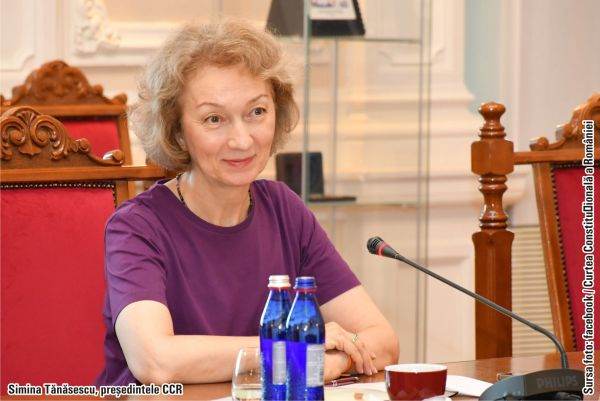
A meeting about which, until two days ago when the Constitutional Court published some clarifications, we knew almost nothing, managed to produce in a few hours what the Romanian judicial system rarely produces when faced with certain problems: an exemplary mobilization. This is the meeting at the Senate between interim Prime Minister Ilie Bolojan and Simina Tănăsescu, president of the CCR, at a time when the CCR was about to rule on cases with legal and political stakes.
The Superior Council of Magistracy - Section for Judges requested clarifications. The presidents of the courts of appeal requested clarifications. The presidents of the tribunals and courts of first instance requested clarifications. The Constitutional Court responded with a clarification that, when read carefully, leaves almost everything unclear.
The SCM found that the public information regarding the meeting between the two officials raised "legitimate questions", invoked the need for transparency, spoke about independence, impartiality, institutional conduct and public trust and requested an explanation of the circumstances of the meeting, its nature, the reason why it was held in the office of the President of the Senate and the topics discussed. So far, the request is justified. Anyone who heads the Constitutional Court must understand that meetings with political leaders, in the proximity of resolving cases with political stakes, are not exclusively private matters. Independence does not only mean the absence of pressure. It also means the institution's ability to publicly demonstrate that there was no pressure.
But the SCM did not stop at questions. It brought up the episode from 2018, when Simina Tănăsescu, then presidential advisor, resigned following the controversy caused by a meeting with CCR judge Petre Lăzăroiu. The Council recalled that the Presidential Administration considered it inadmissible at that time to even raise the suspicion of an attempt to interfere in the Court's work. The allusion is transparent: if he resigned then, why would he not be held to the same standard now?
However, the CSM does not explicitly demand the resignation of the CCR president. It simply places the resignation from the past next to the current meeting, turns on the light above them and discreetly leaves the room, leaving the public to notice the similarity for themselves. It is the refined form of institutional accusation: you do not say that the person must leave; you only recall that, in a situation that you declare comparable, he left. The presumption of innocence remains intact. He simply receives, through the Public Information Service, a career suggestion.
• The lesson of 2018, selectively taught by the judges of the Supreme Court
Only that institutional memory cannot be used like tweezers: you extract only the episode that serves the present accusation and leave the rest of history untouched. We recall that, also in 2018, Liviu Dragnea, president of the PSD and the Chamber of Deputies, repeatedly received the Minister of Justice, Tudorel Toader, in his office at Parliament. The meetings took place during the period of amendments to the justice laws and criminal codes, amid controversies regarding amnesty, pardon and panels of five judges at the High Court.
The respective topics were not of only theoretical interest to Liviu Dragnea. In September 2018, the PSD leader stated that he had asked the Minister of Justice to take steps regarding the appointment of panels of five judges. On October 17, Tudorel Toader arrived at Dragnea's office again, in the midst of a scandal regarding the justice laws. On November 6, after another meeting, the minister declared that they had also discussed the CCR meeting scheduled for the following day. According to the vocabulary used today, the context could generate "legitimate doubts" about the relationship between the political leader and the Minister of Justice.
However, the judicial system did not produce the current symphony of press releases.
The CSM did not stand up in defense of the appearance of impartiality, it did not demand that the framework, place, purpose and topics of the discussions be explained. European jurisprudence was not called to guard the door of Liviu Dragnea's office. The CSM did not discover the same passion for public clarification at that time.
We note that, in the fall of 2018, the CSM was led by Simona Camelia Marcu. Lia Savonea took over the presidency of the Council in January 2019, a year in which Liviu Dragnea continued to exert public pressure on the Minister of Justice regarding emergency ordinances and criminal codes and in which the CSM led by Lia Savonea did not manifest the current moral effervescence. I have not identified a comparable communique in terms of tone, scope and institutional mobilization. The standards probably existed, but the time had not yet come to bring them out of the closet.
• The meeting in the dark room
The year 2019 offers an even more appropriate episode for the current debate. Valer Dorneanu, then President of the Constitutional Court, met discreetly with Cristina Tarcea, the president of the High Court, in the context of the conflict over the five-judge panels.
Cristina Tarcea later reported that the meeting took place in a dark room, and the phones were left in the anteroom. It was so dark, she said, that when leaving, she accidentally took Valer Dorneanu's coat.
We have here all the props of a contemporary press release: two heads of essential jurisdictions, an issue with major political stakes, discretion, phones abandoned at the entrance, and a room in which even coats lost their constitutional identity.
However, the CSM led in 2019 by Lia Savonea did not convene the transparency council. He did not ask to specify who chose the room, why it was dark, why the phones were left outside, what was discussed and whether the involuntary change of clothes could affect the appearance of impartiality. Transparency was probably also in the room, but, being dark, no one recognized it.
We note that we do not claim that the Tănăsescu-Bolojan meeting should be ignored because other questionable meetings were tolerated in the past. Yesterday's silence cannot become the obligation of today's silence. But the institutions that invoke principles must explain why the principles slept in certain periods and why they woke up now, rested, firm and why we have a double standard. That is, one standard for the people who were once in the offices and another for the people who are now in the same buildings.
When Liviu Dragnea discussed with Tudorel Toader about the panels that could affect his judicial situation, silence was probably institutional balance. When Valer Dorneanu and Cristina Tarcea met in the dark, with their phones left in the anteroom, discretion was probably necessary for the proper functioning of justice. When Simina Tănăsescu meets with Ilie Bolojan, the same kind of discretion becomes "deeply inadequate” to the standards of a constitutional jurisdiction.
• Order per unit: press releases from courts of appeal, tribunals and judges
And if it had only been the press release issued by the Section for Judges within the SCM... But no. It seems that the President of the High Court of Cassation and Justice, former head of the SCM in 2019, Lia Savonea gave a phone call or rather an order per unit, following which similar press releases from the presidents of courts of appeal, presidents of tribunals and presidents of judges appeared.
All three adjacent communiques invoked the independence of the judiciary, the appearance of impartiality, transparency, public trust, the 2018 precedent and the jurisprudence of the European Court of Human Rights.
The communiques invoke the ECHR ruling in the case of Sieć Obywatelska Watchdog Polska v. Poland, regarding access to the agendas of some judges of the Polish Constitutional Court, in a context in which there was information about possible contacts with a politician interested in a file.
The reference is pertinent to the public's right to information. But it also has an obvious rhetorical function: it brings Strasbourg to Bucharest and gives still incomplete information the prestige of a European case. With an ECHR ruling at its side, suspicion no longer enters the institution through the back door. It comes in a robe and demands to be called "legitimate doubt".
From the three press releases that followed the one issued by the Section for Judges within the SCM, we note that in the Romanian judicial system, the independence of the courts is sometimes manifested by the sovereign freedom of each to say exactly the same thing. Which has now manifested itself through copy-paste. The courts of appeal, the tribunals and the courts of first instance have thus formed a complete chain of concern. Each link has confirmed that the others are concerned and that, therefore, there are serious reasons for concern.
The mechanism is impeccably circular: incomplete information gives rise to suspicions; the press releases amplify suspicions; the magnitude of the reactions becomes proof of seriousness; seriousness justifies other reactions. It is an institutional perpetuum mobile that operates without new facts, fueled exclusively by the expression "appearance of impartiality”.
If the procession continues, the archives, registries and security services of the courts could follow, each with its own press release on the fundamental importance of transparency. In the end, the printers will reaffirm the independence of the toner.
• CCR response confirms uncertainty
On Sunday evening, the Constitutional Court finally provided an answer. According to the CCR, the position of President of the Court includes, in addition to jurisdictional attributions, also administrative, organizational and representational attributions, as provided for in Article 9 of Law No. 47/1992. The Court specified that the meetings of its President with representatives of the executive authority have as their object "exclusively aspects related to the proper organization, administration and conduct of the institution's activity, within the limits of the powers provided for by law".
So, the mystery has been solved by a legal category. But we are not told what administrative issue was discussed, who requested the meeting, why an issue regarding the administration of the CCR was discussed in the office of the Senate President, why the meeting was not included in a public agenda, who else attended the meeting, how long the meeting lasted.
We are only told that everything took place within the limits of the law. The CCR does not describe the concrete event, but only the category in which it wants to be placed.
The Court also says that no pending case is and cannot be the subject of discussions outside the procedural and legal framework. The wording "does not” represents a factual denial. The wording "cannot” is, however, a normative one: such a thing is not permitted. However, the mere fact that a conduct is prohibited by law does not prove that it did not occur.
The CCR tells us, in other words, that the files were not discussed because the files cannot be discussed. The syllogism has a special constitutional beauty: what is forbidden is impossible; what is impossible did not happen; and what did not happen does not need to be explained.
The most spectacular part of the Court's response, however, is at the end. The CCR argues that "both the constant and public conduct, as well as the ethical and professional benchmarks of the President of the Constitutional Court constitute sufficient benchmarks to exclude any contrary interpretation” regarding the nature of the administrative proceedings.
In other words, the meeting was legal and administrative because the person who participated in it has a conduct and some benchmarks that exclude the contrary hypothesis. We do not find out the content of the discussion, but we are asked to trust the biography. This is no longer transparency, but moral self-attestation.
The institution does not present the information that would allow the public to verify the nature of the meeting, but guarantees that they are not necessary, because the ethical benchmarks of its management are sufficient. It is the institutional equivalent of the formula: "Take our word for it, because we are people who deserve to be taken at our word.”
Perhaps the president of the CCR has impeccable professional conduct. Perhaps the meeting really had an exclusively administrative purpose. Perhaps not a word was said about the cases on the docket. Precisely because all of this is possible, the Court should have provided concrete data. Trust is not strengthened by proclaiming its own virtues. It is strengthened by putting the facts on the table. Otherwise, the Court responds to the request for transparency with a character certificate that it issues itself. Signed, initialed and declared sufficient.
• The man left in the hallway
In this confrontation between institutions, each camp talks about public trust. The CSM says it wants to protect it. The court presidents say that transparency is essential for it. The CCR believes that the ethical guidelines of its leadership should be sufficient to maintain it.
But public trust is not a formula that can be inserted into the last paragraph of a press release to give the document human warmth. It belongs to the people, to those who wait years for a court decision, to those who enter a courtroom for the first time and do not understand the language in which their lives are decided, to those who count their money for a lawyer, to entrepreneurs who do not know whether their companies will still function at the end of the trial.
For these people, the appearance of impartiality is not an expression from the ECHR jurisprudence, but it is the hope that the case will not be decided by a phone call, a political relationship, a discreet meeting or the name written on an office door.
The citizen is asked to trust the institutions, but the institutions offer him two equally poor options. The CSM tells him: "There are serious reasons to be suspicious, although we still do not know exactly what happened”. The CCR tells him: "You have no reason to be suspicious, because our ethical guidelines are sufficient”.
The citizen is not given facts, but the choice between the suspicion of some and the moral certificate issued by others. The simple man does not know Article 9 of Law No. 47/1992, but he recognizes the language of the authority that responds without responding. He has encountered it at the counter, at the city hall, in the hospital, at the tax administration and in the halls of the court. He knows the formula: everything was carried out according to the legal powers. He also knows what is missing after it: the concrete explanation. For him, the rule of law is not a solemn phrase, but the experience of not being treated worse than the man who enters the right office.
ÎCCJ completes the chain of press releases
The High Court of Cassation and Justice, headed by President Lia Savonea, completed yesterday the chain of press releases regarding the meeting between interim Prime Minister Ilie Bolojan and Simina Tănăsescu, President of the Constitutional Court, by issuing a press release in which it considers that the explanations provided so far regarding the respective meeting are not likely to fully clarify its circumstances nor to remove the legitimate concerns generated in the public space and at the level of the judicial authority.
"In this context, the High Court of Cassation and Justice joins the concerns expressed at the level of the judicial system regarding the need to respect the requirements of independence, impartiality and transparency and considers it necessary to immediately and completely clarify the circumstances in which this meeting took place. The situation presents a particular institutional gravity, given that the Constitutional Court is called upon to resolve, among other things, a legal conflict of a constitutional nature triggered by Mr. Ilie Bolojan himself, and the President of the Court participates in resolving the case as a judge. In a conflict between the powers of the state, the constitutional arbitrator must not only be independent and impartial, but must also be located, unequivocally, outside any reasonable appearance of influence or proximity to one of the parties”, states the press release issued by the institution headed by Lia Savonea.
According to the cited document, "the equivocal nature of the conduct of the President of the Constitutional Court, through the appearance of rapprochement that she is likely to create towards one of the parties involved, is likely to weaken public confidence in the impartiality and fairness of the future solution.”
Furthermore, the ÎCCJ argues that the circumstances in which the meeting took place also require clarification, especially since it did not take place at the headquarters of any of the institutions represented by the two participants and, according to publicly available information, was not announced in advance.
"Such a situation cannot remain unclear or without institutional consequences commensurate with its seriousness. When the conduct of the person at the head of a constitutional jurisdiction generates legitimate doubts about the appearance of impartiality, the responsibility of the position requires assuming the necessary consequences, so that no reasonable suspicion of influence or lack of impartiality looms over the credibility of future decisions of the Court,” the press release also states.
We recall that, as we stated in the text of the article, when Lia Savonea was president of the SCM, she was not bothered by the meeting in the dark, at the Constitutional Court, between the president of the then CCR, Valer Dorneanu, and the head of the ÎCCJ at the same time, Cristina Tarcea. Were there no longer any issues to clarify then?




















 Euro
Euro Dolar SUA
 Franc elveţian
 Liră sterlină
 Gram de aur





























