English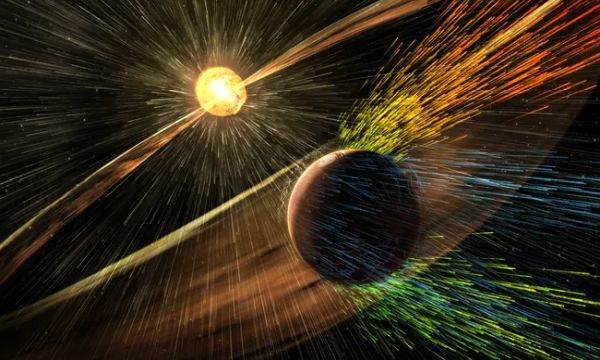
Two European Space Agency (ESA) probes orbiting Mars have observed the impact of a powerful solar "superstorm” on the Martian atmosphere and on space equipment, according to a study published in the journal Nature Communications and cited by Space.com. The Mars Express and ExoMars Trace Gas Orbiter (TGO) probes tracked how the solar storm, which had previously hit Earth, reached Mars, causing unprecedented increases in the number of charged particles in the planet's atmosphere and temporary errors in the probes' electronic systems.
• The strongest solar storm in the last two decades
The solar event occurred on May 11, 2024 and represented the strongest geomagnetic storm recorded on Earth in over 20 years. On our planet, the phenomenon generated spectacular auroras visible much closer to the equator than usual, including in Mexico. When the stream of energetic particles reached Mars, the two ESA probes were exposed in just 64 hours to a level of radiation equivalent to that normally accumulated in about 200 days of orbital activity. "The impact was remarkable: the upper atmosphere of Mars was flooded with electrons,” said ESA researcher Jacob Parrott, coordinator of the study team.
• Unprecedented increase in electrons in the atmosphere
Data collected by the probes show that the solar storm caused a dramatic increase in the number of electrons in two layers of the Martian atmosphere: an increase of about 45% at an altitude of 110 kilometers, an increase of 278% at 130 kilometers above the planet's surface. According to the researchers, this is the highest concentration of electrons ever detected in the atmosphere of the Red Planet. The storm also caused temporary computer system failures on the spacecraft, a common occurrence during "space weather” events, when extremely energetic particles can damage satellite electronics. "Fortunately, spacecraft are designed for this kind of situation and use radiation-resistant components and automatic error correction systems,” Parrott explained.
• A new technique to investigate the Martian atmosphere
To study the phenomenon, the researchers used a method called radio occultation. In the experiment, Mars Express sent a radio signal to the TGO as it descended below the horizon of Mars. The signal was refracted by layers of the Martian atmosphere and then picked up by the original spacecraft, allowing researchers to analyze the structure and density of the atmosphere.
"This technique has been used for decades to explore the Solar System, but it is only in recent years that we have started to use it directly between two spacecraft in orbit around Mars,” explained ESA researcher Colin Wilson.
• Why Mars Reacts Differently to Earth
The study also highlights major differences between the Martian atmosphere and Earth's response to solar storms. Our planet is protected by the magnetosphere, the global magnetic field that deflects a large portion of the charged particles coming from the Sun. These particles are directed mainly towards the polar regions, where they produce auroras. However, Mars does not have a comparable global magnetic field, which makes its atmosphere much more exposed to solar radiation.
• Clues to the planet's past
The researchers believe that the results of the study could contribute to understanding the evolution of the planet's climate. According to Colin Wilson, solar storms and the constant wind of particles emitted by the Sun could have played a major role in the gradual loss of atmosphere and water on Mars, turning the planet into an arid environment. At the same time, high concentrations of electrons in the upper atmosphere can affect radio communications and the operation of radar used to explore the planet's surface, an important aspect for planning future space missions.


























 Euro
Euro Dolar SUA
 Franc elveţian
 Liră sterlină
 Gram de aur