English

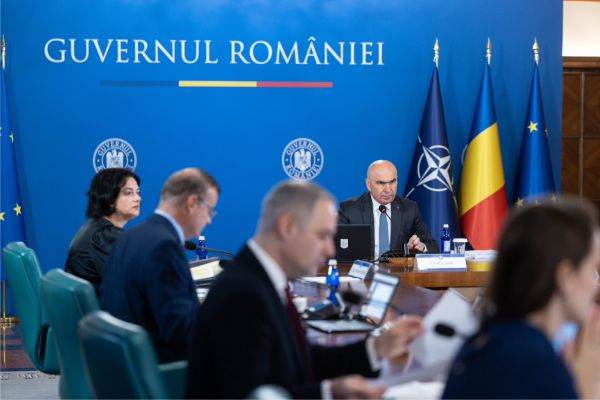
The Government approved yesterday a new state aid scheme - "TechUp Romania", which is dedicated to advanced technologies and will have a maximum budget of 5.313 billion lei, the equivalent of approximately 1.05 billion euros. Through the new support granted to companies, the state is trying to boost the production of solutions with high added value. The program, included in the economic recovery package established by GEO no. 8/2026, will finance research and development projects and investments in production capacities in areas such as artificial intelligence, microelectronics, advanced computing, biotechnology, precision health, green energy, energy storage, climate technologies, autonomous mobility, space industry, advanced materials, Industry 4.0 and cybersecurity.
TechUp Romania is designed as the first government program that finances the entire path of a technology, from industrial research and experimental development to the prototype ready for commercialization and effective production capacity. According to the substantiation note of the government decision approved yesterday, the aim of the new support scheme is to eliminate the fragmentation between the laboratory and the market, one of the major vulnerabilities of the Romanian economy. In the absence of sufficient national testing, certification and pilot production infrastructures, Romanian companies are currently forced to contract R&D services in centers in Germany, France or Israel, incurring high costs and exposing themselves to the risk that know-how, trade secrets and even intellectual property rights resulting from research funded in Romania will remain captive or be shared with entities abroad.
The scheme directly attacks this missing link by conditioning funding on the transition of projects from research to production. Each eligible investment must have costs excluding VAT of a minimum of 5 million lei and a maximum of 50 million lei, include a R&D component of at least 2 million lei and be followed by an investment in production or service provision of at least 3 million lei. The research component can usually be carried out in a maximum of 48 months, the term may reach 60 months in sectors with longer development cycles, which will be established through the Applicant Guide.
For research and development, companies will be able to receive grants from the state budget, cumulatively, for certain expenses with tangible and intangible assets, with a major tax deduction, by reducing the tax base used to calculate the corporate tax. The grants will be able to cover personnel costs, contract research, instruments, equipment, licenses, patents, know-how and additional overhead costs, the latter being eligible up to 20% of personnel costs. For the production or service provision stage, companies will be able to choose between financing the salary costs related to the jobs created and financing the tangible and intangible assets necessary for the initial investment.
• Companies from poorer counties will receive more money
The maximum intensity of aid granted for research reaches 50% of eligible expenses in the case of industrial research and 25% in the case of experimental development. For investments in production capacities, the regional aid intensity varies by county and reaches up to 70% in Galaţi, Prahova, Dolj and Gorj, while in Bacău, Botoşani, Neamţ, Suceava, Vaslui, Brăila, Buzău, Vrancea, Tulcea, Călăraşi, Ialomiţa, Teleorman, Mehedinţi, Olt and Vâlcea it can go up to 60%. In Arad and Timiş counties, the maximum intensity is 30%, and in certain localities in Ilfov it reaches 35% or 45%. The intensities valid for the period 2028-2032 will be established according to the new regional maps approved by the European Commission.
The total budget of TechUp Romania is divided almost equally between the two major directions: 2.657 billion lei for research and development projects and 2.656 billion lei for regional aid for investments. The average annual budget is 759 million lei, equivalent to approximately 150 million euros, calculated at an exchange rate of 5.06 lei to one euro. Financing agreements may be issued in the period 2026-2032, and grant payments will take place between 2027 and 2041. In 2026, applications will be analyzed and budgetary commitments may be assumed, but no payments will be made. For the period 2027-2041, budget credits of approximately 354.2 million lei per year are provided, substantiated annually by the state budget.
The scheme estimates 350 beneficiary companies for each type of state aid and is open to both SMEs and large enterprises, with a special category reserved for autonomous companies that do not have sufficient resources for co-financing and attract private capital exclusively from venture capital funds or individual business angel investors.
Through this structure, the Government aims to eliminate one of the traditional barriers encountered by young technological enterprises: the lack of liquidity, bank guarantees and sufficient assets to obtain the credits necessary for co-financing. Beneficiaries must ensure a financial contribution of at least 25% of the eligible costs for each of the two components, from their own resources or from external financing that does not include other public aid. To avoid blocking projects in the early stages, the scheme allows for advances of a maximum of 30% of the annual value of the approved grant for research and development and of a maximum of 30% of the approved grant for the first year of the production component, in the case of investments in assets. Companies will be able to submit a maximum of two payment requests per year, and a new advance for research will be requested only after the previous one has been extinguished.
• Conditions for accessing the support scheme
The program targets technologies at the border between research and industry. In the digital area, eligible projects include artificial intelligence, machine learning, ASIC and FPGA chip design, quantum computing, integrated photonics, next-generation memories, post-quantum cryptography, 5G and 6G infrastructures, hardware neural networks and laser or satellite communications. In biotechnology and health, the scheme can finance advanced therapies, personalized medicine, biofabrication, robotic surgery, biosensors, labs on a chip, 3D tissue bioprinting and genomic analysis platforms. In Agri-Tech, smart agriculture, autonomous cropping systems, cargo drones and automated vertical farms are targeted.
In the area of energy and climate technologies, the list includes green hydrogen, electrolyzers, fuel cells, components and sensors for small modular reactors, solid-state transformers, power semiconductors, solid-state batteries, graphene, sodium or lithium batteries, advanced battery management systems, smart grids, virtual power plants, carbon capture and storage and recycling of critical materials. Mobility and space industry are represented by autonomous vehicles of level 4 and 5, LiDAR and 4D RADAR sensors, V2X systems, electric vertical take-off aircraft, microsatellites, nanosatellites, ion propulsion, low-orbit constellations, autonomous platforms, anti-drone systems and drone swarms. Industry 4.0 brings robotics, automation, industrial 3D printing, digital twins, automated factories, graphene, two-dimensional materials, nanotechnologies, metamaterials and smart or self-healing polymers into the financing sphere.
Access to money will, however, be conditional on demonstrating technological maturity and commercial viability. SMEs to be financed must be registered in Romania, have a subscribed and paid-up share capital of at least 5,000 lei, not be in difficulty, insolvency, bankruptcy, forced execution, reorganization, dissolution or liquidation and not be subject to unpaid decisions to recover state aid.
The scheme is not limited to granting money, but imposes firm obligations to maintain the results in the economy. Beneficiaries must maintain intellectual property rights over the product or service resulting from research throughout the entire period of maintaining the production investment. The financed capacities must be kept in operation and in the region where they were created for at least five years, and each new job for which aid was received must also be maintained for at least five years. Companies must also achieve an average turnover of at least 30% of the value estimated in the business plan in the last three years of the monitoring period. The maintenance period may be extended by up to two years if the company demonstrates progress through pilot projects, paid tests, letters of intent, certifications, customer validations, private co-financing, new investment rounds, patents or strategic partnerships.
Failure to comply with the obligations may lead to the revocation of the agreement and the full recovery of the aid, together with the related interest. If the beneficiary does not reach the threshold of 30% of the estimated turnover, the money will be recovered in proportion to the degree of non-performance. Loss of intellectual property, unauthorized relocation of the investment, failure to complete the experimental development component , double funding or failure to meet the agreed deadlines may result in the total recovery of the support.
TechUp Romania comes against the backdrop of a major structural delay in innovation. The National Strategy for Research, Innovation and Smart Specialization shows that only 2.9% of Romanian enterprises introduce new innovative products to the market, compared to a European average of 13%, and only 3.5% of innovative companies collaborate with universities and 1.5% with research institutes. The number of public-private co-publications is 24.5 per million inhabitants, compared to the European average of 95, and only 2.6% of the workforce is employed in innovative enterprises, compared to 11.8% in the European Union.






















 Euro
Euro Dolar SUA
 Franc elveţian
 Liră sterlină
 Gram de aur