English
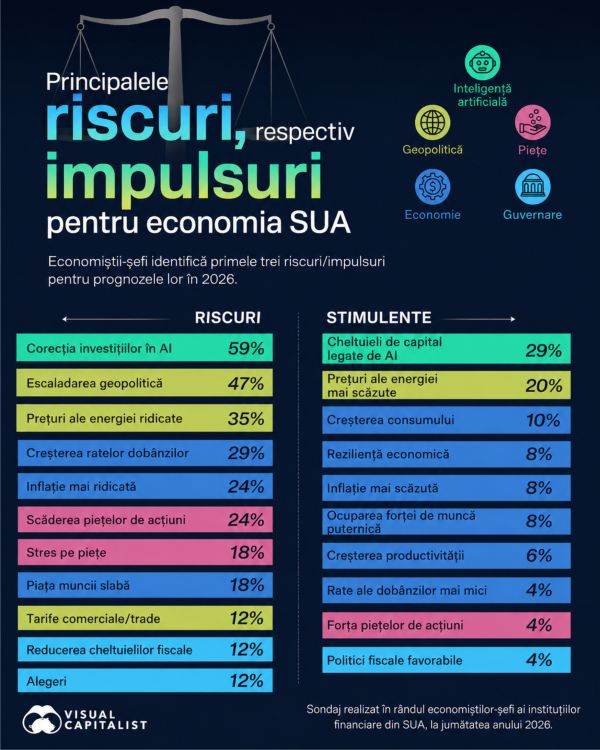
The US economic outlook in 2026 is strongly tied to investments in artificial intelligence (AI). While experts see a potential decline in AI spending as a major threat to the US economy, continued investment in the field could also provide a boost to GDP growth.
Visualcapitalist.com presents the top risks to the US economy in 2026, based on the SIFMA mid-year survey of chief economists at US financial institutions.
• AI Investment Correction - Top Concern
A correction in AI investments stands out as the top concern, cited by 59% of respondents.
The scale of recent spending on AI explains this concern. Specifically, the capital spending of the tech giants - Amazon, Google, Meta, Microsoft and Oracle - is set to reach $412 billion by 2025, equivalent to 1.3% of US GDP. At this scale, AI spending is no longer just a tech sector issue. A slowdown in data center activity, computing equipment and related infrastructure could reduce companies' investment and hurt economic growth.
The other risks highlighted by those surveyed largely point to higher costs. Escalating geopolitical conflicts come in second place, at 47%, while higher energy prices (35%) could squeeze household budgets and business margins. Interest rate hikes (29%) would make mortgages, loans and investments more expensive for companies.
Other risks highlighted in the survey include: a falling stock market (24% of respondents), higher inflation (24%), market turbulence (18%), a weakening labor market (18%), tax cuts (12%), elections (12%), and tariffs/trade (12%).
• AI also dominates the rankings for supporting the economy
While it tops the list of risks, AI also represents the largest potential source of growth for the U.S. economy, according to the survey.
The economic bet is that today's massive investments in AI will ultimately translate into higher productivity. At the same time, spending on AI infrastructure supports business investment and economic activity.
Technology investment accounted for 25% of real U.S. GDP growth in 2023, with its contribution accelerating sharply through early 2026.
For Americans, the other growth scenarios would be more supportive of households. Lower inflation and energy prices would leave households with more money to spend, while strong employment would support incomes, and lower interest rates would make mortgages and other loans cheaper.
• The U.S. Economy's Growing Bet on AI
Taken together, the risk and incentive rankings highlight how important AI investment has become to the economic outlook in 2026.
If the AI boom continues and generates broader productivity gains, it could remain a major driver of growth. However, if spending falls sharply, the same investment that is supporting the U.S. economy today could become a source of weakness.
• US economic growth slowed
US economic growth slowed in the second quarter of 2026, following a widening trade deficit, according to Reuters. The world's largest economy grew at an annual rate of 1.5% in the second quarter of 2026, according to preliminary data recently published by the US Department of Commerce. The growth followed a 2.1% advance in the first three months of this year. Economists had expected annual growth of 2.1% in US GDP in the first quarter of 2026.
• US debt exceeds $40 trillion
US government debt exceeded the $40 trillion threshold for the first time, according to data published last week by the Treasury Department, AFP announced, according to Agerpres.
The U.S. Treasury debt reached $40.047 trillion, driven by increases in both health care and social security loans and interest payments on the debt. This is a faster-than-expected increase in government debt, as the Congressional Budget Office previously estimated that the federal debt would reach about $39.4 trillion by the end of the year.
The accelerating growth in US debt comes as concerns about inflation, particularly the conflict in the Middle East and rising energy prices, have pushed borrowing costs to levels not seen in years.
US debt has doubled since the 2008 financial crisis and now represents almost 125% of Gross Domestic Product (GDP).
However, analysts believe that there is no debt-to-GDP ratio that automatically triggers a crisis.























 Euro
Euro Dolar SUA
 Franc elveţian
 Liră sterlină
 Gram de aur