English
We find ourselves in a constitutional situation that the Fundamental Law does not explicitly describe, but which it does not reasonably allow either: a president who, after the resignation of a designated Prime Minister and after the rejection of a government formula by Parliament, refuses for 62 days to designate another candidate for the position of Prime Minister, thus making it impossible for the Legislature to grant or refuse confidence to a new Executive. In the meantime, we have a dismissed government that continues to administer the country with limited powers.
The inevitable question is whether this paralysis can be brought before the Constitutional Court in the form of a legal conflict of a constitutional nature between the President of Romania and Parliament. The short answer is yes. Such an approach is possible, has a serious legal basis and would put the CCR in the position of determining whether the President's freedom of appreciation also includes the right to block the procedure for forming the Government for an indefinite period.
The success of the referral is not guaranteed, however, because the Constitution does not establish an express deadline within which the President must make the appointment. Article 103 paragraph (1) of the Constitution does not say that the President "may” appoint a candidate for the position of Prime Minister, but that he "appoints” him, after consulting the party holding the absolute majority or, if such a majority does not exist, after consulting the parties represented in Parliament. The formula establishes a mandatory constitutional attribution, not a political faculty that the holder can exercise only when he considers that the result of the parliamentary vote is guaranteed. The President consults, evaluates and appoints; the candidate requests a vote of confidence; Parliament decides. There are three distinct stages, assigned to different authorities. The President cannot substitute Parliament's vote with his own anticipation of its outcome.
• Negative conflict, within the competence of the CCR
According to Article 103, paragraph (2), the appointed candidate has ten days to request Parliament's vote of confidence on the Government's program and list. The Constitution therefore accepts the possibility of a designation failing. Furthermore, Article 89 links the eventual dissolution of Parliament to the rejection of at least two requests for investiture and the passage of a period of 60 days from the first request. If the President refuses to appoint a candidate, the mechanism cannot move forward: no new request for investiture appears, Parliament cannot vote, and the conditions for a possible dissolution cannot be met. By simple inaction, the head of state can freeze both the procedure for forming the Government and the constitutional mechanism designed to overcome the crisis.
It is precisely this blockage that can constitute the subject of a legal conflict of a constitutional nature. According to Article 146 letter e), the CCR resolves legal conflicts of a constitutional nature between public authorities. The Court's jurisprudence does not limit the notion to situations in which two authorities claim the same competence. The conflict can also be a negative one, produced by the refusal or omission of an authority to exercise a constitutional attribution, when this conduct prevents another authority from fulfilling its own role. The Court has repeatedly shown, including through CCR Decision no. 63/2017, that conflict situations that originate directly in the Constitution and that cause an institutional blockage fall into this category.
In the present case, the legal construction of a complaint would be relatively clear: by the prolonged omission to designate a candidate, the President not only fails to exercise his power under Article 103, but also prevents Parliament from exercising its exclusive power to grant or refuse confidence in the Government. Parliament cannot convene the hearing of the proposed ministers, cannot debate the government program, and cannot grant the vote of investiture in the absence of a designated candidate. We therefore have, at least potentially, a negative conflict of competence: the inaction of one authority blocks the power of another.
However, there is an important difficulty. The Constitution does not specify how many days the President has at his disposal for the designation. In other stages, the deadlines are explicit: the candidate has ten days to request the vote of confidence, and the mechanism for dissolving Parliament is based on 60 days from the first request for investiture. In the case of designation, the deadline is missing. Cotroceni Palace could claim that the president must identify a viable political solution and that, in the absence of a majority, continuing consultations is legitimate. Nicuşor Dan publicly justified his inaction precisely by the fact that there is no candidate capable of gathering a majority, declaring that a designation without support would be a "free exercise”.
The argument is not, however, unbeatable. The Constitution requires the president to consult the parties, not to obtain in advance a signed political contract that would guarantee the outcome of the vote. The requirement imposed by the head of state - that the parties first present a clear, stable and assumed majority - does not appear in Article 103. It may represent a prudent political method, but it cannot transform the presidential attribution into one that is suspended until a condition invented by the office holder is met.
• Who can notify the CCR?
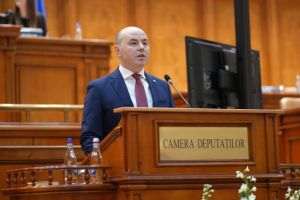
Under these conditions, why is the CCR not notified? Because access to this procedure is guarded by a very narrow political gate. According to Article 146 letter e) of the Constitution and Article 34 of Law no. 47/1992, the complaint can only be filed by the President of Romania, the President of the Senate, the President of the Chamber of Deputies - Sorin Grindeanu, the leader of the PSD -, the Prime Minister or the President of the Superior Council of Magistracy. Realistically, the President will not complain alone, and the SCM has no natural institutional reason to intervene in a conflict regarding the formation of the Government. The interim Prime Minister and the Presidents of the two Chambers remain. If they do not politically wish to open the conflict, if they prefer the current balance or if they fear the consequences of a CCR decision, the deadlock remains without a judge. Here lies the main explanation: not the lack of a legal mechanism, but the lack of will of the incumbents who can activate it.
First, the fact that the President of the Chamber of Deputies, Sorin Grindeanu, does not notify the CCR of the respective constitutional conflict shows that the PSD leader is interested in maintaining the current state of political uncertainty. Especially since he generated it when the PSD and AUR jointly voted for the motion of censure against the Bolojan government.
Secondly, a notification would force the parties to assume an uncomfortable position. Those who attack the CCR would have to demonstrate that they want the procedure to be unblocked, simultaneously assuming the risk of a new designation, a new vote and, possibly, opening the way to early elections. Maintaining a dismissed government can be harmful for the functioning of the state, but temporarily convenient for the actors who retain ministerial positions without having to go through a new vote of confidence. The blockage publicly denounced may become, behind the scenes, a bearable arrangement.
Thirdly, the result at the CCR is not certain. The Court could find the conflict, considering that 62 days exceed any reasonable term and that the President prevents Parliament from exercising its powers. But it could also decide that the lack of an express term, the negotiations between the parties and the presidential margin of appreciation do not allow the situation to be qualified as a legal conflict. This uncertainty may explain the reluctance of the holders of the notification: a decision to reject it would provide the President with a constitutional validation for the continuation of the blockage.
• Kovesi precedent
With regard to constitutional conflicts, we have a precedent - the case of the dismissal of Laura Codruţa Kovesi, from the position of Chief Prosecutor of the DNA. The conflict regarding the dismissal of Laura Codruţa Kovesi was resolved by CCR Decision no. 358 of 30 May 2018, and the notification was formulated by Prime Minister Viorica Dăncilă, the conflict being found between the Minister of Justice and the President of Romania. The CCR then decided that the president's refusal to act on the proposal of the Minister of Justice had created a legal conflict of a constitutional nature and indicated the necessary course of action to extinguish it: issuing a decree of revocation.
The Kovesi precedent demonstrates something essential for the current crisis: the CCR believes that it can analyze not only the abstract existence of a competence, but also how the refusal of one authority to act blocks the exercise of the powers of another authority. If in 2018 the Court was able to transform the presidential refusal into a constitutional conflict and could expressly indicate the obligation to issue a decree, it could, in principle, now find that the president must resume and complete, within a reasonable time, the procedure provided for in Article 103. The Court could not itself designate the prime minister, nor could it impose the name of the candidate on the president. However, it could decide that Nicuşor Dan's inaction cannot continue indefinitely and that the head of state is obliged to exercise the constitutional power.
The conclusion is that referring the matter to the CCR is not only possible, but would be the natural constitutional instrument for clarifying the situation. The issue should not be formulated simplistically as a conflict between two political wills, but as a negative conflict of competence produced by the omission of the President of Romania to finalize the appointment procedure, an omission that prevents Parliament from deciding on the investiture of the Government. The fact that the process does not take place, however, says almost as much about the political system as the blockage itself: the Constitution offers a way, but its keys are exclusively in the hands of dignitaries who, out of calculation, fear or convenience, prefer not to open the door.

























 Euro
Euro Dolar SUA
 Franc elveţian
 Liră sterlină
 Gram de aur