English

Details regarding the Strategic Bitcoin Reserve will be announced by the White House in the coming weeks through Patrick Witt, executive director of the Presidential Council on Digital Assets, following the executive order signed last year by President Donald Trump, according to CoinDesk and TheStreet.
The statement provides the clearest timeline advanced so far by the White House since Donald Trump signed the executive order establishing the reserve, according to TheStreet.
On March 6, 2025, Donald Trump signed the executive order that launched the Strategic Bitcoin Reserve and a separate stockpile of United States digital assets, according to TheStreet.
The document pursues two objectives: to stop the accelerated liquidation of digital assets associated with the previous administration and to require federal agencies to audit their crypto holdings.
Witt did not specify how much Bitcoin or how many other cryptocurrencies the federal government currently holds.
He stated that the administration's priority is to "put its house in order” and protect these assets before discussing concrete figures, according to CoinDesk.
The official admitted at Consensus that the audit revealed a chaotic situation. (Consensus Miami 2026 is a conference organized by CoinDesk, held between May 5 and May 7, 2026, at the Miami Beach Convention Center, bringing together more than 20,000 leaders from the crypto, finance, technology and political sectors, according to the official Consensus website.
"We heard stories and confirmed some of them about cold wallets that were being kept in office drawers across various agencies,” Witt said, according to TheStreet.
Witt appeared to be referring to the alleged theft of 46 million dollars from the crypto wallets of the US Marshals Service, a case that became public this year and led, in March, to the arrest of John Daghita in Saint Martin, according to BeInCrypto (see "The Daghita Case - the vulnerability that triggered the audit”)
• Bitcoin enters the logic of national security
At a hearing of the House Armed Services Committee on April 30, Defense Secretary Pete Hegseth confirmed the importance of Bitcoin for United States national security, according to The Motley Fool.
He stated that many Bitcoin-related actions, whether enabling or countering it, are part of classified efforts currently underway within the department.
According to the same source, this is the first time a sitting Defense Secretary has defined Bitcoin as an instrument of national power projection. Samuel J. Paparo Jr. also confirmed that U.S. Indo-Pacific Command (INDOPACOM) operates a Bitcoin node and tests the protocol for cybersecurity purposes, according to Bitcoin.com.
Republican Representative Lance Gooden of Texas argued that Bitcoin "has evolved from a fringe asset into a national security issue,” according to The Globe and Mail.
He cited Iran's Bitcoin demands at the Strait of Hormuz and accumulation strategies attributed to China.
• Congress decides whether the reserve remains
The executive order does not make this reserve permanent and any future president may revoke it, which is why supporters of the project consider codification through Congress essential, according to TheStreet.
In the Senate, Wyoming Senator Cynthia Lummis introduced the BITCOIN Act of 2025.
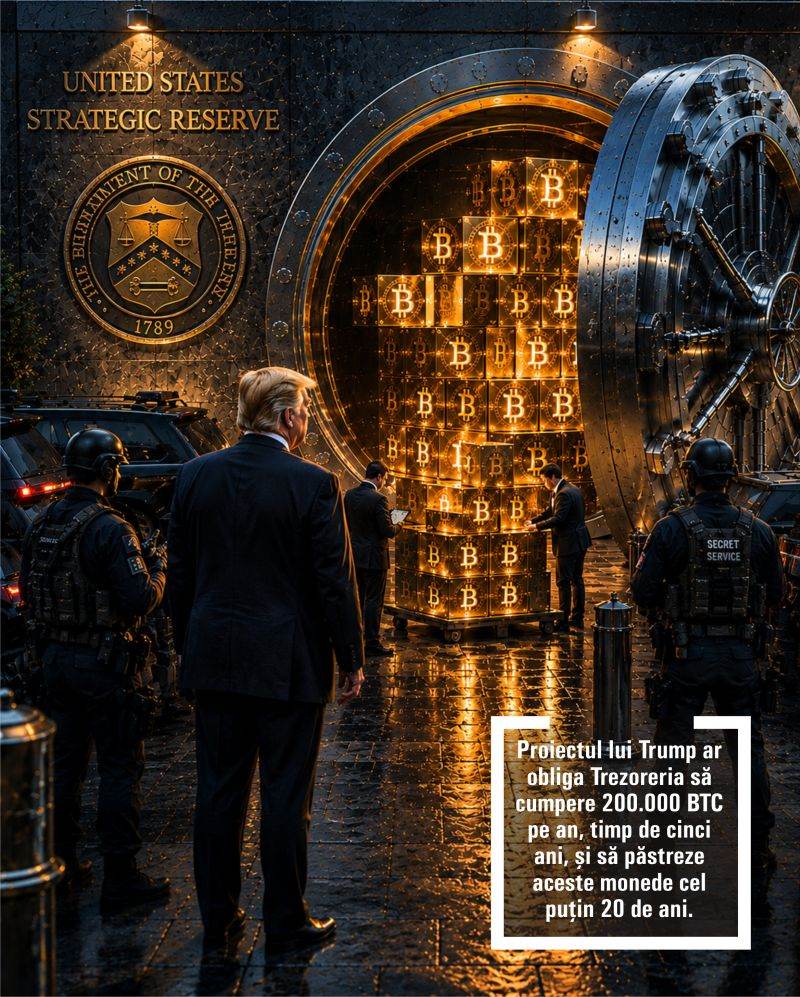
The bill would require the Treasury to purchase 200,000 BTC per year for five years and hold these coins for at least 20 years, according to TheStreet. The initiative is currently before the Senate Banking Committee, with a markup stage expected this month.
In the House of Representatives, Alaska Representative Nick Begich renamed his own version of the bill the American Reserves Modernization Act, with the acronym ARMA, in a move that TheStreet describes as intended to broaden bipartisan support.
Begich stated that he is working together with Lummis to align the two chambers.
If the BITCOIN Act passes, the Treasury could begin the first official Bitcoin purchase in the fourth quarter of 2026, according to TheStreet.
Such a decision would transform the United States into the first sovereign nation to actively accumulate Bitcoin as a strategic reserve asset.
• Impact on the market: five effects
The adoption of the BITCOIN Act would produce an immediate imbalance effect between demand and supply.
Bitcoin supply is limited to 21 million units, and the issuance rate is decreasing, according to the public protocol.
In this context, the annual purchase of 200,000 BTC by the U.S. Treasury, as provided by the initiative supported by Cynthia Lummis, would introduce rigid demand independent of price.
Available data indicate a circulating supply of approximately 19.7 million BTC, of which between 3 and 4 million are considered lost or inaccessible, according to Chainalysis estimates (2020 report) and subsequent Glassnode analyses (2024).
This results in a much narrower liquid market than the gross figure suggests.
The first effect: annual demand on the order of hundreds of thousands of BTC would structurally push prices upward.
The second effect is institutional in nature. By including Bitcoin in the strategic reserve, the United States would validate an asset that it neither issues nor controls. The situation has no precedent in the modern monetary architecture.
By comparison, the U.S. dollar became the global reserve currency following the Bretton Woods agreement, supported by gold convertibility and the economic power of the United States.
In Bitcoin's case, validation comes not from convertibility, but from institutional adoption.
The likely effect is the attraction of global institutional capital: sovereign wealth funds, central banks and asset managers could replicate the American model in order to avoid strategic disadvantage.
The third effect is geopolitical. Statements regarding the use of Bitcoin in sensitive contexts, including references to Iran and China, indicate a shift of monetary competition into the area of digital assets.
If the United States accumulates Bitcoin, other states are compelled to react. The motivation is defensive: avoiding dependence on a strategic asset indirectly controlled by a rival.
This mechanism may accelerate the fragmentation of the international monetary system.
Instead of a system dominated by a single currency, a multipolar space emerges in which digital assets coexist with fiat currencies.
The fourth effect concerns the structure of the crypto market. Bitcoin would become the dominant asset, to the detriment of other cryptocurrencies.
Capital would concentrate around the asset perceived as a strategic reserve, while the rest of the market would become more volatile and more dependent on speculative flows.
This process is already observable during periods of uncertainty, when Bitcoin dominance increases, according to data aggregated by CoinMarketCap (2025).
The fifth effect concerns regulation.
The adoption of the law would impose strict standards regarding custody, auditing and transparency of government holdings. Institutional practices would become standardized, and market infrastructure would become more mature.
If the BITCOIN Act passes, the market will not react as to simple news.
The regime changes.
The price is pushed by structural demand, the asset's status is politically validated, and monetary competition extends beyond the fiat system.
Bitcoin ceases to be an experiment and becomes an instrument of power.
Of course, these scenarios assume that market actors and states react through mimetic accumulation.
Alternative trajectories are also possible - massive sales by early holders taking profits, restrictive international regulatory reactions or fragmentation of institutional demand among several digital assets.
• Counterarguments and risks ignored by the dominant narrative
Public discussion about the Strategic Bitcoin Reserve is dominated by supporters. However, there are serious objections that deserve to be formulated.
Economic skepticism. Nobel laureate Paul Krugman has consistently criticized the idea of Bitcoin as a reserve asset, arguing that the lack of intrinsic value and the absence of an income stream make its price depend exclusively on speculative demand. Several Federal Reserve officials, including in recent mandates, have expressed similar reservations: Bitcoin produces no interest, generates no dividend, is not guaranteed by an issuing authority and does not fulfill the classic functions of a sovereign reserve asset (stability, deep liquidity, predictable correlation with macroeconomic indicators).
Volatility as a structural problem. A strategic reserve asset should preserve its value during crises, exactly when the state needs it. Bitcoin has recorded drawdowns of 70-80% across several cycles: 2014, 2018, 2022. If the U.S. Treasury had purchased at the 2021 peak (~69,000 dollars), the value of the position would have fallen below 20,000 dollars in 2022. A reserve with this amplitude of fluctuation cannot be mobilized in moments of financial stress without crystallizing massive losses.
The direct fiscal cost.
At current prices (~80,000 dollars per BTC), the annual purchase of 200,000 BTC provided by the BITCOIN Act would cost approximately 16 billion dollars per year, therefore 80 billion over the five-year period. The amount is not insignificant in a context of growing federal budget deficits. Supporters of the project propose financing through the revaluation of gold in Treasury reserves or through special bond issuances, but each option transfers the cost either to taxpayers or to the sovereign debt market.
The philosophical paradox.
Bitcoin was designed as an alternative to state-controlled currencies. Its narrative value comes largely from censorship resistance, impossibility of confiscation and independence from any central authority. If major states accumulate Bitcoin in sovereign reserves, the asset loses precisely the feature that distinguishes it: it effectively becomes an instrument of states, not an alternative to them.
A massive concentration in government wallets could, paradoxically, erode the very premises supporting its value.
Concrete reactions are already visible and are manifesting simultaneously in the market, institutional infrastructure and geopolitical discourse.
1. Market reaction: Bitcoin surpassed the 80,000-dollar threshold
Bitcoin climbed these days above 80,000-82,000 dollars, reaching the highest level of the last approximately three months, according to IG Markets, Investing.com and Barron's.
Several sources explicitly link this movement to:
massive inflows into Bitcoin ETFs;
signals coming from the White House regarding the strategic reserve;
the prospect of legislative clarification in the United States.
This is the first concrete reaction: the market is beginning to treat Bitcoin as an asset with potential quasi-sovereign status.
2. Institutional reaction: explosion of inflows into ETFs
Farside Investors data show:
+629.8 million dollars net inflows on May 1;
+532.3 million dollars on May 4;
+467.3 million dollars on May 5.
In just two days, spot Bitcoin ETFs attracted nearly 1 billion dollars, according to CoinRank, KuCoin and CoinPaper.
The dominant players:
BlackRock
Fidelity
The significance is important: large capital is entering before Congress's final decision.
3. Financial discourse reaction: Bitcoin is treated as strategic infrastructure
This includes the information at the beginning of the article that Patrick Witt, White House adviser for digital assets, announced at Consensus Miami 2026 that details regarding the strategic reserve will be presented "in the coming weeks”.
At the same time:
Defense Secretary Pete Hegseth discussed Bitcoin within the logic of national security;
INDOPACOM is testing the Bitcoin protocol for cybersecurity purposes, according to the already cited sources.
This is a major shift in register:
Bitcoin is no longer discussed solely as a financial asset, but as strategic infrastructure.
4. Investment environment reaction: narrative shift
Several recent analyses describe Bitcoin as:
"geopolitical anchor”;
"inflation hedge”;
strategic alternative to gold.
Bloomberg and other analysts cited in these materials observe that ETFs remain resilient even during periods of severe correction, suggesting that the market is shifting from tactical speculation to strategic accumulation.
5. What is not yet visible
There are still no:
- official announcements by other states regarding similar strategic reserves;
- confirmed purchases by the U.S. Treasury;
- proof that the current rally is caused exclusively by the BITCOIN Act.
The market is reacting to anticipation, not implementation.
The first concrete reactions already exist:
- rapid price increase;
- massive institutional capital inflows;
- changes in political and strategic discourse;
- treatment of Bitcoin as a geopolitical rather than merely speculative asset.
These reactions do not yet confirm the new monetary regime.
But they show that the market is beginning to consider it possible.
• The Daghita Case - the vulnerability that triggered the audit
John Daghita, a contractor for the United States government, was arrested on the island of Saint Martin by the elite tactical unit of the French Gendarmerie in a joint operation with the FBI, according to the announcement made by FBI Director Kash Patel.
Daghita is accused of stealing more than 46 million dollars in cryptocurrency from US Marshals Service wallets. The operation involved the International Cooperation Team Serious Crime Unit of the French National Gendarmerie in Saint Martin and the Groupe d'intervention de la Gendarmerie nationale in Guadeloupe.
The case carries significance beyond the financial dimension. Daghita was not an external attacker, but a person with authorized access to the government's crypto custody infrastructure. The exploited vulnerability was internal, not perimeter-based.
This detail directly explains Patrick Witt's statement at Consensus Miami 2026 about "cold wallets kept in office drawers across various agencies” and about the administration's priority to "put its house in order” before discussing concrete figures regarding federal holdings. The Daghita episode illustrates the exact type of administrative chaos that the audit ordered through the March 2025 executive order is attempting to correct: lack of standardized custody procedures, insufficient control over access to private keys, absence of a centralized inventory of digital assets held by federal agencies.
For supporters of the Strategic Bitcoin Reserve, the case functions as an argument in favor of professionalizing government custody. For critics, however, it raises an uncomfortable question: if the American state cannot secure 46 million dollars in crypto, how will it secure a reserve worth tens of billions?


























 Euro
Euro Dolar SUA
 Franc elveţian
 Liră sterlină
 Gram de aur