 English


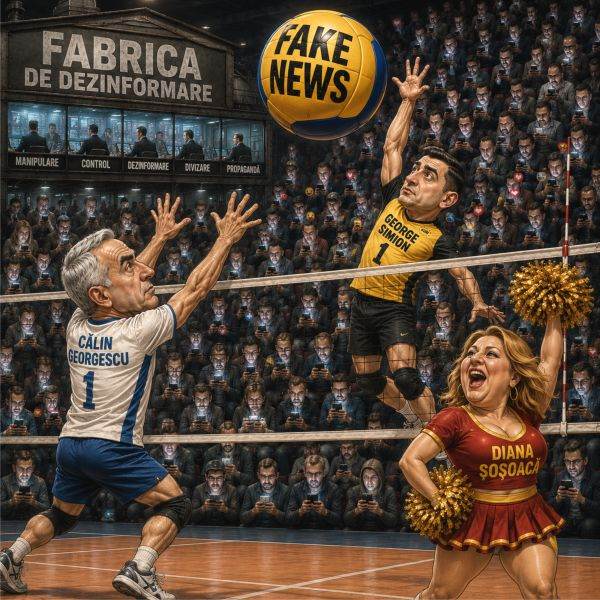
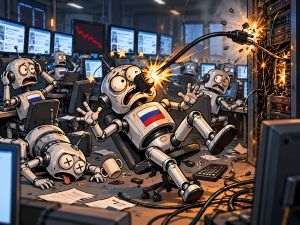
The intelligence services and central authorities in our country seem to be currently incapable of dealing with the tsunami of daily disinformation to which Romanian citizens are subjected on social networks, according to the study entitled "Analysis of disinformation on social networks in Romania", a document presented by the organization Romania Imună, within the "European Summit for Information Integrity and Combating Disinformation", an event that took place at Cotroceni Palace. According to the respective analysis, the Romanian digital space is no longer just a terrain of divergent opinions, but an organized, coordinated and industrialized ecosystem of spreading fear, hatred, conspiracy and systematic distrust in the state, in the West, in the market economy and in democratic institutions, narratives that cannot be effectively combated by officials.
Representatives of the organization that prepared the respective analysis claim that the phenomenon can no longer be treated as a simple problem of "fake news", because the figures indicate the existence of a real information warfare infrastructure, built with operational discipline, with command nodes, with amplification vectors and with psychological mechanisms carefully calibrated to produce social radicalization and political destabilization.
They show that disinformation has penetrated all registers of daily life: health, vaccination, climate, conspiracies regarding cash and digital identity, the war in Ukraine, membership in the EU, the economy, immigration and even the veracity of electoral promises. There is practically no major public interest issue that is not emotionally and ideologically exploited.
The study identifies a perfectly functional architecture of digital propaganda. The Telegram network is presented as the "command center”, with over 48 anti-democratic channels, connected to piloted coordination from Russia, where tutorials for creating manipulative content, volunteer tasks and operational security tactics are distributed. The TikTok network is the "engine for virality”, the platform where lifestyle influencers are instrumentalized, where bots inject comments and where neutral hashtags are hijacked for propaganda. Facebook becomes the "memory of the information ecosystem”, the place where groups and "alternative journalists” consolidate and keep toxic narratives in circulation. YouTube functions as a permanent archive of televised intoxication, and X/Twitter as an international link between the MAGA ecosystem, the global far right and Kremlin-aligned narratives.
• One in six influencers (16.6%) constantly spreads misinformation on social media
The scale of the phenomenon is enormous. The cited study shows that 25,800 online posts were analyzed between March and May 2026, posts that generated over 20.1 million reactions and involved 1,590 unique accounts. Three major categories of actors were monitored: over 500 accounts identified through OSINT as vectors for the propagation of manipulative narratives, over 800 influencers and 235 official sources - institutions, parliamentarians, parties and media entities. From this ecosystem, the report draws one of the most shocking conclusions: one in six influencers and more than one in eight official actors repeatedly spread disinformation in the digital space.
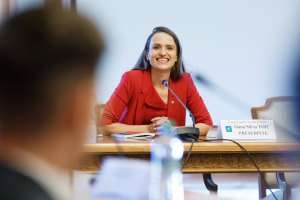
Andreea Nistor, co-founder of the Immune Romania organization, said: "The analysis has three goals: to see what the narratives are on social networks in Romania, to identify who propagates them and the way in which the narratives spread. (...) We are not in an electoral moment today, and yet, disinformation manifests itself in all aspects of our lives. We analyzed five social networks, the first two have the most followers at the moment, TikTok and Facebook. Most often, manipulative news reaches this point due to coordination. For three months, we analyzed over 25 thousand posts made by over 1,500 accounts. We looked at the vectors that spread disinformation most often and we analyzed influencers of all types, including the most viral ones in our country. We found that the phenomenon of manipulation has reached a colossal scale. One in six influencers and one in eight official sources spread disinformation in the digital environment. We need more official entities, the media, that to get on social media accounts. We need to be present where people get their information. If we look at the best performing posts, the most viral, 20% of them represent what we call coordinated attacks. If they were not orchestrated, if they were not based on a succession of social networks, this would not be possible. Information appears injected into the system which, identically, is multiplied by several accounts and reaches the mainstream press. If we understand very well what the major narratives are, our work is no longer so complicated. We also analyzed the language that these posts use. Threat, fear, control and criminal accusations. The Constitutional Court of Romania is the most frequently attacked. The best news of the study is that, if we look at what happens on TikTok, 76% of all disinformation in our country is generated by just 10 accounts. All disinformation in the online environment is generated by 20 accounts, of TV stars, entities paid by the Kremlin and citizens. The important thing is to identify them and respond to their attacks.”
From the end of the above statement, we note that the cited analysis also identifies a serious phenomenon: the legitimization of propaganda through official voices, whether we are talking about TV stars, influencers, or various politicians, the most representative of which is Călin Georgescu. The document shows that when they use the same language as the conspiracy theorists, talking about "globalists”, "coup d'etat”, "dictatorship”, "Ukraine's ATM”, "Brussels puppets”, they offer extremism a certificate of democratic legitimacy. At that moment, marginal narratives are moved to the center of public discourse. Propaganda no longer seems radical, but becomes "a legitimate political position”, the cited analysis claiming that it is actually about "normalization”, "consecration” and "institutional risk”.
• TikTok, the most unbalanced social network in terms of information
According to the document presented yesterday at the Cotroceni Palace, TikTok appears as the most unbalanced information field in Romania. A user who scrolls through 50 posts has only a 4% chance of encountering an official voice and is exposed to a ratio of 142 official posts to 3,540 disinformation posts. Romanians spend an average of 65 minutes per day on TikTok and only 26 minutes on Facebook, which turns the platform into a gigantic accelerator of emotional radicalization. Moreover, official sources have not produced any mega-viral post of over 50,000 reactions on TikTok, while disinformation vectors have generated nine such viral explosions, and influencers three.
Paradoxically, however, the analysis shows that the problem is not the lack of quality of the institutional message. The median engagement of official posts on TikTok is 758 reactions, compared to just 154 for disinformation vectors. On Facebook, influencers have 376 median engagement, official sources 316, and disinformation vectors only 62. The report's conclusion is devastating for the Romanian state: the problem is not the content, but the absence of "super-distributors,” i.e. the inability of institutions to build viralization infrastructures comparable to those of the conspiracy ecosystem.
The analysis also refers to that "modus operandi” through which lies become "social truth.” According to the authors of the study, the first stage is the simultaneous injection of the same narrative on dozens of pages and ghost sites, using identical texts and pseudonews fabricated specifically for the appearance of credibility. The second stage is the takeover by influencers, who package the propaganda in the form of humor, entertainment, or seemingly authentic indignation. The third stage is validation through politicians and official accounts, and the last is absorption into the mainstream, where repetition transforms falsehood into psychological familiarity.
• "Romania-economic colony” and "coup d'etat” - narratives from March-May 2026
The main target of the propaganda is the economy and Romania's relationship with the West. The dominant narrative is "economic colonialism”, which presents foreign companies as plunderers of national resources and the EU as an instrument of exploitation. The analysis identifies 2,053 posts against multinationals, which generated 2.72 million reactions and the highest average engagement per post - 1,325. In comparison, attacks against the electoral system generated 3.74 million reactions out of 3,473 posts, against the government and the president 2.20 million out of 2,444 posts, and anti-NATO/US 5.52 million out of 6,280 posts.
The list of economic narratives is impressive in volume and coherence: 1,426 statements are about "the deforestation of Romania by foreigners”, 991 about oil and gas "stolen” by Western companies, 976 about post-1989 privatization as a "planned transfer of wealth to the West”, 739 about the destruction of Romanian producers by foreign supermarkets, 608 about the repatriation of profits and 215 about "Big Tech censorship”. All narratives are meant to induce the public to believe that Romania is an economic colony without sovereignty.
The analysis identifies six dominant theme-narratives in the period March-May 2026. The strongest is sovereign anti-Westernism - "Romania is a colony” -, which generated 9.8 million reactions and 9,600 posts. The second is the theory of a "coup d'etat” by canceling the presidential elections in December 2024, with 4.7 million reactions and over 4,500 posts. The third is the theme of Christian identity threatened by Western liberalism, with 4.2 million reactions and 6,500 posts. The fourth is anti-Ukraine and the fear of war, with 3.3 million reactions and 4,900 posts. The fifth is "Great Reset” type conspiratorialism, with 3.2 million reactions and 6,500 posts. The sixth is the anti-EU discourse and the idea of the orchestrated bankruptcy of Romania, with approximately 1.3-1.4 million reactions and over 2,300 posts.
The dominant emotions used in the propaganda are fear, domination and criminal accusation. The report identifies 12,537 posts using the language of threat and war, 10,915 operating with the idea of control and manipulation, 6,348 based on accusations of theft and betrayal, 5,232 about destruction and 4,704 about illegitimacy and propaganda. The most extremist language is directed against the Constitutional Court, where 35.5% of the posts use terms such as "coup d'etat” and "treason”. NATO and the US receive "strong” language in 67.2% of cases, the EU and Brussels 66.5%, Zelenskiy and Ukraine 59.2%, and the Presidency 78.2%.
Perhaps the most frightening conclusion that emerges from the analysis is that Romania is no longer witnessing spontaneous information chaos, but digital social engineering that works with mathematical precision. A tiny number of accounts produce most of the propaganda, the same narrative is injected simultaneously on multiple platforms, influencers transform it into viral emotion, political actors validate it, and the mainstream normalizes it. In this ecosystem, conspiracy becomes a current conversation, radicalization becomes identity, and distrust becomes political fuel. Basically, Romania no longer has just a public communication problem, but a major strategic vulnerability, in which the information space is already a geopolitical battlefield.
The document presented yesterday also offers solutions: permanent monitoring of news with the potential to go viral and countering them; conducting digital immunization campaigns for citizens; online activities, building a civic infrastructure, but also a set of ways to bring to public attention all those who spread disinformation.
• Nicuşor Dan: "Disinformation is a matter of national security"
President Nicuşor Dan declared yesterday, at the "European Summit for Information Integrity and Combating Disinformation", that the phenomenon of disinformation represents "a matter of prosperity" and national security, because it affects trust within society.
The head of state stated: "Disinformation is not just a matter of democracy, it is not just a matter of ethics, it is a matter of prosperity, because there is a correlation between trust within a society and the prosperity of that society, and disinformation attacks exactly there, at the level of mutual trust within a society. Today's disinformation, as we know, is no longer a succession of ad-hoc operations, it is coordinated, it is on multiple levels and is based on technology. Therefore, the response to it must be equally coordinated.
And it is not just about politics in the narrow sense of the term. We have disinformation in the medical area and that costs, costs resources and even costs lives. We have disinformation in the economic area, as has been said."
Nicuşor Dan explained the relationship between disinformation and the functioning of democracy, stating that "democracy means people who legitimately try to influence each other so that together they can make the best decisions for themselves as a society”, while "disinformation means perverting this mechanism, that is, artificially unbalancing the hierarchy of arguments and introducing false factual elements that, by promoting them, make them true”.
In his opinion, combating the phenomenon must be done without affecting freedom of expression: "we must look at those mechanisms that pervert a hierarchy of values and legitimate actions that society produces for itself, without affecting the citizen's ability to express any idea, opinion, or assessment they wish”.
Nicuşor Dan also criticized the way institutions and politicians currently communicate, stating that the state must "communicate coherently and strategically and, if possible, humanly and not propagandistically", adding that the authorities must reach "where the public is", including on social networks. "All of us politicians, we are on talk shows, we argue with each other, and there are others on TikTok. And some are the topics that we debate among ourselves on TV, and others are the topics that people debate on TikTok," said Nicuşor Dan.
The president insisted on the need for media and digital education, which he described as "a matter of national security," but also on regaining public trust in institutions.













 Euro
Euro Dolar SUA
 Franc elveţian
 Liră sterlină
 Gram de aur





























