English


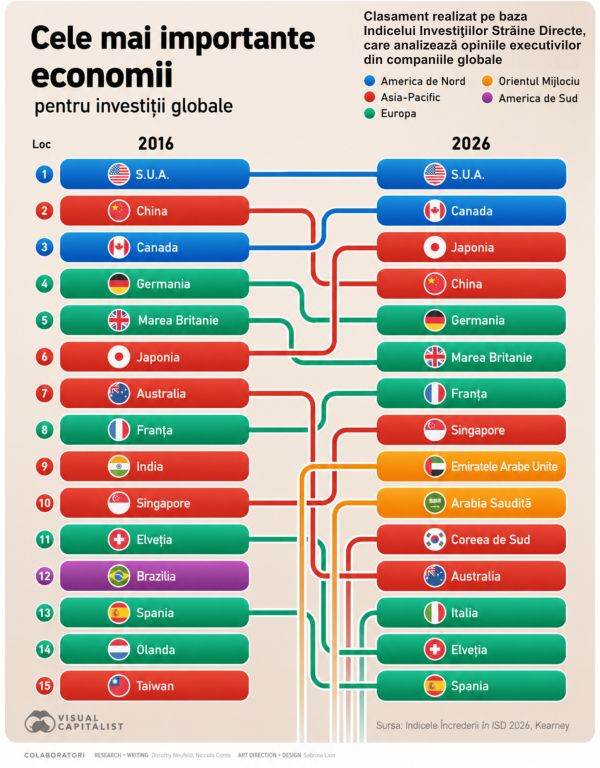
Global investors are rethinking the direction in which capital will flow in the next decade. According to the 2026 Foreign Direct Investment Confidence Index, conducted by consulting firm Kearney, Canada and Japan have risen sharply in the ranking of investors' preferences, while China has fallen from second place to fourth place since 2016, notes visualcapitalist.com.
The US remains at the top of the ranking, a position it held in both 2016 and 2026.
At the same time, Gulf economies such as Saudi Arabia and the United Arab Emirates are emerging as major investment hubs, with billions of dollars being allocated to artificial intelligence (AI) infrastructure, logistics and industrial diversification.
The cited source compares the world's top investment destinations in 2016 versus 2026, based on a survey of 507 executives on the markets they expect to invest in over the next three years.
• How the global investment ranking has changed over the past decade
The biggest change in the ranking is China's decline from 2nd place to 4th place over the past decade, while Canada has climbed to second place and Japan to third. The ranking highlights a major reshuffle in investor confidence over the past decade. The United Arab Emirates (9th) and Saudi Arabia (10th) now rank alongside investment powerhouses Germany (5th) and the UK (6th). This year, Saudi Arabia entered the global Top 10 for the first time. Increasingly, Gulf states are leveraging their sovereign wealth and infrastructure spending to position themselves as technology and logistics hubs.
• Why Canada overtook a power like China
Canada now ranks second as the world's most attractive destination for foreign investment, buoyed by its natural resources, political stability and growing spending on artificial intelligence infrastructure, according to the cited source.
In the first half of 2025, the country registered a record 297 foreign direct investment announcements. The strength of technological innovation has also played a key role in investor confidence, likely bolstered by the federal government's proposed $926 million budget for sovereign AI infrastructure. Geopolitical tensions, however, have hurt China as an investment destination. More recently, however, economies such as Canada and Kenya have struck new trade deals with China amid a changing global order.
• Growing attraction for investment in the Middle East
Saudi Arabia has risen rapidly in the rankings, entering the Top 25 in 2023, before falling to 10th place in 2026. As the country seeks to diversify away from oil and gas revenues, it aims to attract $100 billion in foreign direct investment annually by 2030.
Amazon Web Services (AWS) plans to spend $5.3 billion to expand its data center infrastructure in Saudi Arabia by 2026. At the same time, Google Cloud is working with the kingdom's sovereign wealth fund to build an artificial intelligence hub.
Similarly, the United Arab Emirates has attracted major investment plans from Microsoft, Oracle and AWS.
While the conflict in the Middle East is likely to affect regional economic growth, future investment flows may depend on the extent and duration of the war.
• The New Geography of Global Investment
Countries climbing the rankings have a similar formula: political stability, long-term industrial investment, spending on AI infrastructure and access to critical resources and trade networks, notes the cited source.
Whether it's Canada, Japan, Saudi Arabia or the United Arab Emirates, the next decade of foreign investment could be defined less by rapid growth and more by whether economies can offer resilience, infrastructure and long-term strategic advantage.






















 Euro
Euro Dolar SUA
 Franc elveţian
 Liră sterlină
 Gram de aur