English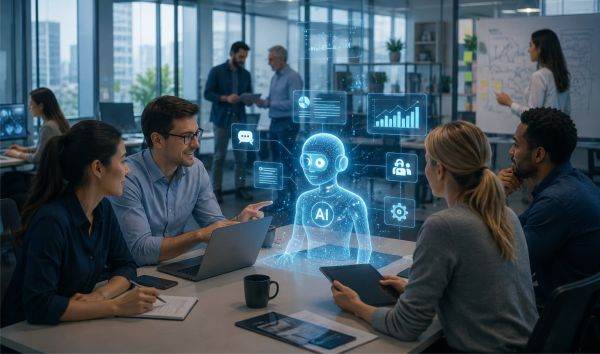
Artificial intelligence isn't just changing how work tasks are performed, it's also starting to affect relationships between coworkers. Shallow, automatically generated text, the use of chatbots instead of face-to-face conversations, and systems that filter communication are contributing to distrust and frustration in companies, according to CNBC.
• AI is Changing the Way Colleagues Communicate
The rapid expansion of artificial intelligence tools comes at a time when many organizations have yet to establish clear rules for their use. About half of employees say they use AI at least once a week, but 84% say they taught themselves how to use these tools, and 55% say their organization doesn't have a formal policy on AI, according to a CNBC and SurveyMonkey survey of 1,686 employees. One case reported by CNBC is that of a project manager in Chicago who worked with an AI expert who had let her intelligent agents manage her emails. However, the systems blocked important messages, causing project delays, and the team was later unable to contact the expert directly. The lack of rules also produces distrust in relationships between colleagues. Some employees say they feel wronged when their work is automatically assumed to have been generated by ChatGPT or Claude, even if it was done without the help of artificial intelligence. An experiment conducted by Atlassian on 1,000 American employees showed that people who admit to using AI at work may be perceived as lazier and less suitable for important projects.
• "Workslop”, the content that transfers work to colleagues
An additional source of frustration is the phenomenon called "workslop”, whereby AI-generated content appears well-done at first glance, but is superficial, incorrect or lacking in substance and must be redone by other employees. About 40 percent of American office workers say they've received such material, according to research by BetterUp and the Stanford Social Media Lab. Proofreading such material can require overtime and reduce productivity.
Kim Bode, the founder of a Michigan communications company, said she lost $10,000 after hiring an outside contributor and having to rewrite all the content she received, which she thought was clearly generated by AI. But the problem goes beyond the quality of the material. Employees are left wondering whether their writers don't notice the problems or whether the responsibility for correcting them is being deliberately shifted to colleagues.
• Fear for the workplace fuels tensions
About one in five employees say that artificial intelligence makes them feel less secure in their jobs, while one in three are more pessimistic about the job market because of the technology. At the same time, companies are asking employees to do "more with less” and are presenting AI as a tool for increasing productivity. But the results are not always as expected.
A Gartner report in May indicated that companies that laid off employees to redirect money to AI investments did not achieve the expected returns. Similarly, an MIT analysis from 2025 found that 95% of organizations analyzed did not achieve financial results from investments in generative AI. The pressure to use the technology can even lead to using it without a clear benefit. Victor Riparbelli, CEO of AI platform Synthesia, said that he criticized his own employees for overly elaborate, AI-generated documents that contained a lot of wording but little substance.
• Chatbot gets ahead of the colleague
Artificial intelligence is starting to replace even some face-to-face interactions between employees. About one in four employees who use AI say they have directed a colleague to ask a chatbot first before asking it for help with a problem.
While the goal is often to save time, the practice can be perceived as disinterested or even insulting. Employees turn to colleagues for their experience, judgment, and knowledge, not just to get information. Research from BetterUp Labs, Stanford Social Media Lab, and Oxford University's Saïd Business School shows that when managers use AI instead of in-person conversations about professional development or mentoring, employee intent to leave increases by 29%, burnout levels increase by 26%, and team coordination decreases by 12%.
• Companies are still setting their own rules
Problems also arise when using automated tools in during meetings. A Washington-based architecture firm discovered that Microsoft Copilot was automatically adding a transcription tool to meetings and then sending the transcripts to all participants. The situation became problematic when the discussions included sensitive topics or evaluations of the work of colleagues. The company later introduced a rule according to which such systems cannot be used without the consent of all participants.
Employees' perceptions of the effect of AI on organizational culture are divided. About 25% of those who work in organizations that have adopted artificial intelligence say that it has deteriorated, while 24% believe that it has improved, according to a Gallup poll. The data suggests that the problem is not solely represented by technology. Experts cited by CNBC believe that artificial intelligence can amplify existing difficulties in the workplace, such as poor communication, sloppy management, poor quality work and insufficient professional judgment.

























 Euro
Euro Dolar SUA
 Franc elveţian
 Liră sterlină
 Gram de aur