English
The initial response of farmers receiving EU funds is to commit to-and subsequently achieve-specific targets or objectives, while also fulfilling all the prerequisites for accessing the money. It appears that Romanian farmers-whether engaged in general agriculture, vegetable growing, fruit growing, viticulture, or livestock farming-have met these conditions; data from the European Commission, the Ministry of Agriculture, AFIR, and APIA show that, under the current 2021-2027 multiannual financial framework, they received nearly euro6 billion in direct payments and other funding schemes by the end of August 2026. This figure is part of the euro9.8 billion earmarked for direct payments and the more than euro2 billion allocated for farm modernization investments in the country through the Common Agricultural Policy. These euro6 billion reached the accounts of Romanian farmers over the last three years-specifically, the 2023-2025 period. Added to this figure are payments scheduled for 2026, amounting to over euro500 million. Also to be included are the funds allocated from the national budget by the various governments that have held office at Victoria Palace over the past three years to support schemes for farmers-totaling euro2 billion. This figure excludes allocations for the INVESTALIM program and other food processing schemes, funds for rehabilitating and expanding irrigation infrastructure, and compensation paid by authorities for livestock culled during disease outbreaks.
In effect, over the last three years, at least euro8 billion has reached Romanian farmers to maintain or boost their competitiveness. Yet, despite these funds, we see them taking to the streets; yesterday, they protested in front of Victoria Palace, decrying the underfunding of Romanian agriculture and the livestock sector. This spontaneous protest was announced in advance by sheep farmers-a sector that accounts for just 2.4% of total annual agricultural and livestock output in Romania, according to data from the European Commission.
It is worth noting that, under the current multiannual financial framework, Romania has nearly euro15.8 billion available for agriculture and rural development via the CAP, with euro11 billion earmarked for direct payments to producers and farm modernization. However, we import agri-food products worth approximately euro13.7 billion annually-a sum equivalent to nearly two-thirds of the total domestic primary agricultural output, estimated at around euro21.5 billion per year. When measured solely against the produce that actually reaches the market, the value of imports accounts for over 70%, although official statistics do not allow for an exact percentage calculation. This paradox is compounded by the extremely poor organization of producers: our country's CAP Strategic Plan estimates that only 0.03% of farms participate in supported forms of cooperation and that merely 1% of the value of marketed fruit and vegetables passes through producer organizations or groups.
• Only 2% of annual fruit and vegetable production is marketed by farmer organizations
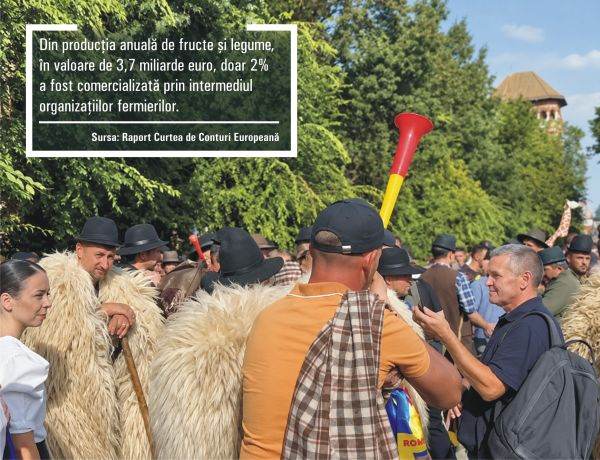
The data estimated by Romanian authorities add to the bleak picture presented yesterday by the European Court of Auditors (ECA), which analyzed how financial aid from the EU budget for producer organizations in the fruit and vegetable sectors of member states is utilized. According to the ECA report, Romania has one of the most poorly organized fruit and vegetable markets in the European Union: although national production amounts to euro3.7 billion, only 2% of its value is marketed through producer organizations, leaving farmers fragmented and vulnerable in negotiations with major retail chains. In practice, the majority of fruit and vegetable producers prefer to sell on the open market to intermediaries who bring the produce to agri-food markets in large cities, while very small-scale producers sell at local fairs or directly from their farm gates located along national roads or county level.
According to the cited document, the rate of farmer organization in our country is 2%, compared to 58% in Spain and Italy, 62% in the Netherlands, 79% in Belgium, and 86% in Denmark. Among states with an output exceeding one billion euros, Romania ranks at the bottom of the European list, trailing behind Poland (where the organization rate is 11%), Greece (9%), Portugal (21%), Hungary (23%), Germany (28%), and France (43%).
Another comparison highlights the imbalance even more clearly. According to ECA auditors, the four largest producer organizations in Romania collectively marketed only 1% of the national fruit and vegetable output-representing a total value of 3.7 billion euros. In contrast, the top four organizations accounted for 63% of production in Belgium, 76% in Slovakia, 54% in the Netherlands, and 86% in Denmark. Essentially, Romanian farmers enter commercial negotiations in a fragmented state, whereas retailers operate through highly concentrated structures.
• Producers at a disadvantage in negotiations with major retailers
According to 2022 data included in the cited report, the country had 23 recognized producer organizations marketing products with a total value of 151.46 million euros. The average marketed output was approximately 6.59 million euros per organization; however, only 26% of these were active-meaning they were implementing operational programs to access European funds. The average EU support granted to an active organization in Romania was euro216,028, with total funding received that year amounting to approximately euro1.3 million. By comparison, Spain had 513 organizations, Italy 299, France 195, and Poland 163. Approximately 75% of all European financial support allocated to these structures was concentrated in Spain, Italy, and France. In 2022, Spanish organizations received euro288.9 million, Italian ones euro252.8 million, and French ones euro127.5 million.
According to data from the European Commission's website, vegetable and horticultural production accounts for 16.6% of Romania's total agricultural and livestock output, while the fruit sector accounts for 8.9%.
Romania's situation confirms one of the key conclusions of the European Court of Auditors' report: EU funding helps farmers become more competitive but fails to eliminate the significant bargaining imbalance between agricultural producers and major retail chains.
• The situation at the European level
Producer organizations can consolidate supply, negotiate larger volumes, invest jointly, and reduce costs; however, the majority remain too small to negotiate from a position of strength with retailers. "For producer organizations to help farmers stand up to major buyers and offer consumers a wide range of European fruit and vegetables, rules need to be simplified, national support must be more coherent, and membership in these organizations needs to become more attractive," stated Ms. Keit Pentus-Rosimannus, the Court member responsible for the audit, according to the press release issued by the ECA upon the report's publication.
In 2023, fruit and vegetable grower organizations received euro1.06 billion in EU support. The funds were used to modernize equipment and infrastructure, automate production, reduce energy and water consumption, obtain quality certifications, improve packaging and logistics, and develop quality labels recognized by consumers.
EU funding is linked to the value of marketed production, thereby incentivizing organizations to increase their turnover and plan crops, varieties, and volumes based on market demand. This support provides stability and enables farmers to make investments that would be difficult to implement individually. Furthermore, joint sales mitigate-to some extent-the risks associated with price fluctuations. However, these benefits have not been sufficient to make the organizations more attractive. Across the EU, the number of farmers belonging to such structures fell by 39% between 2012 and 2023, dropping from 312,823 to 191,310 members. The European organization rate rose from 43.6% in 2012 to 48.4% in 2017, but subsequently entered a downward trajectory, reaching approximately 42% in 2023.
The withdrawal of farmers cannot be explained solely by the disappearance of agricultural holdings and the lack of generational renewal. Between 2013 and 2020, the number of members in producer organizations fell by 29%, while the number of farms in the fruit and vegetable sector decreased by 14%. In other words, farmers left these organizations at a rate more than twice as fast as the rate at which holdings disappeared. In 2024, there were 1,488 recognized organizations in the fruit and vegetable sector in the European Union, with 187,372 members, as well as 69 associations of producer organizations. However, their size and influence vary enormously across Member States. The share of production marketed through organizations ranged from 0.8% in Slovenia to 86% in Denmark, while in some countries, no recognized organizations existed at all.
• euro80 billion - the annual value of fruit and vegetable production across the EU's two million farms
European auditors believe that historical and cultural differences only partially explain this situation. Some national authorities actively collaborate with the organizations, provide advice, and enable the funding of a wide range of investments, whereas others impose restrictive eligibility rules and offer limited administrative support. These disparities create an uneven playing field within the single market and may discourage farmers from forming associations or submitting programs to access EU funds.
Even large organizations have failed to eliminate the structural imbalance. The four largest retail companies generate between 30% and 70% of commercial turnover in the European markets analyzed, whereas in the six Member States that collectively account for three-quarters of the EU's fruit and vegetable production, the top four producer organizations control only between 1% and 13% of national output. Furthermore, the perishable nature of the produce compels growers to sell quickly, limiting their ability to engage in prolonged commercial negotiations. Nevertheless, the sector holds immense economic and social significance. Agriculture provides food for 450 million Europeans and jobs for 30 million people. In 2024, agriculture contributed euro532 billion, equivalent to 1.2% of the European Union's GDP. Fresh fruit and vegetables, produced by approximately two million farms, accounted for around euro80 billion-or 15%-of total agricultural output.
Against this backdrop, the European Court of Auditors calls on the European Commission to issue recommendations for making farmers' organizations more attractive. It points out that, without simpler rules, coherent national support, and genuine supply concentration, massive EU budget allocations may modernize production but cannot provide farmers with the market power needed to compete with major retail chains.


















 Euro
Euro Dolar SUA
 Franc elveţian
 Liră sterlină
 Gram de aur