 English

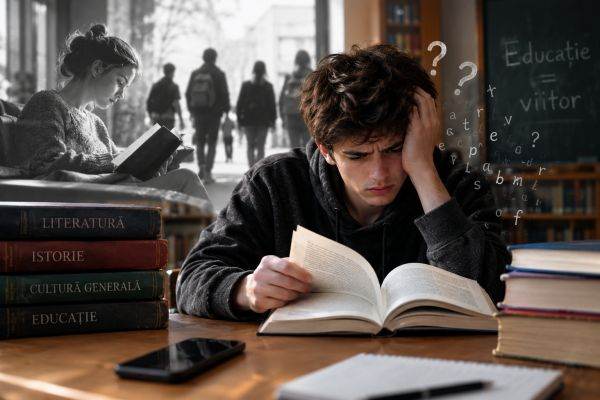
Romania's education system fails to cultivate enough readers and contributes to the shrinking of the book market, while Artificial Intelligence tools raise issues regarding the use of authors' works and information manipulation, stated Mihai Mitrică, Director of the Romanian Publishers Association (AER), in Târgu Mureş. According to the publishers' representative, the decline in the number of readers is not primarily caused by the population's financial situation, but rather by shortcomings in the education system; these deficiencies affect young people's ability to comprehend texts and can make them more vulnerable to misinformation and manipulation.
• "Reading is becoming a luxury”
"First of all, reading is becoming a luxury because the audience is dwindling-and the audience is shrinking not so much for economic reasons, although those are significant, but rather due to a lack of performance in the education sector,” stated Mihai Mitrică at the Bookfest Book Fair in Târgu Mureş. The AER director argued that in a functioning book market, the education system plays a crucial role in cultivating a reading audience through its graduates from middle school, high school, and university. In his view, OECD data indicate problems regarding the ability of 15-year-olds to comprehend written texts. "They lack the basic skill-acquired in school-of reading and comprehending what they read; this puts them at a major disadvantage as they start out in life and makes most of them almost certain prey to the manipulation that, as we can already see, dominates the information landscape," stated Mihai Mitrică. He added that, in this context, false information has come to occupy a significant portion of the information space.
• Criticism regarding the use of works in AI development
The AER director also criticized the way large language models (LLMs) are developed, arguing that they utilize authors' works without authorization.
"Artificial Intelligence is, first and foremost, a thief, because these automated information-compiling engines are based on books by human authors that were scanned without permission and are used without authorization to fuel these large language models," declared Mihai Mitrică. However, the publishers' representative acknowledged that these technologies can have practical utility, while simultaneously criticizing their use to generate and amplify misleading information online. "It is true-they can be useful tools; indeed, they often are. Yet, they are also used to create much of the disinformation circulating on social media," the AER director added.
• Reading and the development of critical thinking
Mihai Mitrică linked the ability to critically evaluate information to the skills developed through reading, arguing that a lack of such skills can expose people to consequences at both the individual and societal levels. "And people who are not prepared to use critical thinking to navigate these new situations easily fall prey to manipulators and charlatans of all kinds; they risk losing not only their own money but, above all, the future of the country they inhabit," warned the AER director. These remarks were made at the Bookfest Book Fair in Târgu Mureş, during discussions on the evolution of the book market, the role of education in cultivating readers, and the impact of new technologies on the publishing industry.


















 Euro
Euro Dolar SUA
 Franc elveţian
 Liră sterlină
 Gram de aur





























