 English

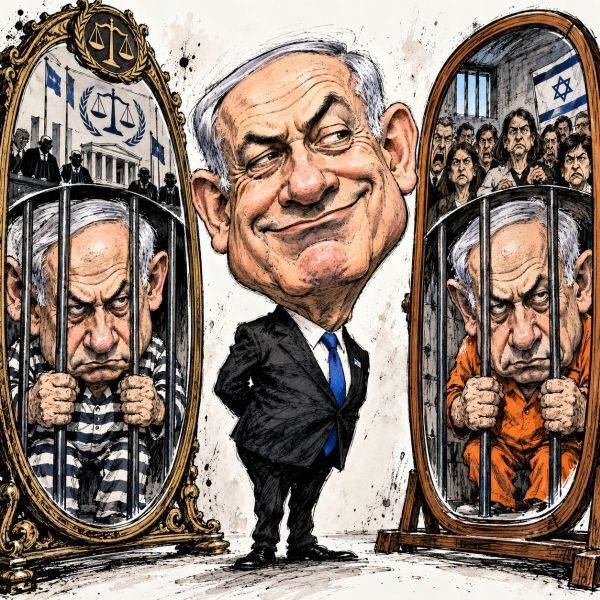

The world judges Netanyahu over Gaza; Israelis judge him over 7 October (Article 1)
Israel's parliamentary elections on 27 October represent the first vote by Israelis since a large part of the world condemned the way their government conducted the war in Gaza.
The condemnation is visible in polls, in states' actions and in the rulings of international courts, and its target is Prime Minister Benjamin Netanyahu, who is wanted by the International Criminal Court.
Israeli voters, however, judge him for something else: for the failure that made the Hamas attack of 7 October 2023 possible, for the hostages and for his refusal to hold an inquiry into that failure.
Even if Netanyahu loses, his main opponents are not promising a different policy in Gaza, so the vote will not by itself provide the answer the world is waiting for.
• What states have done: the empty chamber and recognition of Palestine
Three times during the war, in 2024, 2025 and 2026, delegates at the UN General Assembly walked out when Netanyahu took the podium.
On 24 September 2026, according to the Anadolu agency, cited by The Media Line, representatives of around 70 countries walked out or did not attend, including those of Saudi Arabia, Egypt, Jordan, Turkey, Indonesia, as well as Spain, Brazil and Peru. Netanyahu told those who remained to leave too, if they were "moral cowards”.
Germany, the United Kingdom and France stayed in the chamber, but a year earlier they had made a gesture more consequential than walking out. In September 2025, the United Kingdom, Canada, Australia and Portugal recognised the Palestinian state, and France did the same on 22 September at the UN, through President Emmanuel Macron (To Vima). At the time, the Palestinian state was recognised by 147 of the UN's 193 member states, according to Al Jazeera.
For the first time, close allies of Israel recognised the Palestinian state against the Israeli government's wishes.
• What people think: the Pew survey
Pew Research Center interviewed 44,657 people in 36 countries and territories between 8 February and 13 May 2026. Opinions of Israel were unfavourable among a majority in 30 of them, and the median of the national percentages of people with an unfavourable opinion was 67%, compared with 25% with a favourable opinion.
Of the 24 countries measured in both 2025 and 2026, unfavourable opinions increased in 13: in the United States from 53% to 60%, in Germany from 64% to 73%, and in the United Kingdom from 61% to 69%.
The most negative opinions are held by young people and people on the left: in Hungary, 72% of those aged 18-34 have an unfavourable opinion of Israel, compared with 45% of those over 50; in the United States, 83% of liberals, compared with 37% of conservatives.
The world is not unanimous, however: in India, Sri Lanka, Kenya, Nigeria and Ghana, unfavourable opinions are in the minority.
• Why the world's opinion changed
Has the world turned against Israel because Israel's response to the Hamas attack shocked it? The Pew survey cannot prove the cause, but unfavourable opinions increased during the years of war, alongside the events below.
Gaza's Ministry of Health counted 74,237 Palestinians killed by 4 October 2026, according to the Palestinian agency WAFA. The Ministry does not distinguish between civilians and combatants, but an investigation by +972 Magazine, Local Call and The Guardian showed that the Israeli military intelligence service's own records counted, by May 2025, 8,900 fighters identified by name as dead or probably dead, out of around 53,000 deaths, meaning, according to the investigation's authors, that at least 83% of those killed were civilians.
On 22 August 2025, the Integrated Food Security Phase Classification (IPC), a consortium of UN agencies and humanitarian organisations, confirmed famine in the Gaza Governorate, the first famine confirmed by the IPC outside Africa.
The world's reaction, however, was not only outrage over Gaza. Tel Aviv University's annual report shows that the number of antisemitic incidents reached its peak immediately after the 7 October attack, before the major Israeli offensive. Some of the hostility therefore did not wait for Israel's response, and outrage over what happened in Gaza and hatred of Jews are two different things.
• Why Israelis do not see a disproportionate response
For Israelis, the war began with the deadliest attack in the history of their state. On 7 October 2023, Hamas killed approximately 1,200 people in Israel, most of them civilians, and another 251 were abducted and taken to Gaza, according to Foreign Policy.
The attack was led by Yahya Sinwar, whom Israel had released in 2011 even though he had been sentenced to four life terms. Sinwar was one of around 1,027 Palestinian prisoners released in exchange for a single Israeli soldier, Gilad Shalit, according to Ynet.
Israelis see on the other side a population that, for the most part, approved of the attack. In March 2024, 71% of Palestinians considered the 7 October attack "the right decision”, and in October 2025 the figure was still 53%, according to polls by the Palestinian Center for Policy and Survey Research (PCPSR), while 86% denied that Hamas had committed the filmed atrocities.
In 2014, the ADL Global 100 survey found in the West Bank and Gaza the highest proportion of adults agreeing with antisemitic stereotypes of all the more than one hundred countries and territories surveyed: 93%, according to The Times of Israel.
Hamas fighters do not wear uniforms, and the Israeli government says the organisation hides in populated areas. For 64% of Israelis, "there are no innocent people in Gaza”, according to a survey by the aChord centre at the Hebrew University, published by Haaretz and cited by the Libertarian Institute. Among government supporters, the proportion was nine out of ten, while among left-wing opposition supporters it was 30%.
For Israelis who start from these facts, the deaths in Gaza are not a disproportionate response, but the price of a war started by Hamas.
• International law put to the test
On 26 January 2024, the International Court of Justice, acting on an application by South Africa, ordered Israel, through binding provisional measures, to prevent acts of genocide and allow humanitarian aid. The Court did not rule on the merits.
On 21 November 2024, the International Criminal Court issued arrest warrants for Netanyahu and former Defence Minister Yoav Gallant for the war crime of using starvation as a method of warfare and for crimes against humanity. The warrant is not a conviction, but Netanyahu risks arrest in any of the Court's member states.
The West has been divided over the Court. The United States sanctioned its officials, including prosecutor Karim Khan, and an American federal judge blocked the enforcement of the sanctions. European states that are members of the Court are obliged to execute the warrant: "it is not optional”, said Josep Borrell, the EU's foreign policy chief at the time.
• What Israelis are judging
Israeli Jewish voters, who make up the vast majority of voters, view the war in Gaza differently from the rest of the world. In an Israel Democracy Institute poll in July 2025, only 20.2% of Israeli Jews said reports about famine in Gaza troubled them, while 78.1% said Israel was making major efforts to avoid unnecessary suffering for Palestinians. Among Arab Israelis, 86% said they were troubled.
When choosing a party, Israeli Jews put other issues first. In the Israel Democracy Institute's analysis from December 2025, five issues were each named by 16-18% of respondents as the most important for their vote: the return of the hostages, the events of 7 October, the recruitment of the ultra-Orthodox, the cost of living and judicial reform. The way the war in Gaza was conducted was not among them.
What Israelis are demanding is accountability for 7 October: 71% of Israeli Jews want a state commission of inquiry, which Netanyahu has refused for three years, according to an Israel Democracy Institute poll from October 2026. The dossier's Article 2, "Israelis demand the 7 October inquiry that Netanyahu has refused for three years”, deals with this inquiry and the reasons for Netanyahu's refusal.
• What the 27 October vote could change
Netanyahu's main opponents, Gadi Eisenkot and Naftali Bennett, also support a hard line towards Hamas and Iran. Eisenkot has also ruled out a coalition with the Arab parties-that is, precisely the parties representing Israeli voters who judge the war in Gaza most closely to the way the rest of the world does.
A change of prime minister would change one specific thing: the next prime minister would not be subject to an international arrest warrant and could travel to member states of the International Criminal Court.
Policy in Gaza would not change by itself, however. The 27 October vote will show what Israelis think about 7 October, not what they think about Gaza.




















 Euro
 Dolar SUA
 Franc elveţian
 Liră sterlină
 Gram de aur































Reader's Opinion