 English


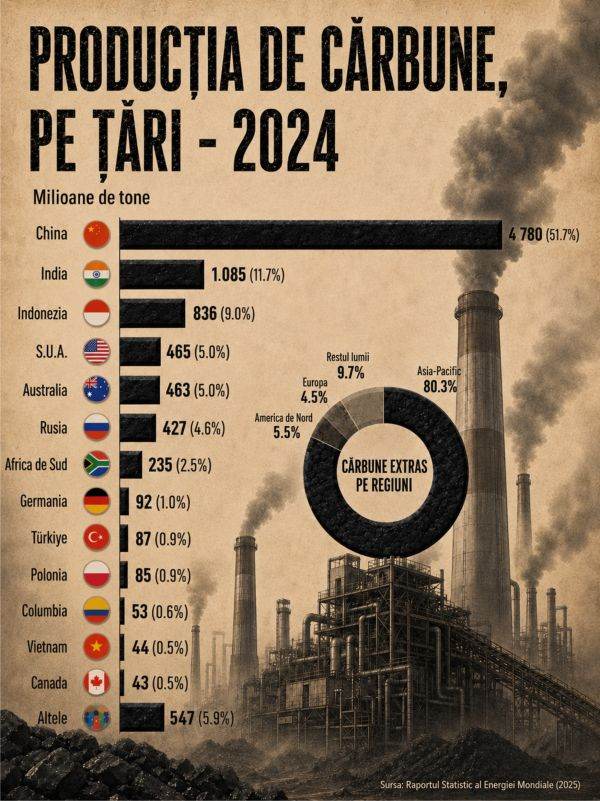
China produces more coal than all other countries combined. The 2025 World Energy Statistics analysis shows that the Asian country produced 4.78 billion tons of coal in 2024, representing 51.7% of the global total, according to visualcapitalist.com.
The cited source also indicates that coal production is highly concentrated outside of China. The top six producing countries, including India, Indonesia and the US, together account for 87% of the total supply.
Visual Capitalist has compiled a ranking of the world's largest coal producers in 2024, illustrating how concentrated global coal production remains.
• India - second, with over a billion tons of coal
China's dominance becomes even clearer when the country is compared to other major producers. India ranks second in the ranking, with just over a billion tons, but its 11.7% share of the global total is well behind China.
The top six countries are completed by Indonesia (9%; 836.1 million tons), the United States (5%; 464.6 million tons), Australia (5%; 462.9 million tons) and Russia (4.6%; 427.2 million tons), after which production drops significantly. Up to 10th place, the ranking looks like this: South Africa (2.5%; 235 million tons), Germany (1%; 91.9 million tons), Turkey (0.9%; 87 million tons) and Poland (0.9%; 85.2 million tons).
• Major increases in coal production
The countries with the largest increases in coal production between 2023 and 2024 are: Turkey, Pakistan, Indonesia, India and China, according to the cited source. Turkey recorded the largest annual increase, at 16.9%, but the country is only the ninth largest coal producer globally.
It is worth noting that all the countries that recorded large increases are located in Asia, which highlights how the region's increasing energy demand is boosting coal production, even as other parts of the world reduce their dependence on this fuel.
• Oil and coal - the world's main energy sources
Much of the world still relies on a small group of traditional energy sources, despite the rapid growth of renewable sources. In many countries, oil, coal or natural gas continue to provide the majority of the energy used in transportation, industry and electricity generation, according to visualcapitalist.com, which presents the largest primary energy sources for 112 countries, based on data from the International Energy Agency (IEA). Primary energy refers to energy in its raw form, before it is converted into electricity or refined fuels.
The global landscape highlights how different regions depend on different fuels. Oil dominates in many countries, coal still powers most major economies in Asia, and traditional biomass remains essential in parts of Africa.
Oil is the most common primary energy source globally, with 39 of the countries analyzed relying on it more than any other fuel. Crude oil, as an energy source, dominates much of Europe, the Middle East and large parts of the Asia-Pacific. In many economies, petroleum products remain essential for transportation and heavy industry. Even countries that produce natural gas, coal, or hydropower domestically often rely on oil for a significant portion of their total energy supply. Major economies such as the United States, Japan, and Germany still rely primarily on oil, despite increasing investments in renewable energy and electrification. After oil, natural gas is the second most common source of primary energy globally, with 29 countries relying on it most.
Coal continues to dominate the energy mix in several of the world's largest emerging economies. China, India, Indonesia, and Vietnam all rely on coal as their largest source of primary energy. The reason for this is availability. Many of these countries have large domestic reserves of coal, and long-established energy and mining infrastructure built around the fuel.
At the same time, coal remains one of the largest emitters of carbon, making these economies central to the future trajectory of the global energy transition.
In much of Africa, biomass remains the largest source of primary energy. This includes fuels such as firewood, charcoal and agricultural waste. In many rural areas, these fuels are still widely used for everyday needs such as cooking and heating, especially where access to electricity or modern fuels remains limited.
Outside of Africa, only three other countries in the group under analysis rely primarily on biomass for energy: Finland, Latvia, and Pakistan.
























 Euro
Euro Dolar SUA
 Franc elveţian
 Liră sterlină
 Gram de aur





























