English

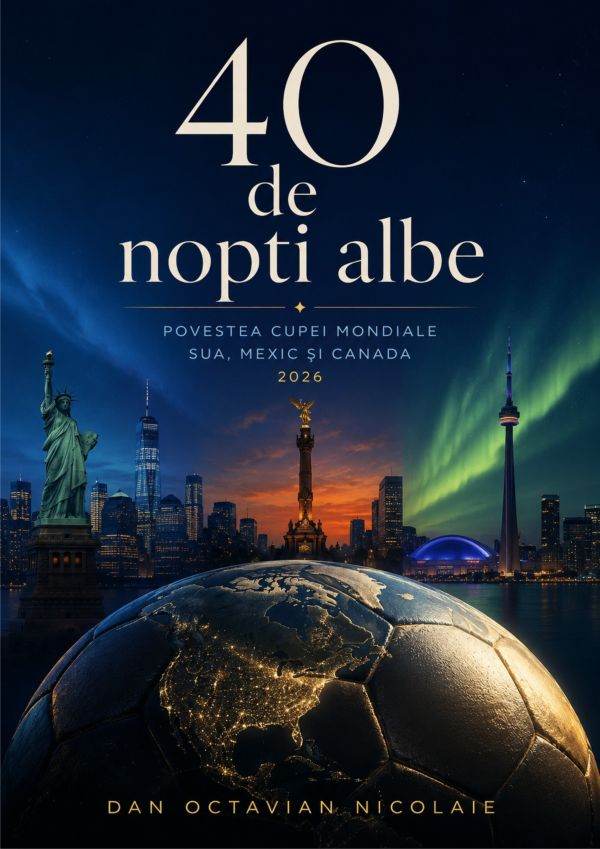

There are final tournaments that are played on the field and there are tournaments that are played in the memory of those who watch them. The 2026 World Cup was, for me, both. It began with a starting whistle in stadiums in the United States, Mexico and Canada, but its true measure was seen elsewhere: in the nights that never ended, in the coffees drunk while the city was still sleeping, in the cold light of the monitor and in the daily fight against time.
The book "40 White Nights" was born before it knew it would become a book.
At first there were just some chronicles. Written for the readers of the BURSA Newspaper (there is a tradition in this regard), after each important match of the World Cup. Most of the time immediately after the final whistle, always before morning takes its rightful place. They were texts written with the emotion still alive, without the respite that distance offers, but with the obligation to maintain the journalist's lucidity. Between spectacle and analysis, between the joy of the supporter and the discipline of the reporter, each chronicle tried to capture something that statistics cannot measure.
Football produces numbers. Journalism seeks meanings.
That is why the the pages of this book are not a series of results and rankings. For these there are archives, databases and encyclopedias. What I tried to preserve is something else: the moment when an entire stadium holds its breath before a penalty, the silence that follows an elimination, the expression of a coach who understands that four years of work have ended in a single evening or the explosion of joy of a nation that discovers that football can suspend, at least for a few hours, all the differences between people.
A World Cup is, after all, the greatest collective story that sport tells the world. For 40 days, borders blur. An inspired pass is understood the same in Buenos Aires, Casablanca, Tokyo, Bucharest or Glasgow. And a goal scored in extra time can change the mood of an entire continent.
Every morning, when the chronicle(s) was/were already on the website, another stage of the same day began. At Radio la Negru, the World Cup continued in the form of a dialogue, between the undersigned and Viorel... Negru. The matches were turned on all sides, the controversial phases became topics of debate, and the surprises of the night were analyzed together with the listeners. It was a ritual that connected two worlds: written journalism and the voice of the radio. The text turned into conversation, and the conversation prepared, without us knowing, the next night.
There was a routine that, seen from the outside, seemed almost absurd. Matches until late, sometimes until the morning. Notes taken in a hurry. A coffee. Another one. Then the chronicle. Corrections. Sending the material. A few hours of sleep. The radio show. And, before the day was over, the preparation for the next match.
For forty nights, time was no longer measured in hours, but in halves.
There were nights when the favorites were confirmed and others when football remembered that it lives on surprises. There were teams that entered the field convinced that history belonged to them and left defeated by opponents who had nothing to lose. There were unexpected heroes and stars who discovered that reputation does not score goals. There were referees who were transformed into main characters and goalkeepers who became, for a few minutes, the most important people in their countries.
The World Cup does not always reward the best team. It rewards the team that best resists pressure, chance and its own emotions.
Perhaps that is why football remains so fascinating. It is one of the few places where logic accepts, without protest, being defeated by the unpredictable. No matter how sophisticated analyses, algorithms and statistical models become, the ball continues to retain a right that no one can take away: the right to contradict all predictions.
The chronicle of a match always begins before the first whistle. It begins in the history of the two teams, in generations-old rivalries, in the memory of forgotten goals, in the pride of some peoples and, sometimes, in the tensions of a world that finds in the stadium a peaceful form of confrontation. That is why many of the texts in this book talk about more than just football. They talk about people, about identity, about memory, about politics, about culture and about the way in which a seemingly simple game ends up saying so much about the societies that love it.
I have tried to write each chronicle without unnecessary emphasis and without pathos. Football does not need to be embellished. It produces its own literature. The journalist just has to be attentive and find those details that, years later, will make the difference between a news story and a memory. Reading these texts now in their natural order, I discover that they tell another story. The story of days lived almost exclusively around the World Cup schedule. The days no longer began in the morning and ended in the evening. They began with the first match and ended with the last paragraph of the chronicle. Between them, there was room for emotions, fatigue, the satisfaction of a successful text, the frustration of a title that didn't sound good enough and the simple joy of seeing that, the next morning, readers were commenting not only on the score, but also on the story behind it.
If this book has a main character, it's not a footballer. It's not even the team that lifted the trophy. The main character is time. The forty nights in which millions of people lived according to the same calendar, in which time zone differences became irrelevant and in which an entire world met, night after night, around the same game. The title of this book speaks of sleepless nights. But they weren't just sleepless nights. They were nights full. Of emotion. Of doubt. Of hope. Of surprises. Of pages written in a hurry and reread in silence. Of coffees that replaced rest and of mornings when football did not end with the final whistle, but continued in the pages of the BURSA Newspaper. Perhaps, in years to come, many of the scores of this tournament will be forgotten. The names of the scorers will fade, and the group rankings, and the statistics that today seem definitive. What I hope will remain is the sensation of those nights when football seemed bigger than itself. And if the reader will find, at least for a few pages, the emotion with which he waited for a match, celebrated a goal or suffered after a defeat, then these chronicles will have fulfilled their mission once again.
This is not a book just about a World Cup.
It is the diary of forty nights in which football was the pretext, and people were, as always, the real story.

















 Euro
Euro Dolar SUA
 Franc elveţian
 Liră sterlină
 Gram de aur