English


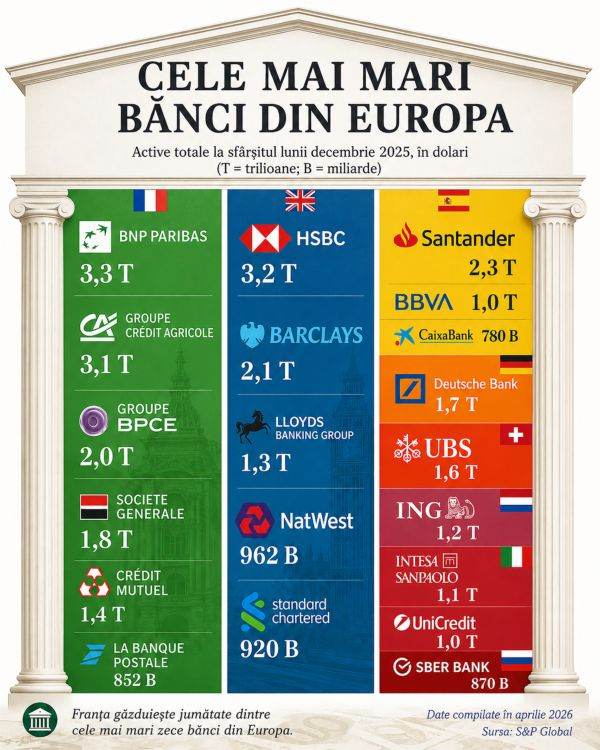
The world's most famous banks may be American, but some of the oldest credit institutions are found in Europe, and as the data shows, France could be the banking capital of the continent, according to visualcapitalist.com.
The cited source ranked the 20 largest European banks by total assets as of December 2025, according to the latest S&P Global data.
• France is home to the largest banks in Europe
London and Zurich are among the most well-known financial centers in Europe, but France is home to half of the continent's ten largest banks by assets.
Based on total assets at the end of 2025, BNP Paribas is the largest bank in Europe, with $3.3 trillion. BNP Paribas was created through the 2000 merger of two of France's largest banks, Banque Nationale de Paris (BNP) and Paribas. Both BlackRock and the Belgian government have minority stakes in BNP Paribas.
France is also home to Credit Agricole ($3.1 trillion), BPCE ($2 trillion), Societe Generale ($1.8 trillion), and Credit Mutuel ($1.4 trillion).
• Traditional banking centers
The second and fifth largest banks in Europe are headquartered in the United Kingdom. HSBC has $3.2 trillion in assets, while Barclays has $2.1 trillion.
London's historic position as a European financial hub has faced new challenges following the UK's exit from the European Union in 2020. Both banks have spent hundreds of millions of pounds in response to the UK's exit from the European single market, the source notes.
Other major British banks include Lloyds ($1.3 trillion), NatWest Group ($962 billion) and Standard Chartered ($920 billion).
• Decentralised banking sector in Germany
Germany, Europe's largest economy, has only one bank among the continent's 20 largest credit institutions by total assets. Deutsche Bank ranks eighth, with $1.7 trillion, and is dually listed on the Frankfurt and New York stock exchanges.
Germany's banking system is decentralised. Instead of relying on a few financial giants, the country has a three-pillar system, made up of private commercial banks, regional state-owned savings banks and credit cooperatives.
By comparison, Spain has three banks in the top 20 in Europe: Santander ($2.3 trillion), BBVA ($1 trillion) and CaixaBank ($780 billion). All three have extensive retail operations, with Santander and BBVA maintaining a particularly large international presence.
• ECB: Eurozone banks tighten access to credit
Eurozone banks tightened access to credit for companies in the second quarter amid fears of political instability, and the trend is expected to continue in the current quarter, according to data from a study recently published by the European Central Bank (ECB), according to Reuters, reports Agerpres.
The study, an indicator of the debate on monetary policy, shows that while demand for loans from companies increased, banks rejected a significant share of applications and tightened lending standards in the automotive sector and energy-intensive industries.
"Perceived risks to the economic outlook and banks' lower risk tolerance remain the main factors contributing to the tightening of lending standards, with institutions being highly concerned about risks related to geopolitical and energy developments,” the ECB said.
In the third quarter of 2026, banks expect the trend to continue across all loan categories, the survey of the 159 largest banks in the euro area showed.
• Measures to strengthen the European banking sector
The European Commission adopted this month a communication on the competitiveness of the EU banking sector, which sets out measures to strengthen the single market for banking services, according to a statement from the EU Executive.
The objective is to build a more integrated, more efficient and more competitive banking sector, which can strengthen Europe's economy by financing economic growth, innovation and strategic priorities, supported by a better balanced regulatory framework, creating the necessary conditions for banks to take prudent risks, while protecting the resilience of the sector, offering better services to households and businesses, while maintaining financial stability and promoting sustainable growth, the EU Executive informed, according to Agerpres.
"The Communication is a key pillar of the Commission's Economic and Investment Union strategy: a banking sector with the strength and scale needed to finance economic growth and strategic priorities such as innovation, clean transition and defence, while providing high-quality financial services to households and businesses. Following a public consultation and exchanges with Member States, stakeholders and supervisors, the Commission has identified three main challenges that limit the banking sector's ability to effectively support the EU economy," the statement said.
Firstly, the sector remains too fragmented along national lines. This prevents EU banks from expanding and competing globally in key market segments and from finding cross-border efficiencies. Secondly, the way in which international banking standards, known as Basel III standards, are transposed within the EU does not always reflect the specific features of the EU banking landscape. The framework needs to work better for both large and small banks. Third, some parts of the EU regulatory framework, including the interaction between microprudential, macroprudential and resolution rules, as well as reporting requirements, are too complex and burdensome and should be simplified. Addressing these three challenges is essential to building a banking sector that is not only resilient and competitive, but also able to support the EU economy, the cited source argues.

























 Euro
Euro Dolar SUA
 Franc elveţian
 Liră sterlină
 Gram de aur