English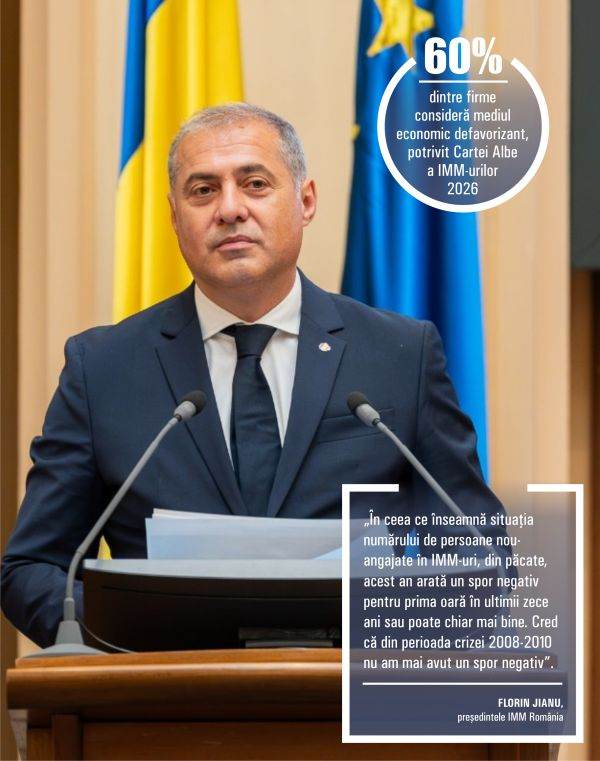
The economy can no longer wait until the parties end their disputes and Romania urgently needs a stable government, predictability and an economic and social pact that will set the major directions of the country, said Florin Jianu, president of IMM Romania, yesterday, during the launch event of the 24th edition of the SME White Paper, which took place at the headquarters of the National Bank of Romania.
Florin Jianu said that the business community is making a public appeal to convene a national meeting attended by all political forces and in which an economic and social pact would be discussed and signed, and he specified: "Romania urgently needs stability, predictability, especially dialogue. The objective should not necessarily be to sign a pact, but to establish directions for which Romania must commit in the coming period. These are difficult times and I believe that in these difficult times we need consensus. We need dialogue and communication and not necessarily confrontations that do not lead to positive things. The economy, unfortunately, cannot wait. But I believe that trust is built on predictability and stability. Ultimately, the appeal is for Romania to have a stable government and an economic and social pact that we need now." The appeal launched by the President of IMM Romania comes against the backdrop of a sharp deterioration in the entrepreneurial climate, a deterioration recorded in the White Paper on SMEs launched yesterday. According to the data in the cited document, almost 60% of companies consider the economic environment unfavorable, only 6% of entrepreneurs anticipate a positive evolution, investments in new technologies have collapsed from 50-55% to 12%, and the difference between hiring and leaving SMEs has become negative, for the first time in at least a decade. The business environment radiography carried out through the White Paper on SMEs, based on responses received from 1,174 enterprises, shows that small and medium-sized companies are increasingly concerned with preserving their activity, financing their inventories and working capital and refinancing their obligations, instead of investing in development, while unfair competition, imported products and unpaid invoices push them towards an area where resilience risks becoming just another name for survival.
• Unfair competition, the main problem facing SMEs
However, the data of the current edition confirms one of the most serious predictions made last year by the employers' confederation of small and medium-sized entrepreneurs: unfair competition, which in previous years occupied second or third place in the ranking of difficulties faced by entrepreneurs, has become the main problem of the business environment and is felt by six out of ten entrepreneurs.
"Unfair competition that for the state means less revenue to the budget, which for entrepreneurs means an obstacle to development, which for society in general does not bring anything good," warned Florin Jianu.
The pressure of imported products rose to second place, a problem that last year was only in fourth position and which indicates, according to Florin Jianu, also a possible lack of competitiveness of Romanian companies. In third place is the non-payment of invoices by third parties, a phenomenon that had barely appeared "on the radar" of SME Romania last year and which has now turned into a direct threat to the liquidity of small and medium-sized companies. Inflation has dropped to fifth place in the ranking of problems, given that the data indicate a possible moderation in the second half of the year, but the difficulties related to obtaining consultancy and professional training services have increased to a level almost four to five times higher than in previous years. In the opinion of the SME Romania leader, this evolution must be linked to the lack of liquidity and the emergency priorities set by small and medium-sized enterprises in a tense economic climate. The cited document also shows that, in the current context, Romanian companies are massively retreating towards the domestic market. If in previous years approximately 57-58% of companies viewed the local market as an opportunity, in 2026 the percentage rose to 90-94%. There are also companies that have increased their exports and continue to pursue foreign markets, and this opportunity has risen to second place in the ranking.
• Dramatic decline in investments in new technologies
Digitalization is also gaining ground, being seen by more and more companies as a real opportunity for adaptation and efficiency. Beyond this favorable development, the collapse of the appetite for new technologies shows how fragile the entrepreneurial situation has become.
"Investments in the use of new technologies have fallen significantly, from a percentage of 50-55% to a percentage of 12%, which shows that this year companies are looking rather at maintaining their own activity at a survival level and not necessarily looking towards development,” said Florin Jianu.
He mentioned that the main need for financing has become the provision of stocks and working capital, although, only a year ago, working capital occupied third place. At the same time, investments in equipment, technology and real estate are decreasing, and the refinancing of companies' financial obligations reappears with a consistent weight. Unfortunately, the labor market reflects the same slowdown. "In terms of the number of newly employed people in SMEs, unfortunately, this year shows a negative growth for the first time in the last ten years or maybe even better. I think that since the 2008-2010 crisis, we have not had a negative growth. It was a positive growth, small, but a positive growth. Now the growth is negative," said Florin Jianu, who showed that the net difference between the number of hirings and departures from an SME dropped to minus 0.1%, a signal that indicates not only the slowdown in business expansion, but also the beginning of a possible contraction in employment.
• Victor Negrescu: "Romania is the only state in the European Union that does not carry out impact studies on European decisions"
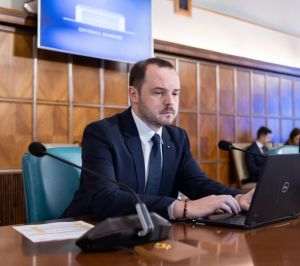
Victor Negrescu, Vice President of the European Parliament, directly linked the degradation of entrepreneurial confidence to the political deadlock in Romania. "The economy pays for every day of uncertainty. Entrepreneurs cannot suspend their businesses until the parties decide who governs. Companies must pay salaries, taxes and bills," he said. In his opinion, the public debate should focus on how Romania can produce more, not exclusively on cutting expenses. "Of course, it is necessary to reduce waste, but we cannot build a sustainable economy only with scissors in hand. Instead of playing with the light in the pantry and consuming electricity for nothing, the rulers should tell us how they plan to fill the pantry and how they can make up for lost time. If you play with the switch all the time, the risk is that the light bulb will burn out and we will be in the dark," said Victor Negrescu, who showed that the study prepared by IMM Romania shows the extent of the crisis of confidence: only 6% of entrepreneurs expect a positive economic development. The White Paper mentions that over half of SMEs want to access European money, but only a quarter have succeeded. The main barriers are bureaucracy and changing rules, with the administration sometimes requesting more documents than the number of pages in the project template. "The PNRR has too often become a marathon of delays and justifications. Speed cannot replace competence. It is not normal for social partners to find out from the press what fiscal changes are being prepared for them. Consultation does not mean sending a project in the evening and asking for an answer by the morning”, criticized Victor Negrescu.
The Vice-President of the European Parliament supports the conclusion of a national pact for the economy and European funds, with the participation of society, entrepreneurs, unions and universities, as well as the introduction of a firm rule of fiscal predictability. "We cannot have new taxes invented to cover the state's lack of performance. Any measure must pass the SME test provided for by the legislation in force”, said Negrescu. He drew attention to the fact that Romania is the only state in the European Union that does not carry out impact studies on European decisions and called for a radical simplification of access to EU funds, by applying the "once only" principle for documents already held by the authorities: "It is not normal to ask the entrepreneur for a document issued by the state." In turn, Ovidiu Nicolescu, honorary president of IMM Romania, stated that almost half of SMEs are self-financed, which limits intensive development and innovation due to low capitalization. Although two-thirds of companies want financing for investments, only one in seven pursues innovative projects. The high cost of financing represents the main barrier to credit for 66% of companies, along with the lack of certainty regarding their own financial situation and the guarantees required. Over half of SMEs declare that they are pursuing investments in cutting-edge technology, these being pursued primarily marketing and digitalization management authorities, but more than a quarter of companies do not make any forecasts, which, according to Nicolescu, calls into question their long-term survival.
• BNR: In the non-financial companies segment, the non-performing loan rate exceeded 5.6% and continues to grow
Leonardo Badea, First Deputy Governor of the National Bank of Romania, described the White Paper as an x-ray of the resilience of the real economy in a geopolitical and macroeconomic context dominated by unprecedented uncertainty, but he was keen to specify that the Romanian entrepreneurial sector also shows signs of maturity: the average age of companies is 16 years, and 86% of entrepreneurs have higher education. Experience and education level suggest a significant capacity for adaptation, but this is limited by what the First Deputy Governor of the NBR called the "paradox of atomization”. No less than 58.6% of SMEs operate as sole proprietors, while only 1.4% have more than five partners or shareholders. The extremely low associative spirit affects competitiveness, prevents economies of scale and makes access to financing more difficult. Fragmentation partly explains why almost 60% of companies consider the current economic environment unfavorable, to which are added the effects of inflation and the decline in domestic demand.
The NBR data, presented during yesterday's event by Leonardo Badea, confirm the pressures felt by entrepreneurs. In the non-financial companies segment, the non-performing loan rate exceeded 5.6% and continues to increase, and prudential analyses indicate a worrying evolution including among companies that benefited from state guarantee schemes. "The support programs functioned as a short-term lifeline, but many fundamental problems remained unresolved," warned Leonardo Badea. Many companies resort to supplier credit or loans granted by associates, because their balance sheets do not allow them to obtain a classic bank loan. At the same time, the reorientation of SMEs towards loans in euros, determined by the interest rate difference, produces an accumulation of currency risks, since micro-enterprises borrowing in foreign currency generally do not have a natural hedge against exchange rate fluctuations.
Romania is in a broad and strict process of adjusting public finances, and reducing the structural deficit is no longer, according to the deputy governor, a theoretical option, but an immediate necessity to maintain investor confidence and exchange rate stability. The space available for generalized fiscal facilities and direct subsidies is, in this context, very limited, which is why any facility must be analyzed and calibrated rigorously, said the first deputy governor of the central bank, who added that the resilience of SMEs must be supported by qualitative increases in productivity, the intelligent use of existing guarantees and the use of European funds. He noted that, however, part of the fragility is created by the state itself: excessive bureaucracy and lack of predictability discourage long-term investment and can partially cancel out the efforts of the private sector.
• Daniel Dăianu: "We do not need new taxes in 2027”
Daniel Dăianu, President of the Fiscal Council, supported the need for a political agreement guided by the national interest, warning that small and medium-sized enterprises bear the most economic shocks and drew attention to the fact that SMEs concentrate over 65% of workers and generate 51% of turnover, being of essential importance for social cohesion. He added that, after the succession of crises caused by the pandemic, the energy transition and the wars in Ukraine and the Middle East, assessments can no longer always aim to prevent shocks, but to limit the damage, and anticipation becomes extremely difficult when the economy is permanently "hit by reality”. Many companies are not bankable, which is why Daniel Dăianu considers it necessary to either have a special bank for SMEs or introduce dedicated programs. The President of the Fiscal Council showed that in the agribusiness sector, the lack of associations prevents small businesses from obtaining financing. "We must encourage farmers to associate so that the Hungarians and Poles do not crowd us. We export raw materials and import products made with the same raw materials. You need to work on concrete things before the productivity pact," said Daniel Dăianu.
The President of the Fiscal Council also said that he does not believe that the rating agencies will downgrade our country to junk status - not recommended for investors, because the budget execution in the first months is good. However, he reiterated that our country needs a government with full powers to prepare the budget for 2027 and manage the P NRR. The wage law is, according to Daniel Dăianu, the most important regulatory act, because it affects the lives of millions of people, and its main stake is not money from Brussels, but repairing inequities. "We have been warning for years that the moment of no return is coming. In our opinion, we do not need new taxes in 2027 and we believe that the economy can grow by over 2%. I do not think we will have a recession," said the president of the Fiscal Council. Public investments must operate at high capacity, and the SAFE program, worth 16 billion euros, will replace the PNRR. If the fiscal adjustment is carried out, Dăianu estimates that Romania will be able to have lower inflation and interest rates.
• 42% of the ESC opinions in the first semester of 2026 were negative towards legislative projects
Sterică Fudulea, president of the Economic and Social Council, drew attention to the degradation of social dialogue and the poor application of the SME test. According to data from the White Paper on SMEs, over 52% of the entrepreneurs consulted believe that the authorities should be obliged to justify the non-implementation of the proposals received. Although there is a government decision from 2009 that obliges ministries to submit justification notes, some institutions comply with this obligation and others do not. Over 66% of respondents request the implementation of the SME test, but in 2024 only ten such tests were carried out, and in 2025 only two. Only 23% of small and medium-sized enterprises see the CES as a real dialogue mechanism, and the percentage of projects published in decision-making transparency is only 10%. Sterică Fudulea promised to improve this perception by the end of her mandate. The CES President added that he is faced with a poor quality of legislative initiatives and specified that, if in 2025, 48% of the opinions formulated by the Council members on legislative initiatives were unfavorable, in the first six months of 2026 the share has already reached 42%.
Tudorel Andrei, President of the National Institute of Statistics, nevertheless identified a core of optimism: 95% of respondents stated that they would maintain or increase their level of activity. "This shows that entrepreneurs are finding resources of resilience after periods of contraction,” said the President of the INS. He showed that, as the study conducted by IMM Romania also states, digitalization and the workforce remain structural challenges. If, 25 years ago, emigration contributed to stabilizing the labor market, the paradigm has changed, and the number of immigrants is increasing, which makes it necessary to build a clear register of them.
Dan Manolescu, president of the Chamber of Tax Consultants, described the White Paper as a "high-resolution snapshot” of the perception of the business environment and anticipated a period of relative fiscal predictability. At the end of May, the budget deficit was 1.75%, compared to 3.25% in the same period last year, a situation he explained by the existence of a budget, but also by the absence of a government for two months, which kept spending at a low level. Tax revenues increased by 15%, and VAT receipts by 22%, so there does not seem to be pressure to increase taxation in the near future. The government's elimination of semi-annual reporting, including the balance sheet due on August 15, announces, in its wording, "a quiet summer”. Beyond the favorable budget figures, the real economy is sending other signals: retail consumption is declining, and more and more empty commercial spaces can be observed in cities.
The resulting image of the White Paper on SMEs is, therefore, that of an entrepreneurial economy mature in experience, but financially vulnerable, atomized, poorly capitalized and pushed by instability towards defensive decisions. Companies want to resist, and 95% say they will maintain or increase their activity, but only 6% still anticipate a positive economic evolution. This apparent contradiction concentrates the real state of the business environment: entrepreneurs are not giving up, but they also no longer have enough confidence to invest in the future.



















 Euro
Euro Dolar SUA
 Franc elveţian
 Liră sterlină
 Gram de aur