English

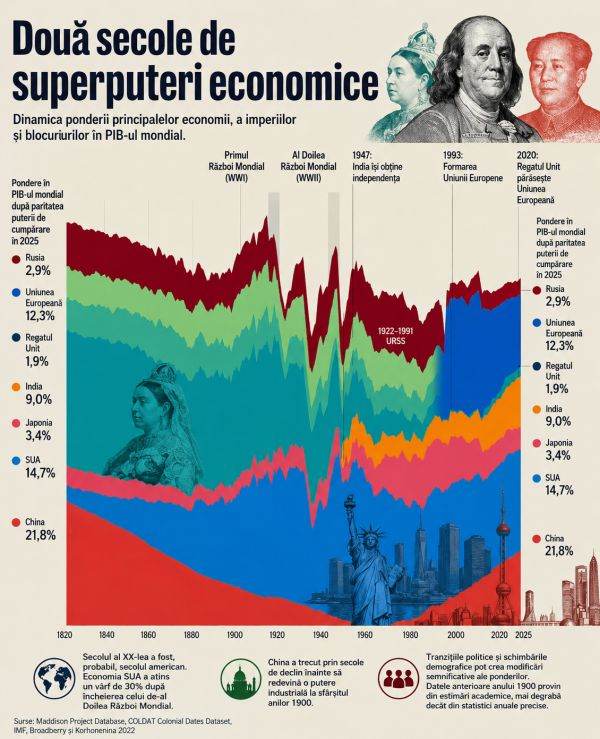
Over the past 200 years, economic leadership has shifted from China to the British Empire, then to the United States, and is now increasingly shifting back to Asia.
Visualcapitalist.com shows how the share of major economies in global gross domestic product (GDP) has changed from 1820 to 2025. The above-mentioned article uses the latest available data from the Maddison Project, COLDAT Colonial, and the IMF.
All GDP figures are adjusted for purchasing power parity (PPP), taking into account differences in the cost of living and production between countries.
• Pax Britannica and the years of European domination
Britain was the first country in the world to industrialize. As a result, the British Empire became the world's preeminent superpower in the 19th century, an era known as the Pax Britannica due to the relative absence of conflict between the great powers.
By 1845, the British Empire, on which the sun "never set", contributed almost a quarter (23.8%) of global GDP. India was the empire's most important economic possession before it gained independence in 1947.
The rest of Europe followed a similar trajectory. The French Empire reached its peak in 1858, with 6.6% of global GDP, while Germany peaked at 8.8% in 1913, on the eve of World War I.
After decades of war and declining influence on the world stage, several European economies grouped together in the European Union. The bloc contributed 17.9% of global GDP in 2007, before the global financial crisis, but its share has since declined, and was further reduced with the withdrawal of the United Kingdom in 2020.
• The Fall of the British Empire and the Rise of the United States
If the 19th century was the British century, the 20th century was the American century. Like Britain before it, the United States became for a time the world's largest exporter.
World War II marked a turning point in global economic leadership. In 1944, the United States accounted for 29.7% of world GDP, the largest share of any economy in modern times.
American economic dominance was underpinned by high-value industries and the country's central role in global finance, manufacturing, and trade. The United States also continues to dominate the rankings of the world's largest and most profitable companies.
• The Asian Century
For centuries, China was a center of the global economy. Political instability and its inability to keep pace with European industrialization contributed to a prolonged decline in its share of world GDP in the 19th and 20th centuries, however.
Beginning in the late 20th century, economic reforms and China's emergence as a global manufacturing center helped it regain lost ground. By 2025, China accounted for 21.8% of global GDP, more than a fifth of the total.
Together, China and India accounted for 30.8% of global GDP in 2025. Their large populations and lower production costs give both countries a larger share when output is measured by purchasing power parity.
Whether this shift continues will depend in part on how China addresses demographic pressures similar to those facing Japan and the European Union, as well as broader challenges related to productivity and economic growth.
• China's economy - in its weakest advance in three years
China's economic growth slowed in the second quarter of 2026, despite strong exports (supported by the global artificial intelligence boom), accelerating industrial production and a better-than-expected rebound in retail sales in June, AFP reports, according to Agerpres.
In the period April-June 2026, the gross domestic product (GDP) of the world's second-largest economy grew by 4.3% at an annual rate, the National Bureau of Statistics (NBS) announced in July, a figure below analysts' estimates, which were betting on an advance of 4.5%. This is a significant slowdown in the Chinese economy after growth of 5% in the first quarter. Beijing has set a growth target for this year of between 4.5% and 5%.
China, which has made exports a pillar of its economic model, still relies heavily on foreign trade to fuel its growth, at a time when a prolonged housing slump and weak consumption continue to weigh on it.
However, tensions over the conflict between the United States and Iran have threatened this dynamic by disrupting shipping traffic in the Strait of Hormuz, causing oil prices to rise, risking disrupting global supply chains and negatively impacting demand for Chinese goods.
"There are many unstable and uncertain external factors, and the domestic imbalance between abundant supply and weak demand persists,” the National Bureau of Statistics commented, concluding: "The foundation for an economic recovery still needs to be consolidated.”
On the other hand, other recently published economic indicators show a better outlook. Thus, China's industrial production grew by 5.3% in June 2026 compared to June of last year, accelerating much more sharply than analysts surveyed by Bloomberg had anticipated (+4.6%), after a 4.5% advance in May.
Also, retail sales, a barometer of consumption, recovered in June (+1% compared to the previous year), while experts expected a new decline after a decline of 0.6% in May. These data suggest that household demand, which had been extremely weak, is starting to recover.
US economic growth slowed in the second quarter of 2026, following a widening trade deficit, but increased consumer spending and robust corporate investments in equipment related to building AI infrastructure highlight the resilience of GDP, Reuters shows, according to Agerpres.
The world's largest economy recorded an annual growth of 1.5% in the second quarter of 2026, according to preliminary data recently published by the US Department of Commerce, after an advance of 2.1% in the first three months of this year. Economists had expected US GDP to grow at an annual rate of 2.1% in the first quarter of 2026.
Analysts say tax cuts and investments in AI will support economic activity this year, but warn that the Middle East war poses a risk of falling demand and could hurt US economic growth in the second half of the year.
























 Euro
Euro Dolar SUA
 Franc elveţian
 Liră sterlină
 Gram de aur