English


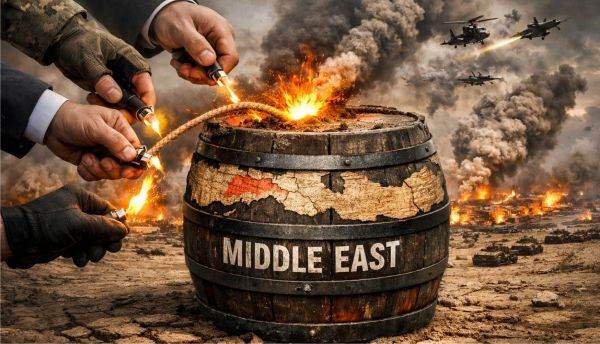
The opening of a ground front in Iran through Kurdish forces in northern Iraq, in a strategy that would combine airstrikes with clandestine operations and attempts to internally destabilize the regime in Tehran, seems to be on the table of American officials, according to information published by CNN, Axios, The New York Times and Welt, which cite sources inside the CIA and the Pentagon. The sources indicate that Iranian Kurdish groups are preparing armed units that could enter Iran, transforming the conflict into a much more complex and unpredictable war.
According to information published by Axios, several Iranian Kurdish factions in exile in Iraqi Kurdistan have "thousands of soldiers along the Iran-Iraq border and control strategic areas", and in recent weeks "hundreds of members of these groups have crossed from camps on the Iraqi side of the border into Iranian territory", as part of preparations for a possible offensive against the regime forces in Tehran.
We note that, according to the Turkish press, the number of fighters in the Kurdish militias amounts to 40,000 fighters, while documents published on the website of the British Parliament, as well as other sources - including the Council on Foreign Relations and dti.mil - claim that the number of fighters would be between 50,000 and 70,000 people.
The cited media sources also show that several Kurdish opposition groups announced, even before the outbreak of the war, the formation of a political and military alliance - the Coalition of Political Forces in Iranian Kurdistan - with the declared aim of fighting the Islamic Republic. The plan discussed in Western political and military circles would involve synchronizing a Kurdish ground incursion with the bombings launched by the United States and Israel. A US official quoted by Axios explained that the objective would be to "take over specific territory in the Kurdish region inside Iran to challenge the regime and inspire a broader uprising”.
According to the same sources, the operation would also involve the work of Western intelligence services. Axios notes that the Iranian Kurdish militias would be supported by the Mossad and the CIA, and an Israeli official stated that "the war began with a kinetic phase by the US and Israeli military, but as the conflict continues, there will be further efforts by the Mossad and the CIA”.
At the same time, the American press reports that the involvement of the secret services may be older than the current conflict. According to an article published by The New York Times, "The CIA previously provided small arms to Iranian Kurdish forces as part of a clandestine program designed to destabilize Iran,” a program that allegedly began before the current war. Sources familiar with the operation said that the agency provided only small-caliber weapons, and the goal of the secret campaign was not necessarily to overthrow the regime in Tehran, but "to distract Iranian leaders or create a domestic security crisis.”
CNN reports that the CIA is talking to Kurdish leaders and Iranian opposition groups about the possibility of providing military support to start an uprising against the regime in Tehran. Sources familiar with the plan say that the Trump administration has held active talks with these groups, and some of them have publicly suggested that they may act soon and have called on the Iranian military to defect.
A Kurdish official quoted by CNN said that the current moment is perceived as a strategic opportunity: "We believe we have a great chance now," adding that the militias expect American and Israeli support.
The discussions have also reached a high political level, according to the cited sources, who claim that President Donald Trump had telephone conversations with the Kurdish leaders of Iraq, Masoud Barzani and Bafel Talabani, to discuss the evolution of the conflict and the possible role of the Kurds in the next stages of the war.
According to officials quoted in the press, these contacts are the result of months of intense lobbying by Israeli Prime Minister Benjamin Netanyahu, who would have supported the idea of involving the Kurds in an uprising against the Iranian regime.
However, the final decision on an incursion has not been made. Sources familiar with the deliberations in Washington said that the American administration is still debating the usefulness of such an operation, and some officials warn that the decision could ultimately belong to the Kurdish leadership itself.
However, the administration in Washington is sending mixed signals. In a press briefing, White House spokeswoman Karoline Leavitt said that reports that President Donald Trump had approved a plan to launch a Kurdish insurgency in Iran were "completely false.”
If it were to happen, a Kurdish incursion would could have a clear military logic. A ground attack could force the Iranian army to move troops to the northwest of the country, giving American and Israeli air forces the opportunity to strike these units.
However, experts warn that the military impact of such an operation would be limited. According to former officials quoted by The New York Times, the Kurdish forces do not have tanks or heavy weapons and could not launch a real invasion or seriously threaten the theocratic regime in Tehran.
Moreover, there is also a demographic and political problem. According to data published by The New York Times, between 6 million and 9 million Kurds live in Iran (ed. - Iran has a population of 90 million people), and the Persian majority could view with suspicion or hostility a Kurdish military incursion supported by foreign powers.
In parallel, Iran's reaction is becoming increasingly harsh. The German website WELT reported that the Iranian military has already launched missiles at Kurdish groups in Iraq. The IRNA news agency also reported that "three missiles were fired at opposition headquarters,” and the pro-government Press TV channel broadcast images of strikes on positions described as belonging to "anti-Iranian separatists.”
In this tense context, a possible Kurdish front could transform the war between the United States, Israel, and Iran into a much broader conflict, in which direct military operations would be combined with internal uprisings, ethnic alliances, and destabilization strategies. If the plans are implemented, the Middle East could enter a new phase of the conflict, one in which air warfare, clandestine operations, and regional uprisings would intertwine in a potentially explosive scenario for the entire region.


























 Euro
Euro Dolar SUA
 Franc elveţian
 Liră sterlină
 Gram de aur