English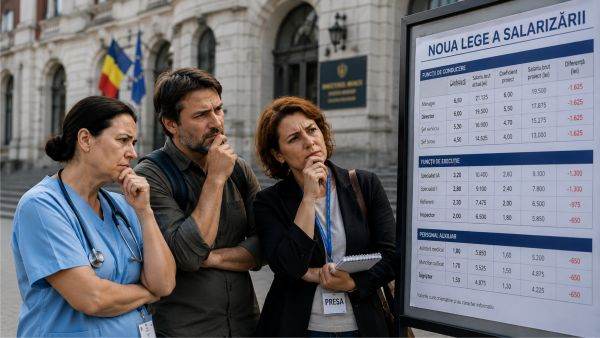
The draft salary law is generating dissatisfaction in several budgetary sectors. The Federation "Solidaritatea Sanitara" has launched a national consultation among employees in Health, while the National Federation of Trade Unions in Culture and Press CulturMedia is asking political parties not to vote for the project in its current form and is warning of a possible social conflict. The unions are complaining about both risks regarding income and the lack of consultation in the process of drafting certain provisions.
• "Solidaritatea Sanitara" consults 60,000 employees
The Federation "Solidaritatea Sanitara" has launched a public consultation at national level to find out the position of employees in Health regarding the draft salary law. Employees are invited to check, through the Health Salary Comparator, the income that would result from the application of the project and compare it with the salaries currently being paid. The tool has been updated with the provisions of the project in the form of August 20, 2026. Subsequently, each employee can fill out the consultation form, indicating whether the project would cause a decrease, an increase or the maintenance of current income. According to the federation, the invitation was sent directly, via SMS and e-mail, to approximately 60,000 Health employees, as well as through the organization's online communication channels. The final results are to be sent to political parties, in order to provide them with information on the impact of the project on employees in the system. The collective management bodies of the "Health Solidarity" Federation will establish the final position on the project based on the results of the consultation.
• Modification of bonuses
In parallel, the "Health Solidarity" Federation is carrying out an action to convince parliamentarians to modify some provisions. Among the demands are the exemption of units subordinated to the Ministry of Health from the 20% limit for bonuses and the introduction of a 30% ceiling. The Federation also requests a range of 50%-100% for additional hourly rates for work performed on days off and public holidays, as well as ensuring the financing of all salary influences resulting from the application of the new legislation.
• CulturMedia demands the rejection of the project
The dissatisfaction also extends to the Culture sector. The National Federation of Culture and Press Unions CulturMedia calls on political parties not to vote for the draft law on salaries in its current form and warns of a possible "large-scale" social conflict. According to the federation, the current form of the project does not eliminate inequities in the museum sector, but rather consolidates them and transforms them into state salary policy. CulturMedia claims that, on August 12, discussions took place regarding the salaries of museum staff without the representative trade union organizations being informed, invited or consulted. "The professional and salary future of the approximately 7,500 employees in Romanian museums cannot be decided through negotiations held in the absence of social partners,” states the federation. Trade unionists believe that the exclusion of representative organizations is incompatible with a real social dialogue, and the selective consultation of some representatives of the system cannot replace institutional negotiations with trade union organizations. The federation calls on the Ministry of Labor and the Ministry of Culture to publish the list of participants in the discussions of August 12, the mandate under which they formulated proposals for the museum sector, the minutes of the meetings, the resulting documents and the criteria that formed the basis of the current salary scales. CulturMedia also disputes the salary differences between positions in museums and those in performance and concert institutions. According to the federation's calculations, the coefficients of management positions in museums have been equalized with those in performance and concert institutions, while execution positions have lagged behind. The difference between the salary of a manager and that of an AI specialist, at the maximum salary level, would reach, according to the federation, 11,200 lei gross in museums, compared to 7,520 lei gross in performance and concert institutions. At the same time, an AI specialist in a museum would earn 3,680 lei gross less than an equivalent level specialist in a performance institution, claims CulturMedia. The federation also considers it unacceptable that a specialist in a large museum, with over 30 years of experience, an AI professional degree, maximum gradation and exceptional professional performance, should have a lower salary than a novice teacher in secondary education.
• The reference value, another point of contention
Another contested element is the reduction of the reference value from 4,325 to 4,000 lei.
According to CulturMedia calculations, that This change leads to a loss of approximately 300 lei in salary, compared to the draft version presented in May. The Federation emphasizes that the salary must take into account the responsibility of specialists working in museum institutions and their role in preserving heritage. "Heritage is not researched, conserved, restored and transmitted to future generations by itself,” states CulturMedia, listing museographers, researchers, conservators, restorers, archaeologists, museum educators, supervisors and technical and administrative staff among the employees involved. CulturMedia warns that, in the event of the adoption of the draft without correcting the claimed inequities, it will use all legal means of union action and will notify the European Commission and other competent European institutions. The Federation argues that the Government and Parliament must assume the possible social consequences and blockages that could occur in the museum system. In this context, CulturMedia states that even events organized outside of working hours could be affected by employee dissatisfaction and invites managers favored by the new pay scales to organize such events themselves, including the Night of Museums in Villages, scheduled for August 29. The contestation of the salary project by the unions in Health, Culture and Press thus indicates that the debate on the new salary scale goes beyond the issue of income levels and includes topics such as financing, differences between professional categories and compliance with social dialogue mechanisms.




















 Euro
Euro Dolar SUA
 Franc elveţian
 Liră sterlină
 Gram de aur