English

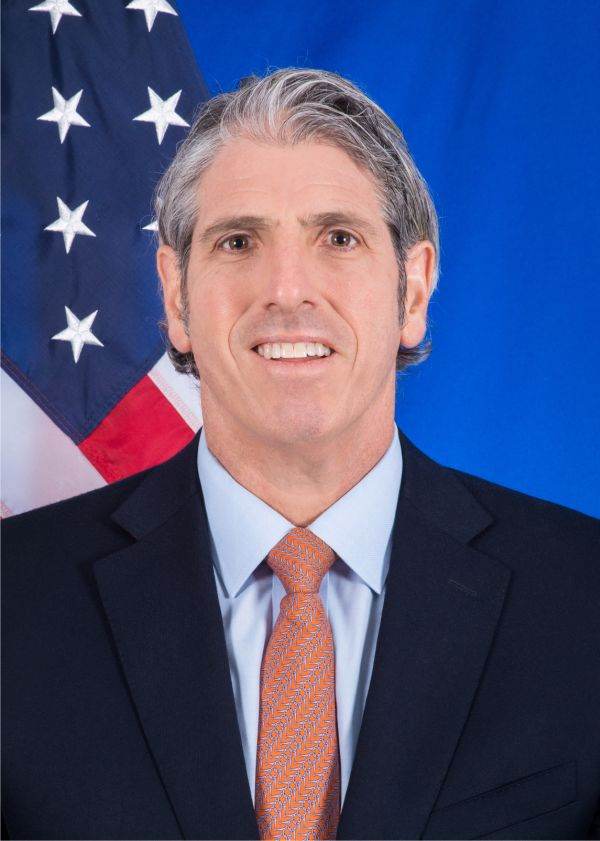
The United States Embassy in Bucharest announced that, at the B9 Summit - a format of NATO's eastern flank and northern allies -, which will take place tomorrow at Cotroceni Palace, the Trump Administration will be represented by Undersecretary of State for Arms Control and International Security, Thomas G. DiNanno.
According to the announcement sent to the editorial office by the US Embassy, Undersecretary of State for Arms Control and International Security, Thomas G. DiNanno, will pay a visit to Warsaw (Poland), Bucharest (Romania), and Tallinn (Estonia), from May 11-15, 2026. In Poland, Undersecretary DiNanno will meet with senior Polish government officials to discuss cooperation in the fields of defense and civil nuclear energy. Under Secretary DiNanno will also meet with U.S. industry representatives to discuss EU defense protectionism, the "America First” arms transfer strategy, foreign military sales reform, defense co-production, and defense innovation. In Romania, Under Secretary DiNanno will represent the United States at the Bucharest 9 (B9) Summit of NATO's Eastern Flank and Nordic Allies. In Estonia, Under Secretary DiNanno will meet with senior Estonian government officials and participate in the Lennart Meri Conference.
The announcement, seemingly technical and protocol-based, carries a much greater geopolitical weight than meets the eye. In reality, the fact that Washington decided to send a third-tier official of the US administration to Bucharest, without the participation of any big names from the White House, the State Department or the Pentagon and without even an online intervention by a top American leader, represents one of the coldest and clearest signals sent by the Donald Trump administration to its European allies in recent years.
The moment is all the more sensitive as the B9 Summit is not a marginal regional meeting, but a strategic event that precedes the NATO Summit in Ankara, in early July, the meeting where the major directions of the alliance will be decided in an explosive international context. Basically, tomorrow's event in Bucharest was supposed to be the place of a firm reaffirmation of the American commitment to NATO's eastern flank, especially after the accelerated deterioration of the global security climate. Instead, what is emerging is the image of an America that is visibly reducing its symbolic and political involvement in the relationship with its European allies.
Thomas G. DiNanno is not the US Secretary of State, he is not the Secretary of Defense, he is not the US Vice President, and he is not one of the major architects of the Trump administration's foreign policy. He is an official specialized in arms control and international security, with a predominantly technical profile. In diplomatic language, the level of representation almost always reflects the level of strategic interest given to an event. And the fact that, at a summit dedicated to the security of NATO's eastern flank, Washington does not send even a high-ranking member of the administration inevitably conveys the idea of a calculated distancing.
Especially since this decision comes at a time when relations between the Trump administration and a significant part of NATO allies are probably going through the coldest period since the Republican leader's first term. The US-Iran conflict and the refusal of several European states to logistically support US operations in the Middle East have amplified transatlantic tensions and fueled frustrations in Washington. For Donald Trump, the lack of European support was interpreted as proof that America is bearing the major costs of Western security without receiving sufficient strategic loyalty in return.
The recent decision of the US administration to announce the substantial withdrawal of troops from Germany, a measure that has caused deep concern in European capitals, must also be read in this context. Officially, Washington talks about repositioning and streamlining the US military apparatus. In reality, however, the withdrawal of troops is perceived by many analysts as a combination of political pressure on Europe and a strategic reorientation of the US towards other areas considered priorities, especially the Indo-Pacific.
Thus, the absence of a high-ranking American official in Bucharest takes on an even more pressing significance. It seems to indicate that the Trump administration no longer considers it necessary to invest the same political capital in the symbolic reassurance of its Eastern European allies. In the past, B9 meetings were used by Washington to send strong messages about NATO solidarity and American commitment to the security of the eastern flank. Now, however, the message seems radically different: European allies must start to assume much more responsibility for their own security and to understand that American protection is no longer unconditional.
For our country, the implications are particularly sensitive. Over the last two decades, the central authorities in Bucharest have built their entire strategic philosophy on strengthening the partnership with the US. Moreover, our country has purchased American weapons in billion-dollar contracts, has constantly increased its defense budget, has unhesitatingly supported Washington's positions in major international issues, and has emerged as one of America's most disciplined and predictable allies in the region. In this context, a month ago, Parliament approved President Nicuşor Dan's request for logistical support that our country was to provide for American planes that were to refuel, in the air, the fighter jets that were attacking Iran. In addition, the message sent by Nicuşor Dan on May 9, on the occasion of Europe Day, was a pro-partnership with the US and a criticism of the European Union. "Europe has made mistakes. (...) When it neglected its defense industry, that was a mistake. (...) When, on several subjects, it acted ideologically, it was also a mistake. (...) It is also true that Romania has often been weak within the European Union, in the discussions that took place there. Romania has often not defended its objectives coherently, because, again, it is true, because it is politics, it is not a cenacle, within the European Union, European countries promote their national interests. (...) Europe and Romania need the European Union to have a fair, solid, equitable partnership with the United States, and Romania is a supporter of such a partnership,” said Nicuşor Dan at the end of last week.
The fact that now the summit hosted by Romania itself does not even benefit from the virtual presence of a top-ranking American official can inevitably be perceived as a diminution of the strategic importance that Washington currently grants to the eastern flank.
And the signal becomes even more disturbing if viewed from the perspective of global geopolitical competition. For years, Russia has sought to induce the idea that NATO is politically vulnerable and that American guarantees depend on the fluctuating will of a leader in the White House. The Kremlin is constantly trying to exploit any transatlantic fissure to fuel the feeling of insecurity in Eastern Europe. In these conditions, the images from Bucharest, where the states most exposed to Russian pressure discuss security without the participation of important American leaders, represent a propaganda gift for Moscow.
At the same time, what is happening now confirms the transformation of the slogan "America First" into a concretely applied strategic doctrine. The Trump administration is sending out ever clearer that the relationship with Europe is becoming a transactional one, conditioned by financial contributions, political support and strategic alignment with Washington's priorities. There is no longer an automatic willingness to maintain the same expensive security architecture without direct benefits for American interests.
The paradox for the states on the eastern flank is that precisely at the moment when the perception of the Russian threat remains extremely high, the feeling of certainty regarding the American commitment begins to erode. Europe talks about strategic autonomy, but the military reality shows that NATO continues to depend heavily on the capabilities of the US, on the American infrastructure and on the strategic umbrella offered by Washington. That is precisely why even seemingly protocol gestures, such as the level of a delegation sent to Bucharest, acquire enormous geopolitical weight.
In essence, the B9 summit in Bucharest risks remaining relevant not through the final statements or official photos, but through the silent message transmitted by the high-level American absence. Because, sometimes, in diplomacy, what is not said and who does not come is worth more than any solemn speech about the unity of the North Atlantic alliance.




















 Euro
Euro Dolar SUA
 Franc elveţian
 Liră sterlină
 Gram de aur