English

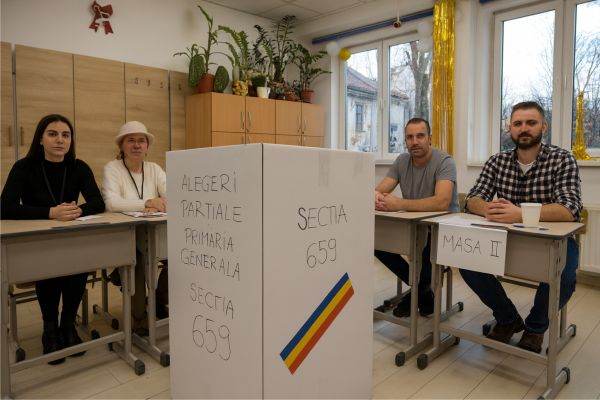
The elections for the position of general mayor of the capital recorded one of the lowest voter turnout. Bucharest residents chose yesterday to do something other than show up at the polling stations to elect a general mayor who will only be in office for two years and eight months, until the next local elections. People preferred either to stay at home, in front of their televisions or devices that they accessed to see what was being posted on social networks, or they chose to go to malls and cinemas, to spend a quiet Sunday.
And those who went to the polling station entered an empty hall, the only ones present being the officials who were waiting for voters to vote. In this context, when you enter a polling station and see that you are the only one crossing its threshold, you feel like when you enter a restaurant where there is no other customer, and the waiters are chatting relaxedly, and it crosses your mind to go back, because, given the lack of demand, it is all possible that the food is old, spoiled and totally non-compliant.
The electoral menu offered by the political class to voters in Bucharest on the occasion of yesterday's local by-elections was a totally unoffering one. After what happened last year with Călin Georgescu and after they managed in March to permanently remove him from the race for the presidential elections, the mainstream parties - PSD and PNL - no longer seemed interested in responding to the signal given by voters regarding the renewal of the political class and pushed forward, to the front, the same type of people.
In these conditions, yesterday's absenteeism from the polls was caused by a deep disappointment of citizens towards the political class and represents a real vote of blame towards it. Bucharesters showed distrust towards the political class, towards the candidates they perceived as replicants, towards the parties that changed their discourse but not their behavior, towards the promises that politicians have been repeating for years, without materializing them into real changes in the life of the city.
All this was also contributed by the fact that the vote of Bucharesters in the referendum on the centralization of certain decisions at the level of the Capital - regarding the issuance of construction permits and the approval of certain budgetary expenditures in the six sectors -, a referendum from the autumn of last year whose results were validated and approved by the Constitutional Court, was not taken into account by the Government or the Parliament, institutions that do not have any draft law on amending the Administrative Code in the sense desired by Bucharesters.
The decline in voter turnout was also noted by President Nicuşor Dan, who said, upon leaving the polling station, that people are dissatisfied with the political class, because "I see in many places that people do not care about the common good, but about their personal good.”
This was also reinforced by former head of state Traian Băsescu, who said that "politicians have reached a stage where they no longer put Romania's interests first, but rather those of their parties.”
In this context, the typical voter comes to feel that there is no authentic alternative, no real stake, no leader capable of breaking the cycle of administrative gridlock and continuous political scandals. Thus, many Bucharesters have come to instinctively reject the idea of going to the polls, because they have been repeatedly asked to decide the future of the city and the country, and the results have either not produced the expected changes or have generated new political tensions. Hence, the feeling that their vote is being diluted in a system that works the same way, regardless of who wins.
Unlike 2020, when the post-pandemic context stimulated a certain type of mobilization, or 2024, when the elections were part of a complete cycle and perceived as important, the December 7, 2025 election caught an electorate already exhausted, irritated, skeptical and less and less willing to believe in the power of their own participation.
Thus, the decrease in voter turnout is not just a statistical phenomenon, but the expression of a collective state of mind: disappointment, disillusionment, the routine of voting transformed into an obligation without purpose. For many Bucharesters, going to the polls again on December 7 seemed more like a useless repetition of an exercise whose result no longer inspires hope. Behind any graphs regarding turnout lies, in fact, a growing rift between citizens and those who represent them. And this rupture explains, more clearly than anything else, why the Capital has come to vote more and more difficult, less and less and less convinced that voting can really change something.
• Polling stations, almost empty in the first 10 hours
In Bucharest, the day of the partial elections for the position of general mayor of the Capital ran until 3:30 p.m. under the sign of a slow, but visibly increasing mobilization, on the wave of a huge political stake: who will take over the seat left vacant after Nicuşor Dan's departure to Cotroceni and administer a city with over 2 million inhabitants, historical debts and many blocked projects. The polling stations for the partial local elections were opened at 7:00, with almost 1.8 million Bucharest residents waiting at the polls to decide the new general mayor.
In the early hours of the morning, the atmosphere was calm, with short queues, dominated especially by older voters, accustomed to exercising their right to vote from the early hours, while young people, including those voting for the first time, began to appear in larger numbers only after 10:00, according to journalists from Buletin de Bucureşti.
During the morning, the turnout for the Bucharest 2025 elections remained modest. The data communicated in real time, taken by the press from the official platform prezenta.roaep.ro of the Permanent Electoral Authority, showed that by 12:00 only 173,314 Bucharest residents, i.e. 9.61% of the voters registered on the lists, had turned out to vote to elect the future mayor of the Capital, a significantly lower level than in the local elections of June 2024, when at the same time the turnout was 12.95% (234,341 voters). After 1:00 p.m., the dynamics of voting day began to change. According to successive updates published by the Central Electoral Bureau and the AEP, the turnout in Bucharest continued to increase, but without reaching a massive mobilization. Euronews Romania noted, around 2:00 p.m., that over 289,000 Bucharest residents, or 16.1% of voters, had already gone to the polls, only to be announced at 3:00 p.m. that over 343,000-347,000 people had already voted in the capital, which means approximately 19.2% of all eligible voters, the figures varying slightly depending on the exact moment of reporting and rounding, but confirming the same picture: almost one in five Bucharest residents had gone to vote before the second part of the afternoon. A surge of voters followed until 7 p.m., when 29.64% (534,657 voters) were reached, so that, when the polls closed at 9 p.m., we recorded a total participation of over 33%, according to data from the AEP website, almost 8% less than in June 2024.
BOX:
MAI: Incidents at polling stations did not influence the electoral process
Inside the polling stations, the electoral process for the election of the general mayor of the Capital took place, in general, without major blockages, but not without incidents. The Ministry of Interior has recorded dozens of complaints and suspicions, including cases of photographing ballots, suspicions of electoral tourism, problems with additional lists or with the identity of voters, but representatives of the institution stated that none of these incidents seriously affected the functioning of the stations and specified that the partial elections in Bucharest were held within legal parameters, with controlled flows, video monitoring and real-time reporting on official platforms.
Against the backdrop of this tense but organized day, voter turnout became the key indicator of the fight for the Capital City Hall. Political analyses published on the day of the election drew attention to the fact that, in a close race, the difference can be given by a few percentage points of participation, and a mayor elected with less than a quarter of those registered on the lists will begin his mandate with a deficit of legitimacy in the perception of a part of the public.
Behind the numbers, the by-elections for the position of general mayor of the Capital were marked by a short electoral campaign, scandals, failed debates and polls that showed spectacular reversals of the situation, and left behind a fragmented, polarized and tired electorate.



















 Euro
Euro Dolar SUA
 Franc elveţian
 Liră sterlină
 Gram de aur