English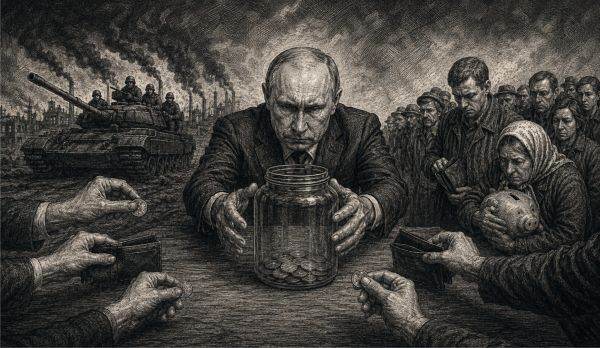
A state always pays for the war in the same order: from reserves, from loans, from taxes, from issuing currency.
Russia has exhausted its reserves, lost its loans, and has already used up its taxes.
The fourth remains.
For four years, the war has been paid for with oil money collected before 2022 - that is, from the past.
The past is over.
From now on, the war is paid for with what the country produces today and with what people have in the banks.
And these same people are also the only remaining creditor of the state, through their deposits.
But they are withdrawing their money.
The Russian state has come to compete with its own population for the same rubles.
• Order is not a choice
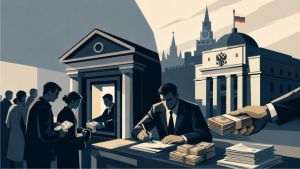
The four sources are used in this sequence because each one costs more than the one before it, and the cost is not measured only in money.
Reserve is the cheapest: the money already belongs to the state, no one needs to be convinced and no one notices.
Loan requires a creditor who accepts the conditions and leaves behind interest.
Tax requires the consent, even if silent, of those taxed.
The issuance of currency does not ask anything of anyone and that is precisely why the last one is used: its cost does not appear in a decision, but in prices, and the payment is taken from everyone at once, without anyone having been asked.
A state moves on to the next source when the previous one has ended or closed.
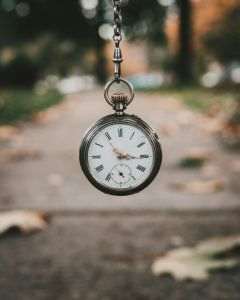
It does not return to it, because the reason for leaving it does not disappear. That is why this sequence reads like a clock: where a state is shows how much it has left.
• Reserves were the past
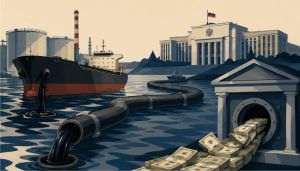
The money in the National Welfare Fund and the free balances of the Treasury were not savings of the current government. They were oil revenues collected before the war, in the years when the price exceeded the threshold at which Russian law obliged the state to set aside. The rule was designed precisely so that a drop in price would not hit the budget.
For four years, this reserve paid for the uncovered part of the war.
The significance of the fact goes beyond accounting: until now, Russia was a rich country fighting a war and covered what was not enough from its wealth.
The wealth was spent. The detailed calculation for 2026 is in the accompanying article (see The Bank of Russia lends to banks so that banks lend to the state); what is of interest here is the size of what is left.
Measured in terms of deficit, it amounts to just over twelve months.
Measured differently, in terms of order of magnitude, all the Russian state has left in liquid form is equivalent to about six months of military spending.
From now on, the war is paid for from current income. It is a completely different economic situation, and the difference is visible in everything that follows.
• Who pays for the war?
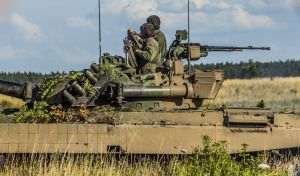
Russia's military spending for 2026 is 16,000 billion rubles, according to the Stockholm Institute for Peace Research, out of a total budget expenditure of 44,070 billion.
The war therefore means just over a third of everything the Russian state spends.
It is generally believed that this war is paid for by China and India, through oil purchases. This is half true, and not even half true. The federal budget's revenues from oil and gas in the first seven months were 4.595 trillion rubles, compared to 17.518 trillion from other taxes. Oil and gas bring in a fifth of the Russian state's revenues, and for the whole year they cover less than half of the cost of the war. The figures and their explanation are in the third article of this study (see Russia's Partners Buy Its Oil, But Don't Lend It Money).
Two conclusions emerge from this.
First: if all foreign buyers stopped buying tomorrow, that would cut less than half of the Russian military budget, which would be serious, but not decisive.
Second: the other half has always been taken from Russians, through taxes.
The proposition that the Russian state is fighting for money with its own population is not a figure of speech, but the result of a division.
• Why were the loans suspended?
Since July, the Russian Ministry of Finance has stopped selling bonds at regular auctions. The explanation given in the statement is that it aims to stabilize the market. The real explanation can be seen if we ask who should have bought them.
Russia has been cut off from Western financial markets since 2022.
The only remaining buyers of its public debt are Russian banks.
The money with which Russian banks buy public debt is the deposits of Russian citizens.
And, for seven months, Russian citizens have been withdrawing their deposits.
The result is a rare situation: the creditor of the Russian state and the depositor fleeing the Russian state are the same person.
This is not a hostile market, nor Western sanctions.
The Russian state is fighting for money with its own population. The war waged abroad has produced, internally, a competition between the budget and the household, and the budget is losing it.
This is also the explanation for the suspension of the problem cannot be fixed by higher interest rates. Higher interest rates attract money that exists. But in Russia, this money is no longer in the banks.
• Taxes are behind, not ahead
The third source has already been used.
From January 1, 2026, the general rate of value-added tax has increased from 20 to 22 percent, a measure taken precisely to reduce this year's deficit.
The deficit has already exceeded the target in the budget law by almost two times.
Which means that the third source was used up before the second one closed.
The usual order has been compressed: two stations were covered in the same year.
• What the depositor understood before the analyst
Cash withdrawals from Russian banks began in February.
Information about the Treasury's free balances was hidden in August.
Between the two moments are seven months, during which millions of people without access to Treasury data have reached, by their own account, the conclusion that analysts are only now reaching, with the data in front of them.
By withdrawing money from banks, depositors are taking away the very resource from which the state could have borrowed and thus hastening the outcome they fear.
This is not panic, in the ordinary sense of the word, but a correct judgment that, made by everyone at once, becomes the cause of its own object.
This also explains why high interest rates on deposits have not stopped the outflows.
Anyone who fears that their deposit will be taken away does not compare two interest rates, but compares one interest rate with the loss of the entire amount.
• Hiding the figure is itself a figure
A state publishes the size of its reserves as long as it is proof of its power and stops publishing it when it becomes an argument against it.
In August, the Russian Treasury removed information about its free balances from public access.
The date a number disappears says more than the number itself. It is the first public acknowledgement, made through silence, that the reserve is nearing its end.
Otherwise, the official communication has remained unchanged: the central bank declares that it does not see liquidity problems in the banking system, and the war continues to be called a special military operation. A state that calls its war something else can also call its deficit something else; therefore, the accompanying article shows, for each figure, in which direction it would have an interest in lying.
• The fourth source and its price
None of this means collapse, nor the end of the war.
Russia has three exits, and its leadership can pay the political price for each one.
It can cut spending, but the expense is either war, or social peace bought with salaries and subsidies. It can take citizens' money, and the preparations are already visible: the leader of the Communists, Gennady Zyuganov, has called in parliament for the mobilization of the 130,000 billion rubles in bank accounts, and the Ministry of Finance is working on a law on savings in privately managed pension funds.
Or it can create money.
The last path is the only one that does not close by itself and that is why it is the one that is reached.
It does not require public decisions and has no deadline. It is paid through prices and exchange rates, to a population that remembers the nineties, that is, exactly the public that is emptying its accounts today.
• What to watch for
Not the monthly deficit figure, which can be corrected with a good month of oil, but three signs of the transition to the fourth source.
1. If the state starts borrowing again, but not through open auctions, but through agreements made in advance with state banks.
2. If the Bank of Russia starts giving banks long-term money, instead of today's weekly refinancing.
3. And if a law appears that affects deposits, under whatever name it is written.
For four years, Russia's economic constraint has come from outside: sanctions, isolation, closed markets.
From 2026 it comes from within.
The Russian state is asking for money from the only party it has left, and that party started saying no a year before it.











 Euro
Euro Dolar SUA
 Franc elveţian
 Liră sterlină
 Gram de aur