 English

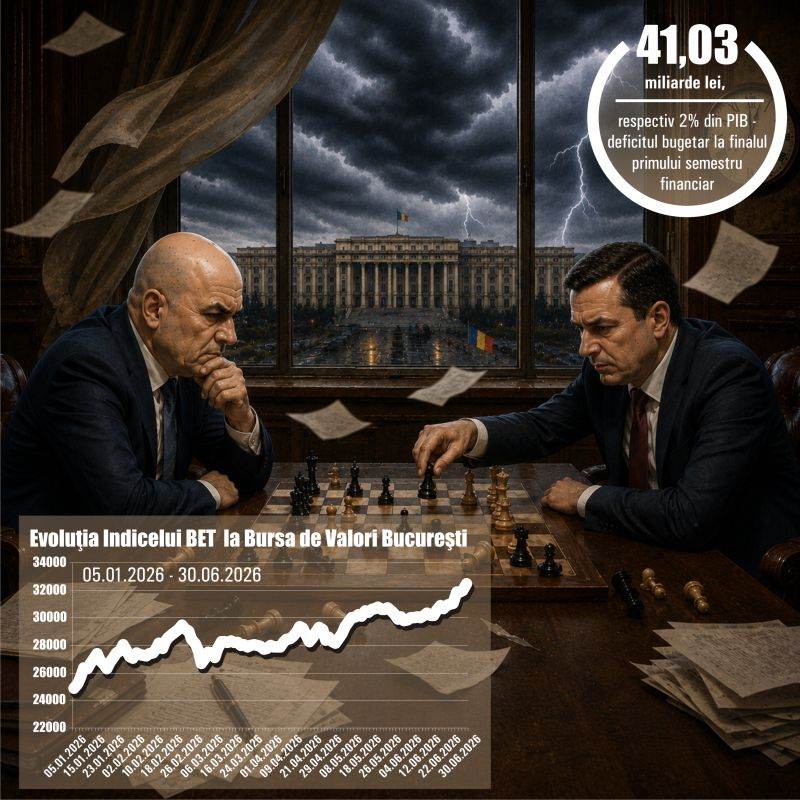
The first half of 2026 brought a spectacular budget correction, but achieved in an economy caught between double-digit inflation, recession, increasingly burdensome financing costs, the depreciation of the national currency and a political crisis that left our country without a government with full powers at the decisive moment of implementing the National Recovery and Resilience Plan. According to data from the Ministry of Finance, the execution of the general consolidated budget ended, after the first six months, with a deficit of 41.03 billion lei, respectively 2% of GDP, compared to 69.80 billion lei and 3.64% of GDP in the similar period in 2025. The decrease by almost 28.8 billion lei and 1.65 percentage points of GDP shows that the fiscal measures adopted in 2025, the freezing of some expenses and the acceleration of collection have begun to produce results. However, the correction did not mean the recovery of the economy, but rather a fiscal consolidation achieved while population consumption decreased, GDP contracted, consumer confidence dropped to the lowest level in the last 15 years, and unemployment rose to 6.4%.
Beyond budget execution, the first semester was dominated by shocks that drastically reduced the authorities' room for maneuver. Annual inflation started at 9.62% in January, fell to 9.31% in February, returned to 9.87% in March and exceeded 10% in the second quarter, reaching a peak of 10.85% in May, before falling to 10.4% at the end of the semester. The National Bank of Romania maintained the monetary policy interest rate at 6.50%, the lending facility at 7.50% and the deposit interest rate at 5.50%, while the conflict in the Middle East pushed Brent oil to $117 per barrel and forced the Government to intervene in the fuel, natural gas and food markets.
On the political front, the dispute over the listing of 22 state-owned companies broke the coalition, the censure motion of May 5 dismissed the Bologna Government, and two failed attempts to form a new Executive extended the interim period. Romania thus ended the semester with a much smaller deficit, higher investments and growing tax revenues, but also with a contracted economy, a weakened leu, high interest rates, expensive debt and political institutions incapable of providing stability.
• January: Local taxes increase, investments and military endowment are financed by debt
January began under the direct effect of the fiscal measures adopted in 2025 and applied from January 1, 2026, the most visible change being the increase in property and vehicle taxes by 70-80% in most localities. The government justified the reform by the fact that Romania collected only 0.55% of GDP from property taxes, compared to the European average of 1.85%, that over a third of the amounts due were not collected and that the tax bases no longer reflected either inflation or the real value of goods. The additional revenues were estimated at approximately 3.7 billion lei, with 1.42 billion lei more from buildings, 1.09 billion lei from land and 1.18 billion lei from cars, motorcycles and other vehicles, money that remains entirely in local budgets.
The 2026 stage was presented as preparation for the transition, from January 1, 2027, to property taxation based on market value. The reform came into force at a time when the population was already suffering from an annual inflation of 9.62%, increases in energy, services and food prices and the effects of austerity measures adopted the previous year.
Financing investments remained key to the start of the year. The Ministry of Finance published on January 9 the list of 195 significant public projects, valued at 457.7 billion lei, including the A7, A1 Sibiu-Piteşti and A8 motorways, the modernization of the Caransebeş-Timişoara-Arad and Braşov-Sighişoara railway lines, regional hospitals, the extension of Metro Line 6 to Henri Coandă International Airport and coastal protection works. On January 15, Finance Minister Alexandru Nazare signed with the European Investment Bank the second financing contract, worth 500 million euros, for the A1 Sibiu-Piteşti motorway, as part of a total package of 1 billion euros. The project, estimated at around 5.5 billion euros, is expected to be completed in the fourth quarter of 2028. The government also increased the ceiling of the Medium Term Notes Program from 90 to 99 billion euros, confirming that financing the deficit and investments continues to depend on constant access to external markets.
The main strategic decision of the month was the approval by the European Commission of Romania's projects under the SAFE mechanism, worth 16.68 billion euros. The amounts are not grants, but loans guaranteed by the European Commission, with a maturity up to 45 years and a grace period of ten years, which must be used by the end of 2030. Of the total allocation, 9.53 billion euros are intended for the Army and associated infrastructure, 4.2 billion euros for dual infrastructure, including the Paşcani-Ungheni and Paşcani-Siret sections of the Moldovan Highway, and approximately 2.8 billion euros for the Ministry of Internal Affairs and other structures in the national defense system. The 21 projects of the Ministry of Defense include armored personnel carriers, logistics platforms, helicopters, radars, anti-aircraft systems, patrol ships, ammunition, drones and command-control capabilities. Romania thus entered 2026 with higher local taxes and a vast investment program, but financed to a considerable extent by loans, including for defense.
• February: CCR - agrees to reduce magistrates' pensions, Government adopts legislation for economic recovery
February shifted the focus from austerity and tax increases to stimulating the business environment, without the pressure on budget collection disappearing. The Government finalized fiscal package number 3 and the economic recovery package, trying to combine rewarding disciplined taxpayers with stimulating investments and reducing liquidity bottlenecks.
The package introduced a 10% tax credit for research and development, deductible from tax, and accelerated depreciation of up to 65% of the value of assets in the first year for equipment purchased in 2026. To stimulate the capital market, companies received an additional deduction of 50% for the costs of listing on the stock exchange, and individuals, deductions of up to 400 euros per year for investments in stocks, bonds or exchange-traded funds. The budgetary impact of the measures was estimated at 2.1 billion lei in 2026, with the Executive counting on the subsequent recovery of the money through investments, economic activity and additional taxes.
The political space for continuing the reforms widened after the Constitutional Court rejected, on February 18, the objections of the High Court of Cassation and Justice regarding the law on special pensions for magistrates. The decision removed an important institutional obstacle for the Government, but did not resolve the biggest administrative anomaly of the beginning of the year: Romania was still operating without a state budget for 2026.
Fitch Ratings reconfirmed Romania's sovereign rating at BBB-, with a negative outlook. The agency found that the VAT increase, the spending freeze and the other measures adopted in 2025 had started to reduce the deficit, and financing costs had fallen from over 7.4% to around 6.5%. The vote of confidence, however, remained conditional on continued consolidation, as public debt, which stood at nearly 59% of GDP at the end of 2025, could rise to 63%.
• March: Delayed budget, expensive oil and emergency interventions in the economy
The end of the first quarter of this year concentrated the first tensions of 2026: the state budget was adopted almost three months late, and the conflict in the Middle East generated an energy shock that hit transport, agriculture, industry and consumer prices. Parliament voted on the budget law on March 20, with 319 votes in favor, 104 against and one abstention, after five days of debate and a deadlock in the coalition caused by the dispute between the PSD and the PNL regarding support for vulnerable people. The compromise consisted of transferring one billion lei from the Ministry of Justice to the Ministry of Labor and postponing the payment of salary rights obtained in court by magistrates. AUR challenged the budget laws, but the Constitutional Court rejected the objections on March 26, and the state budget entered into force on March 27.
The 2026 budget was built on an economic growth of 1%, a nominal GDP of 2,045.2 billion lei and an average annual inflation of 6.5%. Revenues were estimated at 736.5 billion lei, and expenditures at 864.3 billion lei, resulting in a projected deficit of 127.7 billion lei, equivalent to 6.2% of GDP. Investments, estimated at approximately 164 billion lei, 25.8 billion lei above the 2025 level, became the center of economic policy. The budget construction tried to maintain investments above 8% of GDP, but linked the success of this objective to the absorption of European funds and the administration's ability to complete projects on time.
The escalation of the Middle East conflict, which began in late February, has pushed Brent crude oil to $117 per barrel and WTI crude oil above $100, amid the effective blockade of the Strait of Hormuz and the disruption of a fifth of the world's oil and liquefied natural gas supplies. The government has declared a state of crisis on the crude oil, gasoline and diesel markets for the period April 1-June 30, with the possibility of extension. For home consumers, the price of natural gas remained capped until March 31, 2027, and domestic producers were obliged to sell gas intended for the population and thermal energy producers at 110 lei/MWh. The executive extended until the end of the year the partial compensation scheme for excise duty on diesel for transporters, with a budget of over 650 million lei and over 6,200 eligible operators. The compensation was set at 65 bani per liter for purchases in the first quarter and at 85 bani per liter for the April-December period. Farmers received a budget of 620 million lei for the reduction of excise duty on diesel used in agriculture, the difference reimbursed for 2026 being 2,697 lei per liter. The capping of the commercial surcharge on basic foodstuffs was extended until June 30.
The energy shock was reflected in the annual inflation rate, which rose from 9.31% in February to 9.87% in March. Moody's maintained the negative outlook associated with Romania's credit profile, assessing that fiscal measures can reduce the deficit by almost two percentage points in 2026, but warning that the outcome depends on the continued adjustment.
• April: State intervention and list of public companies break the coalition
The beginning of the second quarter of 2026 marked the transition from prudent fiscal consolidation to direct state intervention in the economy. High oil prices were transmitted to fuel prices, transport, agriculture and food, and the Government tried to share the cost of the crisis between the budget, oil companies and consumers. The excise duty on standard diesel was temporarily reduced by 30 bani per liter, with an estimated budgetary impact of approximately 610 million lei. To recover part of the loss, the Executive introduced a solidarity contribution for operators who extract and market crude oil or energy products obtained from oil extracted in Romania. The contribution, applicable when the Brent quotation exceeds 70 dollars per barrel, varies between 1.5% and 9.9%, and the estimated revenues are between 70 and 650 million lei, depending on the market evolution. Fuel traders were given the right to a maximum of one price increase per day, until 12:00, a limitation justified by the need to temper volatility at the pump.
The government also intervened in the electricity grid connection market, where approvals had been issued for approximately 80,000 MW, almost nine times the daily consumption of the economy, of approximately 9,000 MW, although less than 10% of the approved projects had reached implementation. To discourage speculative capacity bookings, the authorities proposed guarantees of 30 euros for each installed kW or a mixed formula consisting of 50% of the connection tariff and 20 euros/kW, with the entire guarantee lost for abandoned projects.
S&P Global Ratings reconfirmed, on April 3, the BBB-/A-3 ratings, maintaining Romania in the investment-grade category, but with a negative outlook. The agency estimated a deficit of 6.5% of GDP in 2026 and economic growth of only 0.25%.
The political balance was destroyed by the dispute over state-owned companies. On April 16, the Government approved the report of the inter-ministerial committee led by Deputy Prime Minister Oana Gheorghiu, through which 22 public companies were to be analyzed for listing, restructuring, merger or exit from the state portfolio. The list included ELCEN, Oil Terminal, CFR SA, MINVEST, REMIN, Avioane Craiova, ROMAERO, CNCIR, CFR Călători, Metrorex, TAROM, CFR Marfă and other railway companies. The executive argued that listing on the Bucharest Stock Exchange would bring capital, investment and corporate governance, while the PSD, the opposition and the unions accused the preparation of accelerated privatization of strategic assets. The PSD ministers withdrew from the Government on 23 April, and on 28 April the PSD and the opposition parties submitted the motion of censure that would end the mandate of the Bolojan Cabinet.
• May: Bolojan Government is dismissed, inflation rises, the deficit continues to fall
May began with the adoption, on 5 May, of the motion of censure against the Bolojan Government. The motion met with 281 votes in favor and four against, with three votes being annulled. The executive remained interim, with limited powers, precisely at a time when Romania needed to accelerate the reforms in the PNRR, implement the late-adopted budget, and convince rating agencies that deficit reduction can continue in the absence of a functional majority.
The foreign exchange market reacted immediately. The euro approached 5.3 lei in the first days after the government was dismissed, then the interbank rate stabilized around 5.2 lei. The depreciation turned the political crisis into an additional financial cost for the state, companies, and the population, especially since more than half of the public debt is denominated in foreign currency.
In the meantime, S&P conducted an unscheduled review on May 16 and reaffirmed the BBB-/A-3 rating, with a negative outlook. The agency estimated a deficit of 6.25% of GDP for 2026, economic stagnation this year and a possible return to 2.5% growth in 2027. Fitch Ratings warned two days later that the interim administration could continue budget execution, but political uncertainty reduces the visibility of fiscal policy for 2027 and 2028 and jeopardizes the absorption of European funds. At the same time, annual inflation reached 10.85%, and the NBR maintained the key interest rate at 6.50%.
In parallel, the PNRR entered a critical stage. Over 11,000 projects financed through the PNRR and other European programs were in various stages of execution, and some of the 45 milestones and targets analyzed were not met. The interim government could manage ongoing investments, but it did not have the political strength necessary for the outstanding reforms, so that every day of government crisis turned into a direct risk of losing European money.
At the end of May, the interim government signed all financing contracts for projects carried out through the SAFE mechanism, the value of which amounts to 16.68 billion euros, the second largest allocation in the European Union, after Poland. The Ministry of Defense estimated at that time that almost 60% of the value of the program could be run through the national industry.
• June: Budgetary consolidation, overshadowed by recession and institutional deadlock
The end of the first semester of 2026 transformed the political crisis into a prolonged institutional deadlock. On June 4, President Nicuşor Dan appointed MEP Eugen Tomac as prime minister, but he resigned after ten days, unable to obtain the necessary support. On the same day, the head of state nominated the liberal Adrian Veştea, a proposal that caused tensions in the PNL and was rejected by the USR. The Veştea cabinet received, on June 22, only 189 of the 233 votes needed for inauguration, after the AUR parliamentarians left the room. Parliament went on vacation without having installed a new Executive, and the Bolojan interim Government was left to manage current affairs.
The final execution of the first semester confirmed the fiscal correction. The deficit of the general consolidated budget was 41.03 billion lei, or 2% of GDP, almost 28.8 billion lei below the level of the first six months of 2025. Revenues reached 342.52 billion lei, and expenditures reached 383.55 billion lei. Net VAT receipts increased by 25.1%, to 74.14 billion lei, insurance contributions amounted to 110.86 billion lei, and the amounts reimbursed by the European Union rose by 20.8%, to 30.29 billion lei. On the expenditure side, the interest bill reached 29.37 billion lei, 4.14 billion lei more than in the first half of 2025, while personnel expenses decreased to 82.11 billion lei. Public investments increased by 9.52 billion lei, to 59.96 billion lei, and payments for projects financed from the funds related to the 2021-2027 financial framework, from the PNRR and from the loan component of the PNRR were 15.32 billion lei, respectively 56.32%, above the level of the same period of the previous year. The deficit correction was not achieved by stopping investments, but by limiting current expenses, increasing tax revenues and using European funds more intensively.
This budgetary performance was, however, overshadowed by the deterioration of the real economy. The European Commission's economic confidence indicator for our country fell in June to 83.5 points, from 90.8 points in May, the most severe monthly deterioration since the outbreak of the pandemic. Compared to June 2025, a decrease of 14.3 points was recorded, the largest in the European Union. Consumer confidence reached minus 34.6 points, the lowest in the last 15 years, and the services indicator fell to minus 23.8 points. The unemployment rate rose to 6.4% in May, the equivalent of approximately 522,100 unemployed people, and Erste Group Research found that our economy was in technical recession territory for the fourteenth consecutive month. Moody's warned on June 26 that the lack of a parliamentary majority and the prolongation of the government crisis threaten fiscal consolidation and reforms. The agency estimated that interest could consume 9.2% of budget revenues in 2026 and 9.6% in 2027. The warning came when the euro had exceeded 5.24 lei on the interbank market, and the official BNR exchange rate had set a new record, of 5.2180 lei. The leu had become the weakest currency in the region, and Romanian government bond yields remained the highest in the European Union.
The banking system also received a shock. On June 7, the Competition Council announced fines totaling 3.73 billion lei, approximately 710 million euros, imposed on ten banks participating in the ROBOR setting mechanism, for alleged exchanges of confidential and strategic information that would have affected the independence of quotations. The banks rejected the allegations and announced they would contest the sanctions, and the NBR warned that the decision should not be interpreted as invalidating the ROBOR index or evidence that interest rates for the period 2021-2023 were artificially set.
In the same month, the European Commission approved Romania's fourth payment request from the PNRR, worth 2.62 billion euros, and the program's implementation rate reached approximately 70%. The state attracted 21.7 billion lei from the population through the Tezaur and Fidelis programs in the first semester and continued the preparation of projects worth 16.68 billion euros financed through SAFE.
Our country thus ended the first half of 2026 with a deficit almost halved compared to the same period last year, with higher investments and accelerated tax collection, but also with an economy in recession, double-digit inflation, a weakened currency, oppressive interest rates and an interim Government. Fiscal consolidation was real, but the first semester of 2026 demonstrated that budgetary balance cannot become economic stability as long as the political crisis blocks the decision, and the population and companies simultaneously pay the cost of taxes, inflation and expensive financing.














 Euro
Euro Dolar SUA
 Franc elveţian
 Liră sterlină
 Gram de aur





























