English
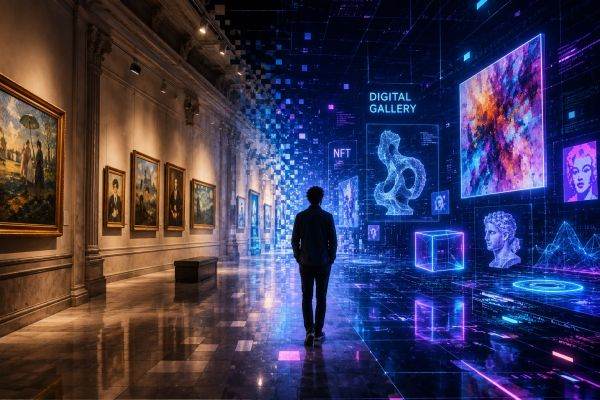
Immersive museums and projects that combine art with technology are increasingly making their way into the cultural landscape in Romania, transforming visiting an exhibition into an experience based on image, sound and interaction. The expansion of MINA-type projects (Museum of Immersive New Art, project) shows how multimedia technologies can become a tool for bringing the public closer to art, but also for diversifying the cultural offer.
• Art enters a digital space
One of the most visible examples is MINA, which introduced in Romania an art presentation model based on large-scale projections, sound and digital technology. The museum opened in Bucharest in August 2023, and the concept was later expanded through new locations and the itinerant MINA Pop-Up project. According to the official presentation, the network currently has spaces in Bucharest, Cluj-Napoca, Iaşi and Timişoara. The model changes the traditional relationship between the visitor and the work. Instead of an exhibition in which the public looks at the works displayed in a conventional space, the image is projected onto large surfaces, and the visitor is placed inside the visual spectacle. The concept has been used to present various artists and themes, from painting and heritage to nature, history and the cosmic universe.
• MINA Pop-Up experience also reached Galaţi
An example of the expansion of this model outside of major cultural centers is MINA Pop-Up Galaţi. The project brought three immersive exhibitions to the city, in a temporary space equipped with 360-degree projections. According to local media, the space was arranged in a tent of approximately 450 square meters, installed in the parking lot of Shopping City Galaţi. The project was co-financed by the Galaţi City Hall and hosted by the shopping center. The experience in Galaţi is relevant in that such a project does not require the existence of a permanent museum infrastructure. The Pop-Up format allows the concept to be moved to other cities and to expand access to digital art beyond Bucharest. In the case of Galaţi, the program included "Van Gogh: The Immersive Show”, followed by other productions presented to the local public.
• The audience becomes part of the experience
Digitization does not just mean replacing the painting with a screen. In the case of immersive exhibitions, technology also changes the way the audience goes through the exhibition. Large-scale projections, music and sound effects build a multisensory experience, and the visitor is no longer just an observer. The exhibition space practically becomes the environment in which the work is presented and reinterpreted. This approach can play an important role in attracting the public that does not usually frequent traditional museums and galleries. MINA also presented productions dedicated to Romanian art, in which the works of classical painters were reinterpreted through animation and digital technologies.
The thematic expansion shows that the model is not limited to the digital reproduction of famous paintings. In 2026, MINA launched, in Bucharest, Cluj-Napoca and Iaşi, two new experiences: "The Gods of Olympus” and "In the Heart of the Ocean”. The first proposes an incursion into Greek mythology, while the second explores the underwater world. In this way, technology becomes a presentation tool for different fields, and the immersive museum begins to function as an intersection between art, education, entertainment and technology.
• A changing cultural market
The development of these projects also indicates a change in public behavior. Cultural consumers are accustomed to digital content, high-resolution images and interactive experiences. Museums and cultural institutions are thus put in the position of finding ways to integrate technology without losing the educational and artistic component. This development shows that digital art is no longer just an experimental niche. It is beginning to be integrated into a cultural model with permanent spaces, its own productions and itinerant projects. The transformation does not imply the disappearance of the traditional museum. Painting, sculpture and heritage continue to be presented in classic spaces, and the direct experience in front of an original work cannot be completely equated with a digital projection. Immersive museums, however, offer another possibility: that of reinterpreting and contextualizing the work through technology, making it accessible in a different form. For Romania, the phenomenon is relevant not only from the perspective of culture, but also of the development of creative industries and new media technologies. Productions of this type involve collaboration between artists, programmers, designers, specialists in image, sound and digital production.




















 Euro
Euro Dolar SUA
 Franc elveţian
 Liră sterlină
 Gram de aur