 English

Wars, revolutions, embargoes and disruptions at crossing points have repeatedly removed millions of barrels of oil per day from global markets, putting pressure on prices and energy security.
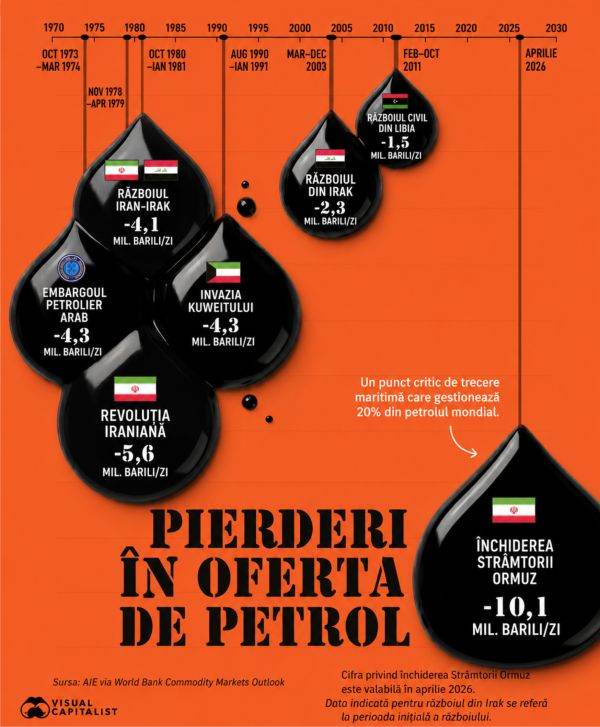
Visualcapitalist.com presents seven major oil supply disruptions (millions of barrels per day), according to IEA data from a World Bank report. The figure for the Strait of Hormuz closure specifically refers to March 2026, the latest available date (April).
• The largest oil supply disruption in history occurred in 2026
The magnitude of the disruption reflects the importance of the Strait of Hormuz to global energy markets. Located in the Persian Gulf, the world's main oil trading region, the strait is a critical shipping lane that typically handles about 20% of all shipping traffic.
Iran largely blocked shipping through the Strait of Hormuz on February 28, 2026, when the United States and Israel launched an air war against it.
The near-total shutdown of tanker traffic through the strait has prompted Gulf countries to cut crude production, with supply losses increasing as shipping flows remain disrupted.
Before the closure of the Strait of Hormuz, the Iranian Revolution was the largest oil supply disruption of the events presented. From November 1978 to April 1979, the decline in oil production resulted in a loss of supply of 5.6 million barrels per day.
The March 2026 disruption at Hormuz exceeded this by 4.5 million barrels per day, or about 80%.
• Revolutions, embargoes, and wars that caused disruptions
Two other major disruptions each caused losses of 4.3 million barrels per day: the Arab oil embargo and the invasion of Kuwait. The Arab embargo, which lasted from October 1973 to March 1974, caused oil prices to nearly quadruple and forced some countries to rationate fuel due to shortages. It is considered the first major global oil crisis and led to the creation of the International Energy Agency (IEA).
The invasion of Kuwait disrupted supplies from August 1990 to January 1991 and caused global oil prices to double in a matter of days.
The Iran-Iraq War, in turn, caused a loss of supply of 4.1 million barrels per day between October 1980 and January 1981.
• Smaller but significant supply losses in the 2000s
The early Iraq War (March-December 2003) and the Libyan Civil War (February-October 2011) caused smaller losses than the major shocks of the 1970s, 1980s, and early 1990s. However, their impact was significant in absolute terms: the Iraq War caused a loss of supply of 2.3 million barrels per day, while the Libyan Civil War resulted in a loss of 1.5 million barrels per day.
Five of the seven disruptions presented are related to the Middle East, highlighting the importance of the region for global oil supplies. The closure of the Strait of Hormuz in 2026 stands out as the first event to generate a loss of supply of over 10 million barrels per day.
• IEA warns that prolonged Strait of Hormuz crisis threatens global economy
The global economy will face a new challenge if the conflict that has blocked the Strait of Hormuz is not resolved within weeks, the head of the International Energy Agency, Fatih Birol, said in July, as quoted by Bloomberg.
"The markets are nervous” and face "great uncertainty” due to the escalation of attacks on both sides, which threaten to disrupt shipments of oil, fertilizer, natural gas and other goods through the key waterway, Birol said.
Traffic through the Strait of Hormuz fell sharply in July as ships were attacked and the US reimposed a blockade on Iranian shipping. Saudi Arabia's oil shipments from the Persian Gulf have dropped following attacks on oil tankers, while the International Maritime Organization said the Strait of Hormuz remains too dangerous for commercial ships to pass through, Agerpres notes.
"If the Strait of Hormuz remains closed, we may once again face some difficulties for economies around the world, including those in the region, developing nations and Asia," Birol said, noting: "We are not talking about months, but weeks, after which the strait must be completely open, unconditionally open."
While the disruption of energy and raw material supplies from the Persian Gulf has affected economies such as South Korea and Japan, countries such as Bangladesh, Pakistan and India are much more vulnerable to such disruptions, Birol stressed.
• OPEC cuts global oil demand forecast
The Organization of the Petroleum Exporting Countries (OPEC) recently cut its forecast for global oil demand growth in 2026, its fourth consecutive downgrade, due to the economic impact of the Middle East war, according to Engine. OPEC now expects demand to be about 105.74 million barrels per day, about 200,000 barrels less than it had previously estimated.
OPEC revised its forecast for 2027 up, showing that global oil demand is expected to grow by about 2.2 million barrels per day, compared to a previous forecast of 1.9 million barrels per day.

























 Euro
Euro Dolar SUA
 Franc elveţian
 Liră sterlină
 Gram de aur





























