English

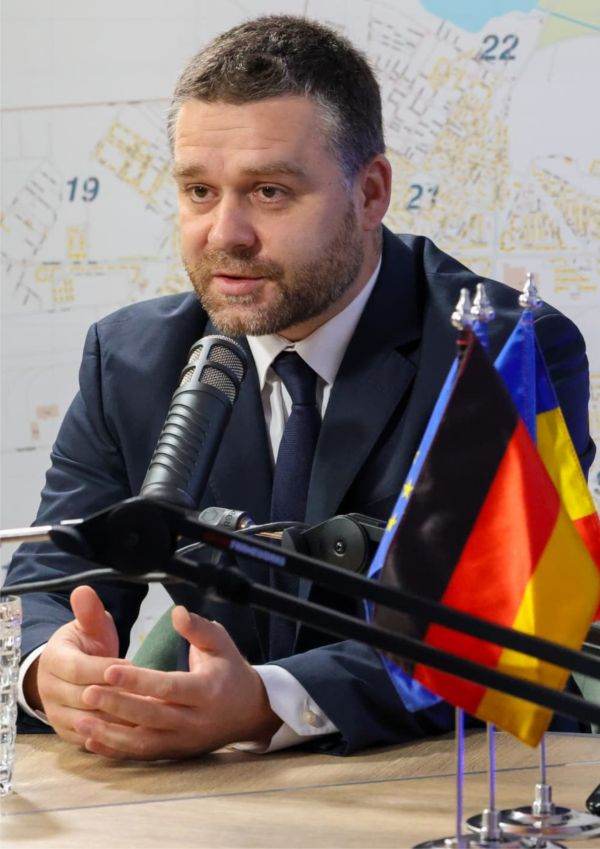
Ciprian Ciucu won the by-elections for the position of mayor general of the Capital, with 36.16% (211,562 votes) of the total votes cast - 585,133. The new mayor general of the Capital is a graduate of the National School of Political and Administrative Studies (SNSPA), where he attended the Faculty of Political Sciences, obtaining a degree in Political Sciences between 1996 and 2000. Later, he continued his academic training also at SNSPA, where he completed the Diploma of Advanced Studies/Master in Public Policies and European Integration between 2000-2001.
Before holding the position of mayor of Sector 6, between 2019 and 2020 Ciucu was president of the National Agency of Civil Servants and general advisor of the PNL. His administrative experience also includes roles in central institutions. He was an expert in communication on European funds at the Ministry of European Affairs and an expert in European integration at the Economic and Social Council.
Ciprian Ciucu also has a strong professional background in civil society, working in at least four major NGOs. According to his CV, for seven years (2009-2016) he worked at the Romanian Center for European Policies (CRPE), alongside Cristian Ghinea who is the co-founder of CRPE and director of the organization during the same period. Ciprian Ciucu has also worked in other non-governmental organizations such as the Foundation for Civil Society Development, the Education 2000+ Center, the Romanian Association for Freedom and Development, and the Center for Urban and Territorial Development.
In his campaign for the position of general mayor of the Capital, Ciprian Ciucu benefited from the support of the PNL, Prime Minister Ilie Bolojan, but also from some political leaders from the center-right area, including Vlad Gheorghe (who withdrew his candidacy in favor of Ciucu), Ludovic Orban, recently dismissed by Nicuşor Dan from the position of presidential advisor, and Dragoş Pîslaru, Minister of Investments and European Projects, a prominent member of REPER, a political party founded by Dacian Cioloş that supported the former mayor of Sector 6 in last Sunday's elections.
Moreover, Ciprian Ciucu is considered one of the few liberals loyal to Ilie Bolojan, who also promoted him to the political position of first vice-president of the party. Regarding his relationship with the president of the country, Nicuşor Dan, as long as he was the general mayor of the Capital - October 2020-May 2025, although administrative and political relations were tense, Ciprian Ciucu did not break the institutional collaboration with him, and PNL advisors continued to vote for Dan's administration projects.
In this context above, if we analyze the composition of the General Council of the Municipality of Bucharest, we could say that Ciprian Ciucu will have to prove his skills as a skilled negotiator. In the current CGMB, the United Right Alliance (USR-FD) holds 17 mandates, PSD - 16 mandates, PNL - 7 mandates, PUSL - 6 mandates, AUR - 5 mandates, REPER - 4 mandates. Basically, the political right has 28 mandates - a simple majority, while the political left plus AUR holds 27 mandates, which shows a very fragile balance at the level of the Capital. Therefore, in order to pass the important projects and the annual budget of the Capital through the General Council, Ciprian Ciucu will have to negotiate and reach an agreement with the general advisors of the PSD, without making too many concessions in order not to upset the other right-wing partners, that is, the advisors of the USR, those from the Democratic Force and those from REPER. Therefore, Ciprian Ciucu's mandate is expected to be difficult, but not impossible for the implementation of some projects provided for in his electoral program.
• Urban regeneration and maintenance - the constants of Ciprian Ciucu's program
Ciprian Ciucu's electoral program for the position of general mayor of the Capital, summarized under the slogan "Bucharest put in order", starts from the idea of a short mandate, of almost three years, in which he does not promise gigantic projects, but a "culture of maintenance" and an administration that repairs, maintains and brings order to the city. He explicitly says that he does not have the honesty to promise large infrastructure projects in the remainder of his mandate, but that he can ensure a Bucharest in which things are well maintained, public spaces are cared for, and investments are visible in the neighborhoods and in the quality of daily life, an idea emphasized at the launch of the program.
Regarding traffic, Ciucu starts from the promise to decongest road traffic, with infrastructure projects where time and procedures still allow, but especially by changing mobility behavior: personal cars should be used less inside the city, drivers should be encouraged to use the Capital Ring Road, to leave their cars at the entrance to the city and switch to public transport. In the center of Bucharest, he declares that he no longer wants car traffic, but an urban space free from cars. The program relies on small, proximity parking lots, located in a network, with very low rates, including parking at 1 leu per hour, and rejects the model of large, little-used underground parking lots, such as the one at the University. In addition, Ciucu also proposes a unified parking system at the city level, the elimination of free curbside parking in the center and on major boulevards, and the reorganization of parking spaces in such a way as to discourage the use of personal cars in favor of public transport.
Public transport and alternative mobility occupy a central place in the program. Ciucu talks about predictable public transport, with buses, trolleybuses and trams that arrive on time, supported by large-scale dedicated lanes and a tram network separated from car traffic, to ensure frequency and speed. The campaign program also mentions the reorganization of public transport, the modernization of the fleet through the purchase of electric buses and the increase in the frequency of trips, so that Bucharest residents have a real alternative to personal cars. In addition, Ciucu assumes the implementation of the Velo Masterplan approved by the General Council, with bicycle paths that allow commuting to work by bicycle, thus integrating the bicycle into the city's mobility scheme and connecting neighborhoods to central areas.
• Rehabilitation of another 100 kilometers of primary network, Ciprian Ciucu's priority in the field of district heating
Another pillar of the program is district heating, i.e. the sensitive issue of hot water and heat. Starting from the fact that the district heating network in the Capital is already under rehabilitation, and hundreds of thousands of Bucharest residents have been left without hot water and heat in recent years, Ciprian Ciucu promises long-term investments in infrastructure, with the objective of reducing damage and losses. According to his program, Ciucu proposes the rehabilitation of another 100 kilometers of primary network, the replacement of pipes older than 30 years with pre-insulated pipes, equipped with automatic damage detection systems and the continuation of the modernization of district heating plants, so that district heating becomes "safe, efficient and cheaper".
At the urban level, Ciucu's program focuses on the regeneration of the Unirii Square-Victoria Square axis, extended, in some documents, to Magheru, seen as the "backbone" of the city. Therefore, the new general mayor of the Capital will propose a Zonal Urban Plan dedicated to this axis, which will coherently and "harmoniously" connect the urban areas in the north - Lahovari Square, Grădina Icoanei, Rosetti Square, Sfântul Gheorghe Square - with those in the south - the Old Center, University Square, Calea Victoriei up to Victoriei Square - and link them to a rehabilitated, clean and attractive historical center. This project also includes the rehabilitation of Iosif Sava, Valter Mărăcineanu squares and the Palace Hall area.
Regarding this topic, in a campaign clip, Ciprian Ciucu states that he wants to start "from Magheru", which he now sees as a "tunnel with many meanings", and to transform Calea Victoriei from a parking lot into a pedestrian promenade where people want to spend time. Also in the area of urban planning, the program of the new mayor of the capital provides for the completion of the new General Urban Plan of Bucharest and the protection of the historic center, old neighborhoods and parks.
The green and environmental dimension is structured around two concepts from Ciucu's program - the "Green Belt" and the "park city". The Green Belt will be a continuous network of parks, urban forests, ecological corridors and protected green spaces, designed to surround Bucharest and create connections between sectors, in order to reduce pollution and provide a "barrier" of vegetation against noxious substances. The concept of a "city-park", explained in the program, involves collaborating with district mayors to create "small oases of greenery" in dense neighborhoods: spaces with perennial flowers, recently planted trees, simple and modern benches, designed to be environmentally friendly and easy to maintain. In the same vein, Ciucu promises the rehabilitation of existing parks and an explicit effort to save the IOR Park, which has been affected by arson and land disputes in recent years.
In terms of public services and safety, the program of the new mayor general of the Capital includes references to the reinforcement of buildings with seismic risk, in order to limit the vulnerability of a city exposed to earthquakes, as well as to the construction of new hospitals and the modernization of existing ones, so that the medical system in the Capital can keep up with the real needs of the population. Ciprian Ciucu also talks in his program about order, cleanliness, road safety and a reformed local police, intended rather to ensure compliance with the rules than to be perceived as an abusive factor, all in the logic of a "fixed" city, where public space is cared for, and the administration works according to clear rules and procedures, not improvisations.
Taken as a whole, the "Fixed" Bucharest program combines promises of specific investments - in district heating, mobility, green spaces, urban regeneration and health -, where the basic things work, are well maintained and where the existing infrastructure is brought "up to date".
But the support of the CGMB is needed to implement this program. Depending on how Ciprian Ciucu manages to obtain the agreement of the majority in the General Council and to achieve specific alliances with PSD councilors, we will see the degree of implementation of the projects described above.












 Euro
Euro Dolar SUA
 Franc elveţian
 Liră sterlină
 Gram de aur