English


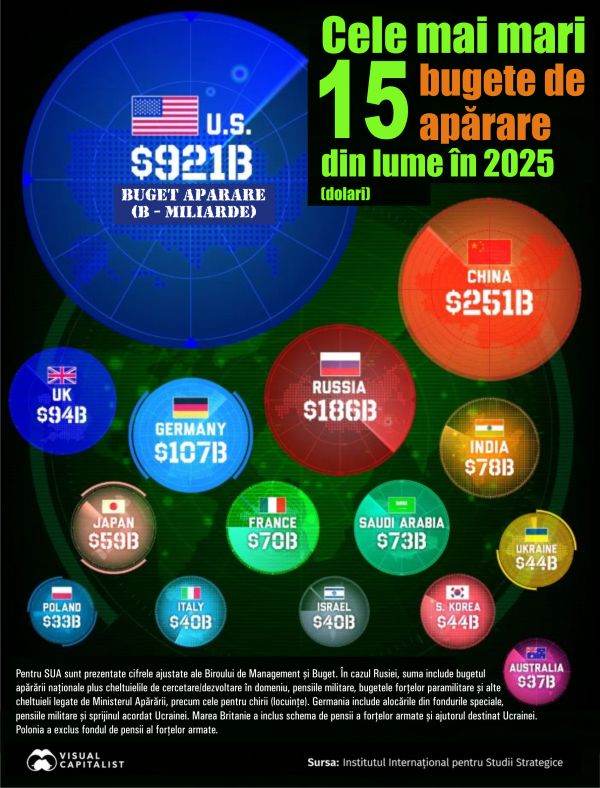
The top 15 countries with the largest military spending budgets have collectively allocated more than $2 trillion to defense in 2025, an amount that has never been reached in history. Total global defense spending has also reached a record $2.6 trillion, signaling a major shift in geopolitical priorities, according to an analysis by visualcapitalist.com.
The cited source presents, using data from the International Institute for Strategic Studies, the ranking of the 15 countries that have determined this major increase in military spending.
While the US still operates on a completely different scale than the rest of the world, the biggest change is taking place in Europe, where countries are not only maintaining their military capabilities, but also significantly expanding them.
• Arms Race - Spending by Country
The US defense budget reached $921 billion in 2025, which is higher than the combined military spending of China ($251.3 billion), Russia ($186.2 billion), Germany ($107.3 billion), the United Kingdom ($94.3 billion), India ($78.3 billion), Saudi Arabia ($72.5 billion), France ($70 billion), and Japan ($58.9 billion).
Looking ahead, Donald Trump has proposed increasing defense spending to $1.5 trillion by 2027, although this plan has not yet been implemented. If achieved, this would represent spending about 90% higher than at the height of the Cold War (in real terms).
China, the world's second-largest military spender with a defense budget of $251.3 billion in 2025, has increased its share of Asia's military spending to 44% from 39% in 2017, underscoring its growing regional influence, the source said.
Russia's defense budget, which reached $186.2 billion in 2025, has increased by more than $40 billion in a single year, or 7.3% of GDP. However, its defense spending is expected to fall in 2026, the first decline since the invasion of Ukraine. With a growing deficit, the country is facing increasing economic pressure, although higher oil prices have recently provided some support.
• Europe's expanding war budget
Given Russia's ongoing war in Ukraine and pressure from the US, European NATO members have pledged to spend 3.5% of GDP on defence by 2035. That would translate to about $1.2 trillion by 2035, the largest increase in defence budgets in these countries since the Cold War, according to the source cited.
Outside of Russia, Europe has six of the world's 15 largest defence budgets, led by Germany ($107.3 billion) and the UK ($94.3 billion). Both countries increased their spending by tens of billions of dollars between 2024 and 2025. Ukraine, ranked 10th, spent $44.4 billion on defense last year.
What was once a gradual advance has turned into a sudden acceleration, with defense being one of the fastest-growing spending categories in advanced economies.
• Global arms trade - concentrated in a few countries
The global arms trade is highly concentrated in a few countries, with the United States far ahead of any other supplier, according to visualcapitalist.com, which notes that between 2021 and 2025, the US generated 42% of global arms exports, more than four times more than the second largest exporter.
The world's largest arms exporters are, according to SIPRI: USA (42% of global arms exports); France (10%); Russia (7%); Germany (6%); China (6%); Italy (5%); Israel (4%); Great Britain (3%); South Korea (3%); Spain (2%).
The United States has long been the world's largest arms exporter, but its dominance has expanded in recent years, the cited source notes. Several factors contribute to this development, including: technological superiority in advanced systems such as fighter jets, missile defense, and surveillance technologies; large-scale defense production capacity, supported by massive domestic military spending; and extensive alliance networks, including NATO partners and security arrangements in Asia and the Middle East. As geopolitical tensions rise, many countries are turning to the United States for advanced weapons systems. European demand, in particular, has surged following Russia's invasion of Ukraine, contributing to a nearly 10% increase in global arms transfers. These exports are also closely linked to broader geopolitical influence, consolidating the United States' position as a key supplier to allied nations.

























 Euro
Euro Dolar SUA
 Franc elveţian
 Liră sterlină
 Gram de aur